
How do AI interviews impact candidate quality? Explore research-backed strategies, interview structures, and practical workflows for hiring teams.

AI interviews do not automatically improve or distort hiring quality. Their effectiveness depends on how they collect evidence, how candidates understand the evaluation, and how human hiring teams review the outputs.
When implemented poorly, such as relying on black-box scoring or analyzing non-verbal cues, AI interviewing technologies can introduce bias and score anchoring. When designed around structured job criteria, explicit follow-up questioning, and human-in-the-loop validation, AI interviews expand evidence, reduce recruiter friction, and yield more consistent hiring signals.
What Are AI Interviews?
AI interviews are automated or software-assisted candidate evaluations that use artificial intelligence to conduct interactions, analyze responses, or guide human interviewers.
It is critical to distinguish employer-led evaluation technologies from candidate-facing generative tools:
Employer-Led AI Interviewing Systems: Technology deployed by hiring teams to standardize candidate screening, conduct initial conversations, generate transcripts, surface role-relevant evidence, and summarize competency signals.
Candidate Answer-Generation Tools: Generative AI tools (e.g., ChatGPT, real-time teleprompters) used by applicants to draft resumes, pre-write answers, or generate real-time responses during an assessment.
This distinction matters because employer-led AI is designed to improve screening consistency and surface evidence, while unmanaged candidate answer-generation can mask genuine candidate capabilities.
How Do the Different Types of AI Interviews Work?
Not all "AI interviews" function the same way. The evaluation architecture determines who asks questions, who processes the data, and how decisions are reached.
Interview Format | Primary Evaluator | Question Generation & Flow | Primary Use Case | Risk / Limitation |
One-Way Video Evaluation | Algorithm / Human Reviewer | Static, pre-recorded prompts (no live follow-ups). | High-volume initial applicant filtering. | High candidate stress; risks evaluating superficial cues (facial expressions, tone). |
Conversational AI Interview | Autonomous AI Agent + Human Reviewer | Dynamic, two-way adaptive dialogue driven by structured criteria. | First-round technical or situational screening. | Requires strict boundary guardrails to prevent off-script probing. |
Live Interviewer Copilot | Human Interviewer (AI-Supported) | Human conducts conversation; AI offers live prompts and notes. | Mid-to-late stage deep-dive interviews. | Risk of interviewer over-relying on real-time prompts instead of listening. |
Do AI Interviews Improve Hiring Outcomes?
Yes, under specific architectural conditions: when AI standardizes information collection while leaving final hiring authority in human hands.
A large-scale natural field experiment by Jabarian & Henkel (2026) examined approximately 70,000 job applicants randomly assigned to be interviewed by either human recruiters or AI voice agents. In both conditions, human recruiters made all final hiring decisions based on interview transcripts, recordings, and objective criteria.
Human Interviewer Group (Baseline Offer Rate) | 8.70% |
AI Voice Interviewer Group (Intervention Offer Rate) | 9.73% |
Absolute Increase | +1.03 percentage points |
Relative Offer Increase | 12% relative gain (9.73% vs. 8.70%) |
Key Findings & Limits
Expanded Evidence Collection: AI voice agents covered an average of 6.8 job-relevant topics versus 5.5 covered by human recruiters. The AI compressed execution variance across high-volume screenings without losing adaptive responsiveness.
Downstream Job Impact: Applicants hired via the AI-interview pathway showed higher job-start rates (an 18% relative increase) and improved retention, with no drop in on-the-job productivity.
Essential Boundary: This study tested a highly structured voice AI in a specific high-volume context where human recruiters retained full evaluative oversight. It does not prove that every avatar software, one-way video platform, or automated scoring system guarantees identical improvements.
Why Can AI Evaluation Change Candidate Behavior?
Opaque evaluation systems increase candidate stress and deceptive impression management (IM), whereas transparent systems reduce candidate anxiety but require guarded score review.
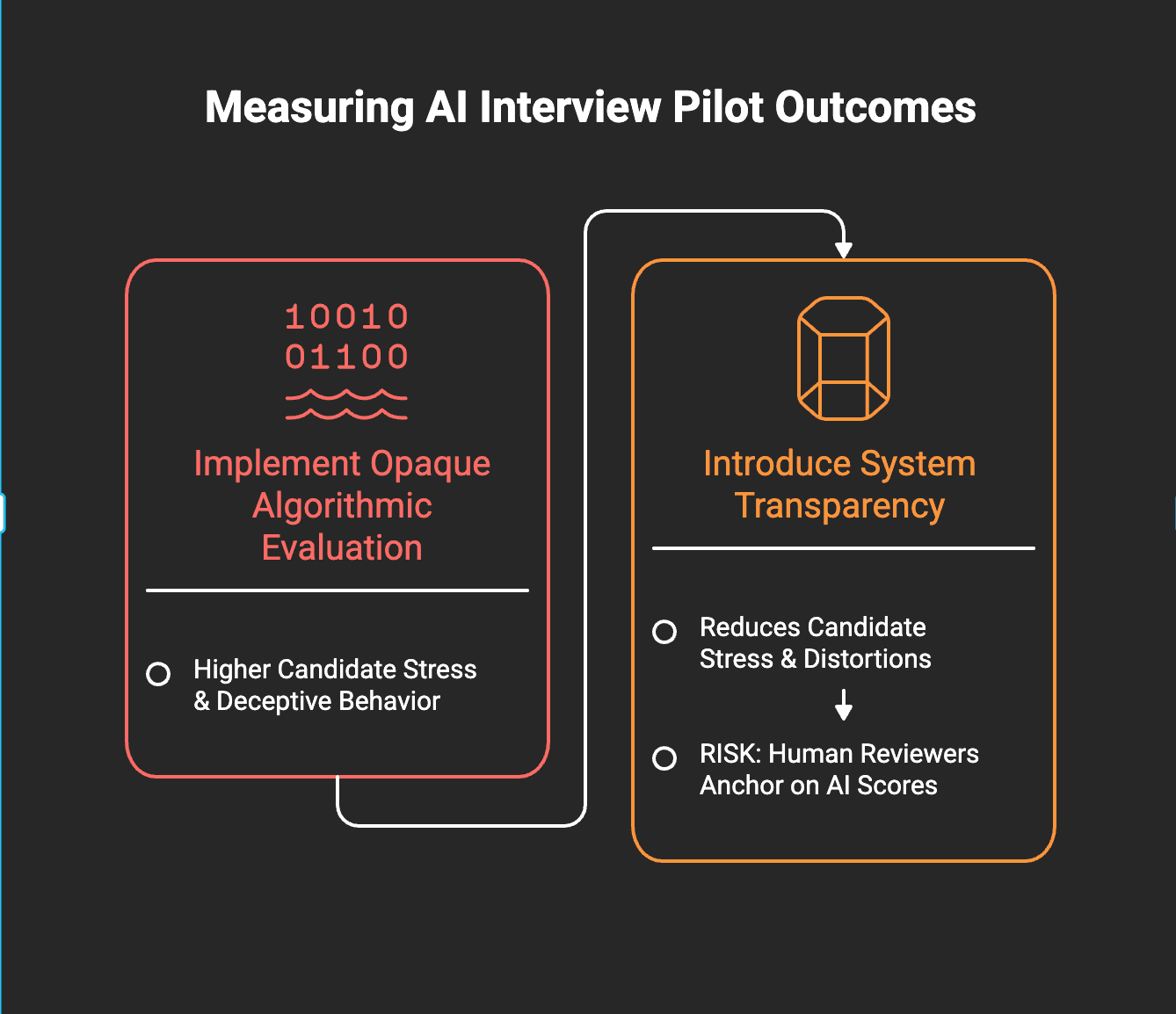
In a comprehensive study across eight studies, including two main experiments and a quasi-field replication, Lakhiwal et al. (2026) investigated candidate reactions and reviewer behavior in algorithmically evaluated interviews.
The Dual Insights for Hiring Teams
Candidate Transparency Mitigates Distortion: When candidates understand how they are evaluated and what evidence is captured, their stress levels drop and opportunistic exaggeration aligns closer to human-led baseline levels.
The "Score Anchoring" Hazard: Evaluators given access to automated AI candidate scores often anchor heavily on those ratings, discounting their own critical judgment even when the AI score fails to distinguish honest answers from exaggerated claims.
Takeaway: Informing candidates how the system works improves authentic evidence collection, but evaluators must review underlying evidence rather than blindly trusting an AI score.
What Makes an AI Interview Structured and Useful?
An AI interview is useful only when it enforces standard interview structure: job-related competencies, common core questions, standardized rating scales, and targeted probing.
As established in the foundational review of structured employment interviews by Levashina et al. (2014), structuring an interview directly reduces bias and elevates predictive validity. However, transferring unstructured questions to an AI model does not automatically make the process valid.
In a SHRM WorkplaceTech Spotlight discussion, JobTwine founder Vikrant Mahajan emphasized defining role competencies and building interview playbooks before introducing technology. Hiring teams must establish clear parameters:
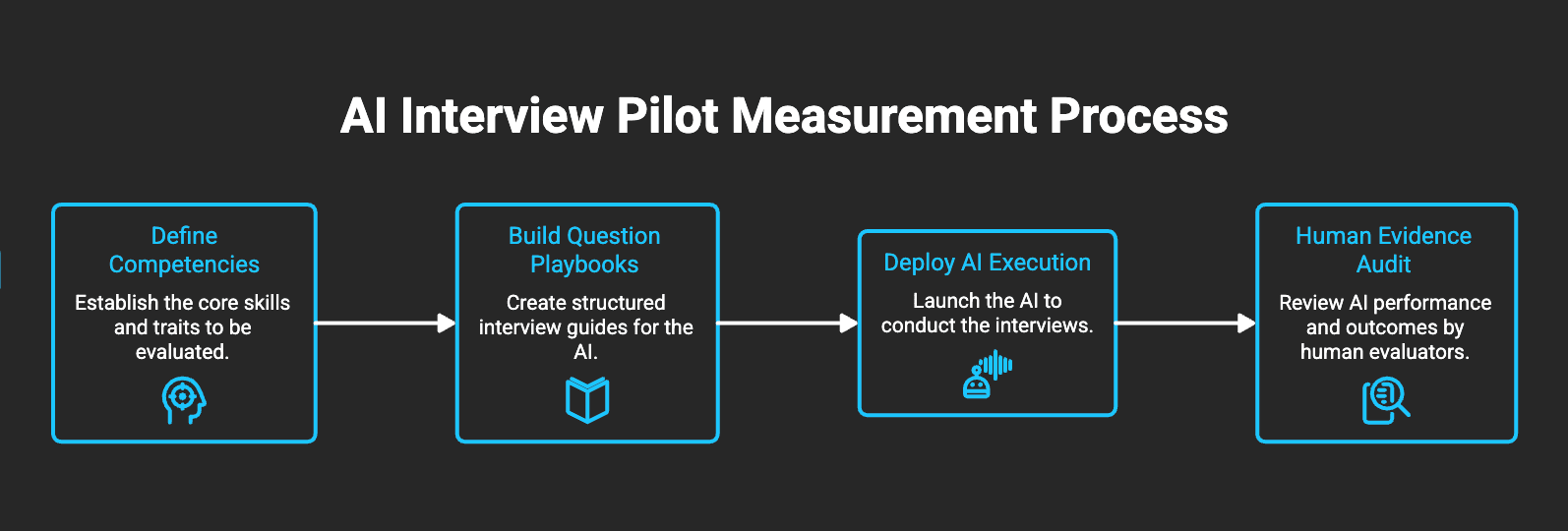
Applying Structured Research to AI Systems
Competency Mapping: Align every AI prompt directly to a critical job specification.
Targeted Probing: Levashina et al. note that systematic follow-up probing clarifies applicant responses. AI interviewers excel at asking dynamic, clarifying questions ("What was your specific role in that project?") without drifting into off-topic chatter.
Score Disaggregation: Never rely on a single composite "hireability" percentage. Evaluate applicants against discrete, evidence-backed competency rubrics.
What Does a Useful Interview Answer Look Like?
To understand how structured evidence extraction works in practice, examine this illustrative response flow showing candidate input, AI probing, and final human review:
Element | Illustrative Example Content |
Candidate's Initial Answer | "I improved our customer support response times significantly in my last role." |
AI Follow-Up Question | "What specific changes did you personally implement, and how did you measure the resulting response time?" |
Candidate's Detailed Response | "I reorganized our ticketing queue into tier-1 and tier-2 routing and configured auto-responses for common FAQs. This reduced average first-response time from 45 minutes to 12 minutes over three months." |
Evidence Collected | Ownership over queue architecture; specific configuration actions taken; metric tracking (45m to 12m over 3 months). |
Still Unknown / Unverified | Whether customer satisfaction (CSAT) dropped due to auto-responses, and how team conflict was handled during rollout. |
Human Reviewer Action | Record evidence relevant to ‘Technical Execution’; independently verify the claimed outcome where necessary; use the next live conversation to explore CSAT impacts and change-management skills. |
How Can Employers Use AI Interviews in High-Volume Hiring?
High-volume AI screening should act as an evidence-gathering engine that feeds human decision-making, not an autonomous rejection filter.
[1. Role Setup]
└─ Configure playbook competencies & scoring rubrics
[2. Candidate Invitation]
└─ Disclose AI usage, format expectations, and evidence goals
[3. Conversational AI Screening]
└─ For example, JobTwine's AI interviewer, JayT, conducts first-round
conversations using configured criteria and relevant follow-up questions.
[4. Evidence Review]
└─ Recruiters review transcripts, flag highlights, & audit structured feedback
[5. Live Human Round]
└─ JobTwine's Interviewer Copilot supports live interviewers with
contextual guidance and evidence capture.
[6. Final Progression Decision]
└─ Examine structured interview feedback alongside supporting responses
Role Setup: HR teams establish clear competency parameters. Teams can use role-specific interview playbooks to define the competencies and questions before inviting candidates.
Transparent Candidate Onboarding: Inform candidates how their data will be processed and evaluated, neutralizing candidate anxiety.
Conversational Screening: Deploy conversational agents to conduct flexible, interactive initial rounds.
Structured Evidence Review: The next step is to examine structured interview feedback alongside the supporting candidate responses to verify competency matches.
Human-Led Deep Dive: Move qualified candidates to a live round. JobTwine's Interviewer Copilot supports live interviewers with contextual guidance and evidence capture during these complex discussions.
What Can Interview Fraud Signals Tell You?
Integrity flags indicate areas requiring human verification—they are not conclusive proof of candidate misconduct.
With the proliferation of real-time AI assistance tools, candidates may attempt to use answer generators during remote assessments. Modern interviewing platforms track technical anomalies, but interpreting these signals requires nuance:
Suspected Assistance: Rapid, unnatural typing bursts or eye-gaze tracking shifts off-screen. Candidate fraud detection can surface signals for investigation; a flag should not be treated as proof.
Answer Inconsistencies: High-level jargon in written text paired with an inability to explain core concepts during dynamic probing.
Signals requiring investigation: Unexpected overlays or additional audio streams should be reviewed in context before reaching a conclusion.
Best Practice: If an anomaly flag is raised, the hiring team should ask targeted, spontaneous follow-up questions during the human-led round to verify authentic depth of knowledge.
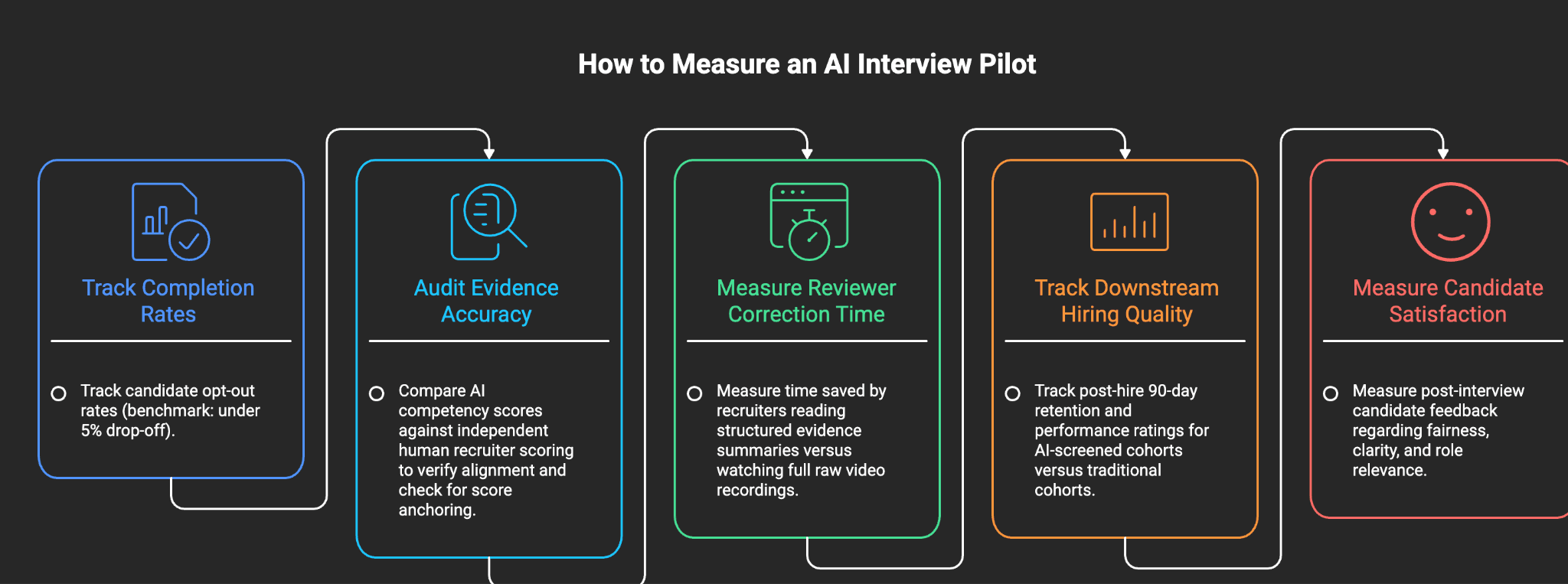
How Should You Measure an AI Interview Pilot?
Evaluating an AI interviewing system requires tracking specific operational and quality metrics. Use this audit checklist during pilot implementations:
Frequently Asked Questions
Do AI interviews eliminate hiring bias?
No. AI interviews remove interpersonal human biases during data collection, but they can introduce algorithmic bias if trained on flawed historical data or if evaluators anchor uncritically on automated scores.
Are one-way video interviews the same as conversational AI interviews?
No. One-way video interviews force candidates to record answers to static prompts without interaction. Conversational AI interviews engage in dynamic, two-way conversations that ask relevant follow-up questions based on candidate answers.
Can an AI interview system reject candidates automatically?
Technically yes, but practically ill-advised. Leading compliance standards and research emphasize keeping humans in the loop to make final progression decisions based on evidence collected by AI.
How do candidates react to being interviewed by AI?
When the process is transparent and convenient, candidate reactions are positive; in field studies, 78% of applicants chose an AI interview over a human recruiter when given the option. However, opaque or unguided automated systems increase candidate stress.
What is the best way to start using AI interviews?
Begin with a controlled pilot in a high-volume role. Define clear competency playbooks, establish candidate transparency disclosures, and train recruiters to evaluate captured evidence rather than raw scores.
Research References
Jabarian, B., & Henkel, L. (2026). Voice AI in Firms: A Natural Field Experiment on Automated Job Interviews. CESifo Working Paper Series No. 12984.
Lakhiwal, A., et al. (2026). From Opacity to Transparency: User Behavior and Downstream Effects in Algorithmic Evaluation. Information Systems Research.
Levashina, J., Hartwell, C. J., Morgeson, F. P., & Campion, M. A. (2014). The Structured Employment Interview: Narrative and Quantitative Review of the Research Literature. Personnel Psychology, 67(1), 241-293.