
Stop AI script reading, deepfakes, and proxy candidates. Learn how to secure your remote screening funnel with real-time, automated proctoring.

The widespread availability of real-time large language models and screen-sharing tools has fundamentally changed how candidates approach assessments. Today, talent teams are not just verifying credentials; they are actively defending the structural integrity of their selection funnels.
When a candidate uses a browser extension to generate answers mid-interview, or when a proxy professional secretly takes a technical assessment on their behalf, traditional screening systems fail to catch it. Legacy tools focus on recording data, completely ignoring the active manipulation happening on the other side of the screen.
Securing your funnel requires moving away from passive recording and implementing intelligent, real-time verification directly into your recruitment workflow automation.
The Four Forms of Modern Interview Fraud
To build a secure screening system, you must first isolate how candidates use technology to compromise remote evaluations.
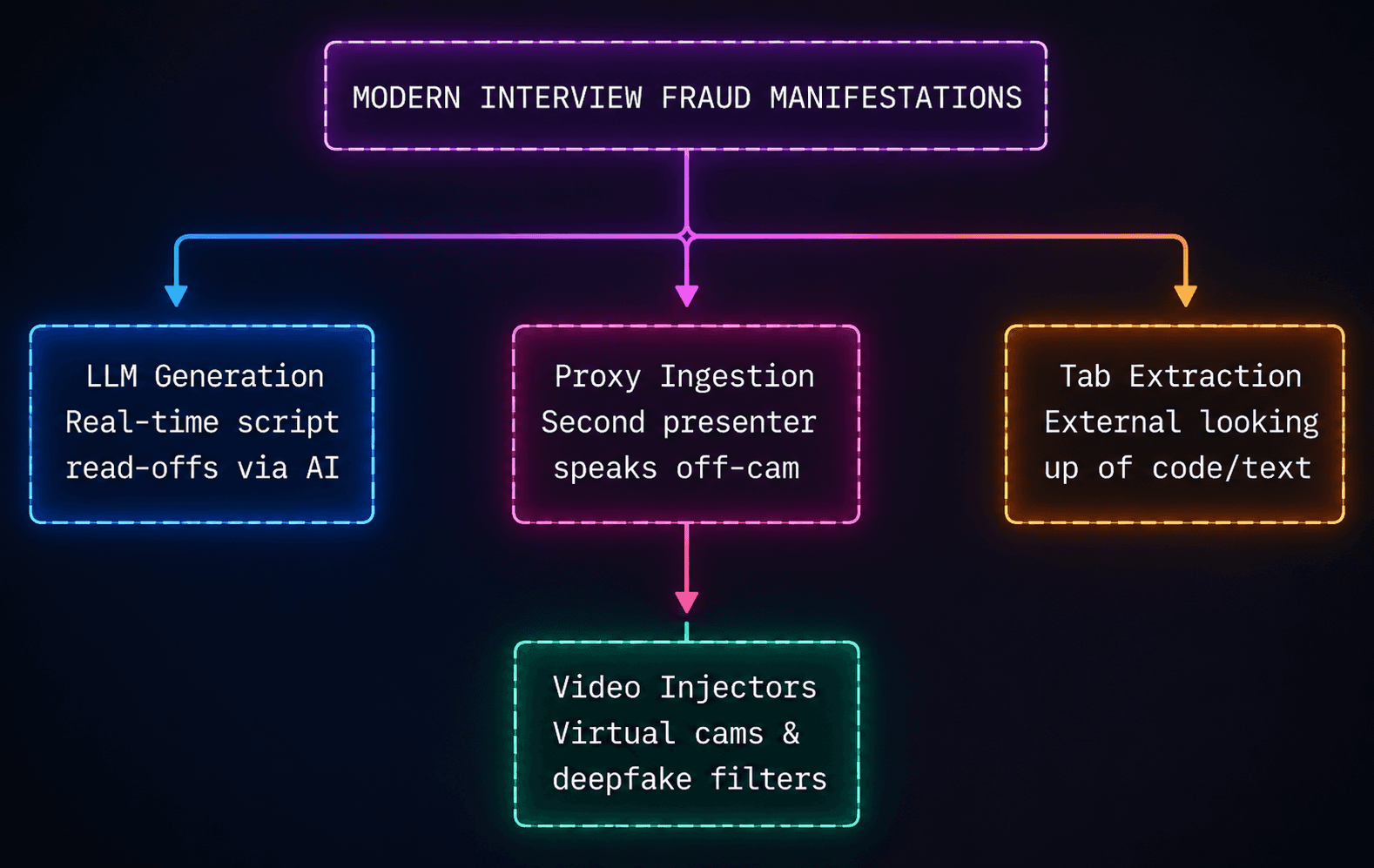
Real-Time LLM Generation: Candidates run a hidden, split-screen window or background plugin. As the question is spoken, the system transcribes it, feeds it to an AI model, and streams a word-by-word script onto the monitor for the candidate to read live.
Proxy Ingestion: A hidden companion sits behind the laptop screen or communicates via an earpiece, typing answers or whispering code solutions in real time.
Tab Extraction and Multi-Screen Access: Candidates frequently navigate out of the active interview interface to search documentation, copy pre-written code repositories, or reference external databases.
Pre-Recorded Video Injectors & Deepfakes: Candidates bypass standard webcams using virtual camera software to loop a pre-recorded clip of a proxy candidate or apply real-time generative face-swaps to hide their true identity.
Why Traditional Recording Platforms Leave You Exposed
Many talent operations teams rely on basic interview note-takers or post-call transcription tools to monitor quality. When evaluating systems, it is essential to understand the structural differences in how platforms protect data.
Security Capability | Legacy Recording Tools (e.g., Metaview, Brighthire) | Modern End to End AI Hiring Platform (JobTwine) |
Operational Intent | Capture conversational text and automate human note-taking post-interview. | Actively evaluate competencies while running real-time fraud mitigation. |
LLM Pattern Analysis | None. The system treats generated speech exactly like authentic, human speech. | Active. Detects unnatural linguistic cadences and structural similarities to AI patterns. |
Biometric & Focus Tracking | None. The system only records the raw audio or video file. | Active. Monitors eye-gaze deviation, face tracking, and background acoustic shifts. |
System Event Logging | None. Cannot track actions occurring outside the browser frame. | Active. Detects and timestamps tab-switching and window-blur events immediately. |
As companies review metaview alternatives or explore brighthire alternatives, the core question must pivot from "Does this tool summarize my meeting?" to "Can this tool guarantee the person speaking is actually qualified?"
Core Security Standards for Remote Screening
Securing an enterprise talent funnel requires four specific, real-time proctoring layers built directly into your primary AI recruiting platform.
1. Real-Time LLM Cadence Analysis
Human speech patterns are inherently imperfect. True conversational dialogue contains irregular pauses, mid-sentence adjustments, and unpredictable structural variations. Conversely, a candidate reading an AI-generated script follows an unnaturally smooth, continuous reading rhythm. An advanced ai interview platform analyzes audio inputs in real time to spot these exact reading patterns, assigning an instant suspicion score based on the delivery structure.
2. Multi-Modal Eye-Gaze and Attention Tracking
When a candidate constantly shifts their eyes away from the camera to look at a secondary window or reading pane, the system must notice. Automated candidate screening needs to include real-time facial verification that flags persistent off-screen gaze anomalies, mapping those exact moments to timestamps within the core interview evaluation.
3. Integrated Tab-Switching and Interface Monitoring
The moment a candidate clicks away from the live screening window to check an external reference, the event must be logged. A secure AI recruitment platform creates an automated, immutable log of every interface exit, ensuring that technical evaluations measure actual human knowledge rather than search proficiency.
4. Continuous Biometric Liveness and Deepfake Verification
To counter video injection tools and face-swapping filters, the platform must run background continuous identity verification. This security layer maps unique facial geometry markers and analyzes visual artifacts—such as edge blurring, unnatural eye-blink rates, or lighting shifts—to ensure that a static recording or an AI filter hasn't bypassed the active webcam stream.
How JobTwine's JayT Agent Secures the Pipeline
At JobTwine, we believe that fraud prevention should be completely hands-off for your recruitment team. If your staff has to spend hours reviewing recorded footage to look for cheating, the system is broken.
Our autonomous AI recruiter agent, JayT, runs full multi-modal proctoring entirely in the background.
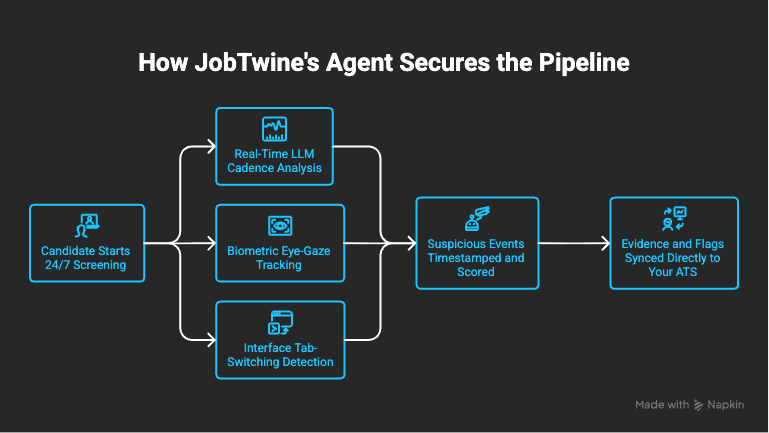
When JayT conducts a 24/7 autonomous screen, the platform monitors the environment for behavioral anomalies. If a candidate uses an external AI generator or switches windows, JayT logs the exact timestamp, flags the specific skill rubric affected, and attaches the direct evidence to the profile.
Your recruiters do not have to watch anything. They simply review their Applicant Tracking System (ATS) dashboard to see candidates sorted by both role competency and verification confidence.
Data Integrity Drives Successful Automation
Transitioning to automated candidate screening only works if you can completely trust the underlying data. By introducing intelligent, real-time fraud monitoring to your AI hiring tools, you remove the vulnerabilities of remote interviewing. This protective layer ensures your pipeline remains fast, fair, and completely secure against manipulation.
To see how to protect your remote funnel from AI fraud while maintaining an exceptional candidate experience, explore the platform security architecture directly at JobTwine.