
How to choose an AI recruitment platform for a scaling team. Compare screening, AI interviews, fraud detection, ATS integrations, security and ROI.

An AI recruitment platform is software that uses AI to automate and support recruiting tasks such as resume screening, candidate communication, interviews, evaluation and workflow management. The right platform should reduce manual work while maintaining structured hiring processes, human oversight, security, ATS integration and measurable improvements in recruiting efficiency.
When a company enters a high-growth phase, talent acquisition (TA) teams quickly hit a capacity wall. Screening hundreds of applications, conducting first-round phone screens, prepping hiring managers, and syncing notes with an Applicant Tracking System (ATS) consumes dozens of recruiter hours each week. Expanding headcount just to handle top-of-funnel administrative fatigue is inefficient and costly.
However, not all talent acquisition software is created equal. Many solutions are little more than keyword filters or generic text summarizers that create hidden operational bottlenecks. This guide breaks down the essential criteria, technical evaluation frameworks, and core capabilities required when evaluating an ai recruitment platform for a scaling business.
What Is an AI Recruitment Platform?
An AI recruitment platform is an end-to-end talent acquisition software suite that leverages artificial intelligence to automate, structure, and optimize the candidate journey, from resume shortlisting and autonomous first-round screening to live interview guidance, fraud detection, and scorecards. Unlike basic keyword search tools, modern AI recruiting engines synthesize job requirements into standardized rubrics and capture structured candidate evidence to support faster, more consistent and data-informed hiring decisions.
Why Scaling Companies Need an Enterprise AI Recruitment Platform
Fast-growing teams need an enterprise AI recruitment platform when application volume, screening workload and interview coordination exceed what recruiters can manage efficiently through manual processes alone.
As application volume scales, traditional manual recruiting workflows break down. According to benchmark studies by SHRM, traditional hiring processes average 44 days to close an offer with an average cost-per-hire around $4,000. When scaling rapidly, that timeline delays product launches, stretches existing teams, and leads to costly mis-hires.
Implementing an enterprise ai recruitment platform changes these economics by removing administrative friction across the entire funnel:
Metric | Traditional Manual Process | Enterprise AI Recruitment Platform (e.g., JobTwine) |
Time to Offer | 44 days | 8 days (80% reduction in cycle time) |
Cost-Per-Hire | ~$4,000 | Under $240 per hire |
Candidate Screening Speed | 10–15 resumes/hour | 10X faster automated shortlisting & 24/7 screens |
Risk of Wrong Hires | High (unstructured, subjective) | 80% lower risk of mis-hires |
Post-Interview Admin | 2–3 hours/week per interviewer | Zero manual data entry (100% automated ATS sync) |
5 Critical Features to Look for When Choosing an AI Recruitment Platform
When evaluating vendors, TA leaders should avoid fragmented point solutions. A true full-stack platform provides continuous context from the moment a job description is published to the final hiring decision.
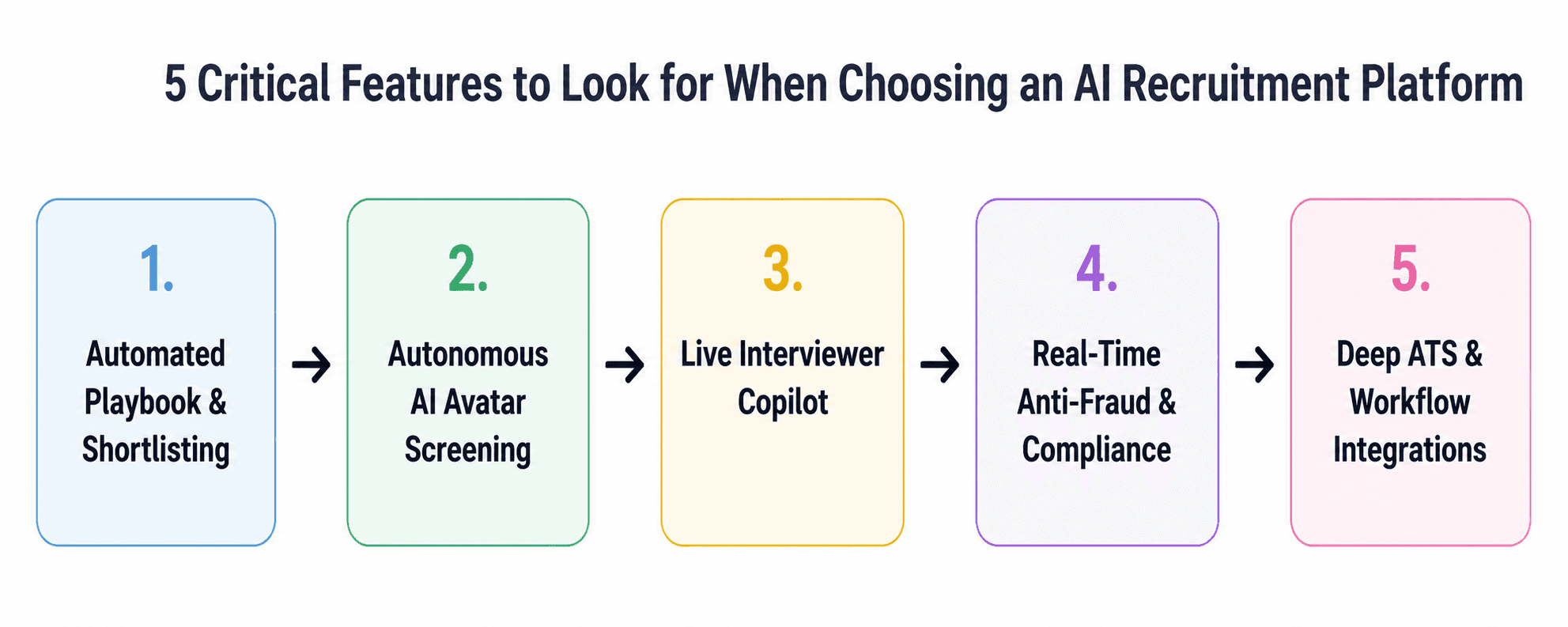
1. Automated Playbook Building and Resume Shortlisting
A modern platform must translate a standard Job Description (JD) into a structured evaluation framework instantly. Look for solutions that automatically extract key competencies, build calibrated question banks, and establish objective scoring rubrics before the first applicant applies. Furthermore, some platforms can also identify potential resume manipulation or AI-generated content during the screening process, depending on their detection capabilities.
2. Autonomous AI Avatar Recruiter (24/7 Screening)
Top talent doesn't wait for recruiters to clear their calendar. Advanced engines—such as JobTwine’s AI Avatar Recruiter (JayT)—conduct interactive, conversational first-round video screens 24/7 in over 16 languages. Unlike static video prompts, an interactive avatar adapts follow-up questions dynamically based on candidate answers, scoring responses against the job playbook while recruiters sleep.
3. Live Interviewer Copilot for Human Rounds
Automation should support human judgment, not replace it. During live technical or managerial interviews on Google Meet, Microsoft Teams, or Zoom, an ai recruitment platform should provide a live in-meeting copilot. This copilot offers real-time nudges, prompts interviewers on untested competencies, captures structured notes, and eliminates post-interview administrative burden.
4. Real-Time Fraud and LLM Assistance Detection
With the rapid rise of generative AI, candidates increasingly use secondary screens, real-time LLM prompting, or hidden assistants during remote interviews. An enterprise solution must include built-in real-time fraud monitoring that detects:
LLM Output Cadence: Analyzes speech phrasing and structure to flag real-time AI generation.
Gaze and Eye Movement Signals: Can identify patterns that may indicate off-screen reading or unusual visual behavior during an interview.
Suspicious Facial Tracking & Tab Switching: Can flag unusual browser or visual behavior that may warrant human review.
5. Native Integration with 50+ Enterprise ATS Platforms
Look for bi-directional integrations with the ATS and recruiting systems your team already uses, so candidate profiles, interview data, notes and scorecards can move into the system of record without unnecessary manual work.
Key Steps on How to Choose an AI Recruitment Platform
Selecting the right software requires a clear framework that balances speed, accuracy, data security, and team adoption.
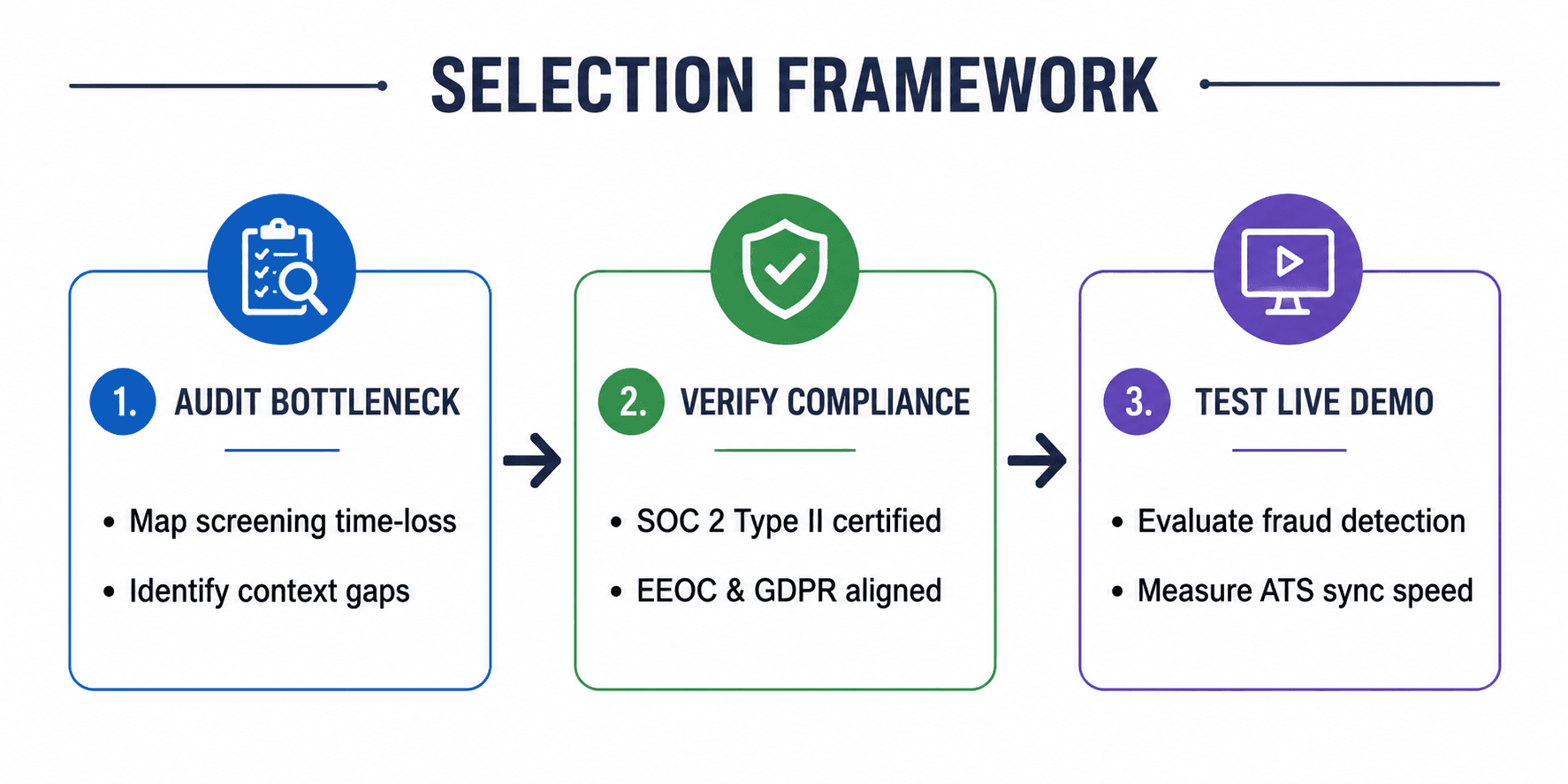
Step 1: Map Your Pipeline Bottlenecks
Determine where your hiring loop stalls. If recruiters spend 15+ hours weekly on 15-minute introductory phone calls, prioritize autonomous avatar screening. If hiring managers submit inconsistent scorecards 3 days late, prioritize an interview copilot with automated feedback generation.
Step 2: Audit Compliance and Algorithmic Bias
Security and fairness are non-negotiable for talent acquisition software. Check that the platform complies with standard regulatory standards:
Data Security: SOC 2 Type II certification and full data encryption.
Global Privacy: Full alignment with GDPR privacy guidelines regarding candidate data retention and candidate consent workflows.
Ethical AI Audits: Compliance with EEOC guidelines on employment AI and regular third-party audits to prevent demographic or algorithmic bias.
Step 3: Run a Pilot on High-Volume Roles
Before rolling out software across your entire enterprise, pilot the platform on 2–3 active, high-volume roles. Measure time-to-shortlist, candidate completion rates, interviewer satisfaction, and overall reduction in cost-per-hire.
Frequently Asked Questions
How does an AI recruitment platform reduce time-to-hire without lowering candidate quality?
An AI recruitment platform reduces time-to-hire by automating initial shortlisting and first-round screens 24/7. Instead of waiting days for phone calls, applicants complete autonomous avatar screens immediately upon applying. Candidate quality increases because every applicant is evaluated against structured, competency-based rubrics, reducing subjective bias and human oversight errors.
Can an AI recruitment platform integrate with our existing Applicant Tracking System (ATS)?
Yes. Leading platforms integrate bi-directionally with over 50 major ATS solutions—including Greenhouse, Lever, Workday, and BambooHR. Candidate profiles, video transcripts, AI fraud detection flags, and structured scorecards sync automatically into your existing system with zero manual copy-pasting.
How do AI interview platforms prevent candidates from cheating using ChatGPT during video screens?
Advanced platforms use real-time anti-fraud monitoring during interviews. They analyze speech patterns and phrasing cadence to detect real-time LLM prompting, monitor eye gaze for off-screen reading, track tab switching, and flag suspicious face movements. Every incident is timestamped and attached to the candidate's scorecard.
What is the difference between an AI recruitment platform and a standard video interviewing tool?
Standard video interviewing tools record static, one-way answers to fixed prompts without real-time interaction or deep evaluation. An AI recruitment platform uses interactive AI avatars that conduct dynamic multi-turn interviews, adapt follow-up questions in real time, provide live copilots for human panel rounds, and sync structured evaluation scorecards directly to your ATS.
Conclusion: Scale Your Hiring Loop with JobTwine
Selecting the right AI recruitment platform can have a meaningful impact on how efficiently a fast-growing talent team screens, interviews and evaluates candidates. The right platform should reduce administrative work without sacrificing structured evaluation, candidate experience, security or human oversight.
With JobTwine, scaling talent acquisition teams achieve:
3X faster offer closures and an 80% reduction in total hiring cycle time.
80% lower risk of mis-hires through structured, competency-aligned playbooks.
Sub-$240 cost-per-hire, replacing $4,000 industry average administrative waste.
The best AI recruitment platform is the one that removes the most meaningful bottlenecks from your hiring workflow while preserving structured evaluation, candidate experience and human accountability.
Ready to Build Your Dream Hiring Loop?
Discover how JobTwine’s 24/7 AI Avatar Recruiter (JayT) and Interview Copilot can transform your recruitment workflow. Book a Demo today to experience the future of AI-driven talent acquisition.