
Wondering if AI interviews are truly fair or biased? We unpack the data on AI interviewing accuracy, legal regulations, and best practices for HR leaders.

The adoption of AI interviews across global enterprise hiring has moved from an experimental trend to standard corporate operating procedure. Driven by high-volume recruitment needs and the push for talent acquisition efficiency, companies are increasingly replacing initial phone screens with automated digital interviews.
However, as algorithms replace human screeners, talent leaders and job candidates alike are raising urgent questions: Is AI interviewing fair? Can an algorithm judge potential without inheriting historical prejudices?
In this comprehensive analysis, we unpack empirical research, audit data, and regulatory guidelines to distinguish reality from common misconceptions—giving HR leaders, recruiters, and candidates a clear look at how automated assessments measure up against traditional human recruitment.
Myth vs. Reality: Is AI Interviewing Fair?
When evaluating whether automated screening tools create a level playing field, public sentiment often splits into extremes. Critics fear dystopian automated rejections, while vendors promise completely bias-free talent selection. The truth, supported by recent data, lies somewhere in between.
Traditional Human Hiring vs. Algorithmic AI Screening | ||
Bias Type | Human Recruiters | Audited AI Systems |
|
|
|
Myth 1: AI Eliminates All Hiring Bias Completely
The Reality: AI is not inherently neutral; it is a reflection of its training data. If an algorithm is trained on 10 years of historical company hiring decisions that are skewed toward a specific university or demographic, the model will learn to favor those patterns. As demonstrated by high-profile algorithmic failures, unmonitored machine learning tools can unintentionally scale historical bias in milliseconds.
Myth 2: Human Interviewers Are Always More Objective
The Reality: Peer-reviewed social science demonstrates that human recruiters carry profound cognitive biases. Studies published by the Harvard Kennedy School reveal that identical resumes with traditional white-sounding names receive 50% more callbacks than those with minority-sounding names. Human interviewers suffer from affinity bias (favoring candidates who resemble themselves), halo effects (letting one good trait mask weaknesses), and fatigue variance.
Key Takeaway: AI doesn't create bias out of thin air; it codifies existing data patterns. Unlike human subconscious bias, however, algorithmic logic can be audited, measured, and continuously recalibrated.
Predictive Reliability: How Accurate Are AI Interviews?
A central question for talent acquisition teams is predictive validity: How accurate are AI interviews at identifying future job performance compared to human recruiters?
Research indicates that the effectiveness of AI interviews stems not from artificial intelligence itself, but from forced structure.
According to research highlighted in the Harvard Business Review, structured interviews outperform unstructured conversations in predicting job performance by up to 25%. However, due to time constraints, most human interviewers default to unstructured, conversational screens.
Structured Skill Evaluation: AI platforms force every candidate to answer identical questions derived strictly from core job competencies, eliminating off-topic chatter and subjective "culture fit" traps.
Predictive Accuracy Benchmarks: Controlled performance studies show that structured AI interview scoring accurately predicts on-the-job performance in 62% of cases, compared to 56% for unstructured human screening.
Retention and Efficiency: According to research by Accenture, enterprises adopting structured AI screening with built-in bias controls experienced a 35-40% reduction in time-to-hire and up to a 25% increase in employee retention over 12 months.
3 Critical Pitfalls in Algorithmic Screening
To ensure fairness, talent acquisition leaders must understand where automated interviewing tools frequently misstep:
1. Facial Analysis and "Emotional AI" Risks
Early automated interviewing tools attempted to score candidate micro-expressions, eye contact, and vocal pitch to judge confidence or honesty. Modern scientific consensus has largely discredited facial analysis as an accurate indicator of job capability. Facial scoring disproportionately penalizes neurodivergent candidates and individuals with diverse cultural communication styles. Leading ethical platforms have completely removed facial analysis in favor of speech-to-text transcript scoring.
2. Over-Reliance on Resume Keyword Proxies
When machine learning models use text embeddings without fine-tuning, gender-neutral terms like "computer programmer" can sit closer to masculine vector spaces in training data. Without proper oversight, NLP tools can inadvertently penalize resume gaps or non-standard syntax.
3. Black-Box Scoring Models
If a platform cannot explain why a candidate received a low assessment score, the employer faces both ethical liability and severe legal exposure under expanding labor regulations.
Navigating the Regulatory Landscape: Compliance in 2026
The regulatory frame around automated employment decision tools (AEDTs) has shifted from passive guidelines to strict legal mandates:
NYC Local Law 144: Requires employers in New York City to conduct independent, annual bias audits of AI hiring tools prior to deployment and publicly publish impact ratios across gender and race.
EU AI Act: Formally classifies AI tools used in employment, recruitment, and worker management as High-Risk AI Systems. Organizations must ensure technical documentation, continuous bias testing, explicit candidate disclosure, and human oversight.
U.S. EEOC Guidelines: The U.S. Equal Employment Opportunity Commission explicitly enforces Title VII compliance on AI selection procedures, holding employers legally liable if automated screening causes an illegal adverse impact on protected groups.
State Video Legislation: States like Illinois require written advance candidate consent, detailed explanation of algorithm metrics, and automatic video deletion windows for AI-assisted video screenings.
Best Practices: Building a Fair "Human-in-the-Loop" Framework
The consensus among industrial psychologists, data scientists, and legal experts is clear: AI should evaluate competencies, but humans must make hiring decisions.
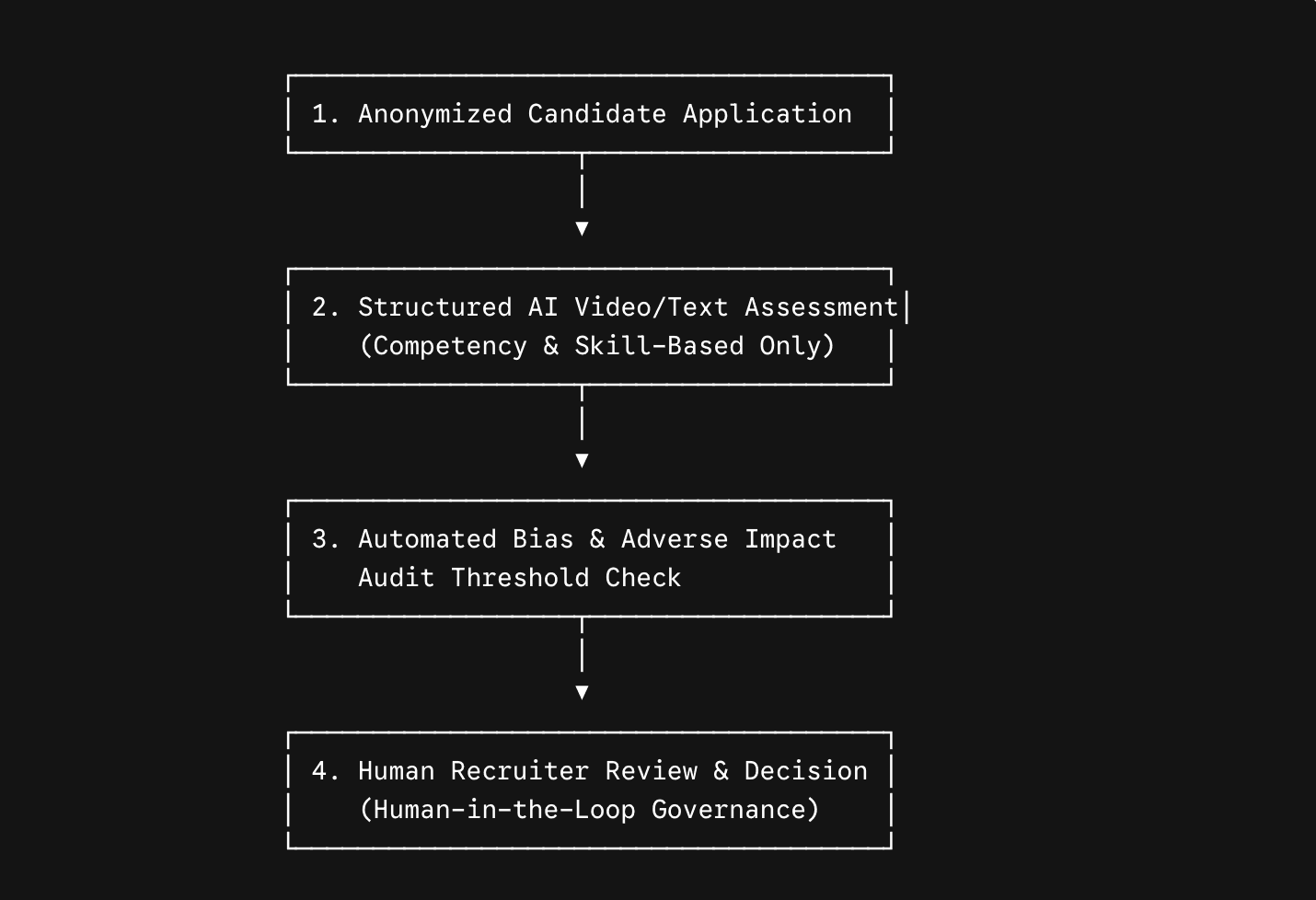
Key Principles for Responsible Deployment:
Mandate Blind Skill Evaluation: Ensure your platform redacts names, age markers, graduation years, and demographic indicators before algorithmic assessment.
Eliminate Non-Verbal Biomarkers: Opt for text-transcript NLP scoring that measures what a candidate says rather than facial movements or pitch.
Conduct Continuous Impact Audits: Measure selection rates across demographic groups on an ongoing basis to detect drift or adverse impact early.
Maintain Candidate Appeals and Opt-Outs: Always provide candidates with an alternative human review pathway upon request..
Conclusion: The Path Forward for Equitable Hiring
When asking is AI interviewing fair, the answer depends entirely on system design and human oversight. Left unmonitored on flawed historical data, AI can automate bias at scale. But when engineered for transparency, skill-based rubric scoring, and appropriate human oversight, AI interviews can help reduce the influence of human unconscious bias—helping organizations build diverse, highly capable teams.
Next Step: Upgrade Your Hiring Process with Ethical AI
Ready to reduce hiring bias, improve screening accuracy, and speed up your hiring pipeline with full legal compliance?
Book a Demo with Our Talent Experts Today to see our fully auditable, bias-tested AI interviewing platform in action.