
JobTwine’s CEO explores how evolving AI shapes interview fraud detection, why flags need context, and how hiring teams can assess candidate evidence.

AI is evolving every day, and that evolution shapes how we think about every product at JobTwine, from shortlisting and AI interviews to interviewer support and candidate evaluation.
Generating good interview answers with AI takes seconds. Verifying authentic candidate capability takes better technology and clear proof. That is what we build for.
That is why interview integrity matters. Detection must give hiring teams actionable evidence while leaving room for candidates to explain what a system flag cannot. An alert is a prompt to investigate. Our job is to protect employers from fraud without turning technical hiccups into automatic rejections.
Why the First Impression Is Insufficient
In automated and AI-assisted interviewing, an alert typically triggers when a system detects a pattern anomaly. This might include off-screen eye gaze, micro-pauses in speech, audio feeds that do not match video synchronization, or language patterns that resemble real-time LLM generation.
However, there is a fundamental difference between an unusual signal, weak assessment evidence, and confirmed misconduct:
An unusual signal indicates that something in the environment or candidate behavior triggered a rule or model threshold.
Weak assessment evidence means the candidate failed to demonstrate skills clearly during the interaction, but without proof of bad faith.
Confirmed misconduct requires corroborating evidence showing deliberate impersonation, covert assistance, or automated response generation.
A detection signal on its own cannot establish intent. An eye-gaze flag might reflect a candidate looking at a dual monitor where the coding environment is hosted, a second video feed, or physical notes. An audio delay flag might be the byproduct of an unstable VoIP connection or Bluetooth device latency. If a hiring team acts strictly on the initial automated alert, they risk turning a probabilistic estimate into an arbitrary rejection.
What the Wider Research Tells Us
The broader conversation around interview integrity often suffers from conflating general survey data with system performance metrics. To evaluate detection responsibly, we must look at what empirical data actually establishes and where its limitations lie.
Research / Source | What the Data Establishes |
26% of candidates trusted AI to evaluate them fairly. | |
Gartner Q2 2025 Survey (3,000 Candidates) | 6% of candidates admitted to interview impersonation. |
Fabric Internal Analysis (19,368 Interviews) | 38.5% flagged for potential anomalies in vendor sample. |
61.22% false positive rate on non-native English text. |
These findings highlight two distinct problems:
The Trust and Fraud Gap: While impersonation and live assistance are real issues, candidate trust in automated evaluation is low. Over-indexing on aggressive, opaque flagging deepens this distrust.
The Validation Deficit: High vendor flag rates show how frequently detection systems demand human attention. However, academic research on automated text detection—such as the Stanford-linked study on TOEFL essays—demonstrates that statistical classifiers can exhibit high false-positive rates, particularly when evaluating non-native speakers or unexpected input styles.
What Happens During Our Review
To move from an automated detection signal to an accountable hiring decision, a flagged session must undergo systematic human verification. The process follows five distinct phases:
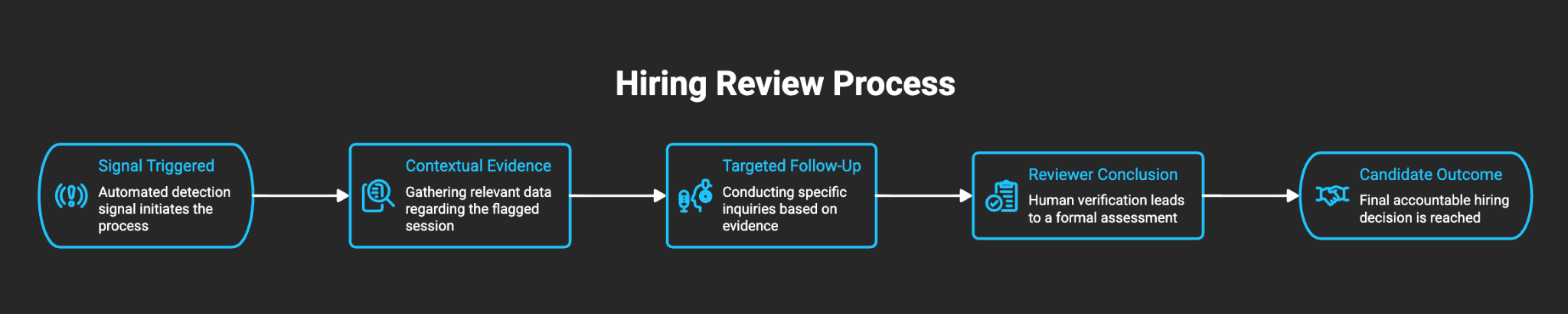
Signal Triggered: The system identifies a specific event, such as an unexpected secondary audio input or an anomaly in the candidate's speech cadence during a technical question.
Contextual Evidence Check: A human reviewer opens the session log to review the complete window around the event. The reviewer checks:
Is the behavior continuous, or did it occur only when the candidate was accessing an allowed IDE/documentation window?
Does the audio visual timeline show network dropouts, frame rate dips, or hardware re-configurations?
Are there independent markers, such as consistent problem-solving logic when asked to explain an answer verbally?
Targeted Follow-Up: If the system evidence remains ambiguous, the candidate is given a direct opportunity to clarify or complete a brief, practical verification step (e.g., a short live follow-up or technical explanation).
Reviewer Conclusion: The reviewer synthesizes the signal, the session log, and any clarification into a documented evaluation: Confirmed, Cleared, or Unresolved.
Candidate Outcome: The candidate either moves forward in the pipeline, is invited to re-assess under stabilized conditions, or is formally disqualified with an archived evidence trail.
What We Changed Afterward
Learning from edge cases in detection leads to updates in operating procedures and software design.
For example, when investigating flags caused by dual-monitor setups, where candidates legitimately looked off-camera to reference development tools, we modified our candidate pre-interview onboarding instructions. Candidates are now explicitly prompted to confirm their screen setup before the session begins, and review guidelines were updated so that off-screen gaze during active coding tasks is not flagged as a primary anomaly without secondary audio or text evidence.
Every edge case should result in a clearer standard for the candidate, a more precise task for the reviewer, and an updated model rule for the platform.
Where JobTwine’s Technology Helps
JobTwine’s candidate fraud detection surfaces potential integrity concerns during interviews for human review. The useful question is what evidence a reviewer can examine and what further checks are needed before the concern affects a hiring decision.
Rather than issuing binary "pass/fail" scorecards, JobTwine generates an evidence timeline. Reviewers can inspect synchronized video, screen activity, and audio logs corresponding directly to flagged timestamps.
ILLUSTRATIVE MOCK EXAMPLE - FOR REVIEWER INTERFACE ONLY | |
Flag ID: #8042-A | Type: Audio Cadence Anomaly |
Timestamp: 14:22 - 15:05 | |
Primary Signal | Pause duration exceeds baseline during technical explanation. |
Contextual Log | Screen share shows active local terminal compilation at 14:20. |
System Recommendation | Human verification required. Review audio against screen log |
By presenting flags alongside contextual logs, the technology assists the reviewer without replacing their judgment. The platform highlights where to look, but human reviewers own the ultimate decision.
What I Would Ask Any Vendor
If you are evaluating AI interviewing or fraud detection vendors, do not ask simply "What is your detection accuracy rate?" Ask how their system handles edge cases and human oversight.
Here are five questions every buyer should ask:
What specific evidence accompanies an alert? Can my hiring team inspect the raw timestamped data, or does the system provide only an aggregate risk score?
How do you measure and report false positives? What percentage of flagged candidates are ultimately cleared after review?
How do you test for missed cases (false negatives)? Do you regularly audit an unflagged sample of interviews to verify system recall?
What is the average review time required per flagged interview? How much human operational overhead does the detection system add to the recruiting team?
How can a candidate clarify a concern? Is there a defined, structured process to resolve hardware or network anomalies before a candidate is rejected?
The Standard I Want Us to Meet
As AI tools become more sophisticated, the urge to build fully automated, hands-off filtering systems will grow. But hiring decisions carry real consequences for people’s careers and companies’ team cultures.
The standard we aim for at JobTwine—and the standard I believe our industry must adopt—is centered on decision accountability. Technology should make interviewing faster, fairer, and more insightful. It should catch bad actors efficiently. But whenever a candidate's integrity is in question, the outcome must be owned by a named human reviewer who has evaluated clear, accessible evidence.