
Compare AI recruitment platforms vs traditional ATS. Discover how autonomous AI screening, anti-fraud tools, and live copilot guidance cut hiring time by 80%.

Every talent acquisition leader manages an Applicant Tracking System (ATS). For two decades, the ATS served as the unquestioned system of record for recruiting—a digital filing cabinet designed to log applications, track stage transitions, and maintain legal compliance.
However, TA teams now face a structural crisis. High-volume inbound applications driven by candidate-side AI prompt generators are flooding candidate pipelines. At the same time, hiring managers demand shorter time-to-fill, and executive leadership expects recruiters to scale hiring without expanding headcount.
Confronted with these challenges, legacy systems fail. Storing candidate data does not solve the operational bottleneck of processing it.
This operational reality has created a clear industry shift: the rise of the AI recruitment platform.
Understanding the distinction between an AI recruitment platform vs traditional ATS is no longer a matter of software nomenclature—it is a core strategic requirement for modern talent acquisition.
At JobTwine, we build agentic interview intelligence systems. We regularly consult with CHROs and TA directors to evaluate their hiring architectures.
Below is an executive breakdown detailing what actually separates an ai recruitment platform from legacy tracking systems, along with the operational strategies required to modernize your hiring workflow.
The Core Strategic Shift: Reactive Tracking vs. Agentic Execution
1. Static Database Storage vs. Autonomous Screening Workflows
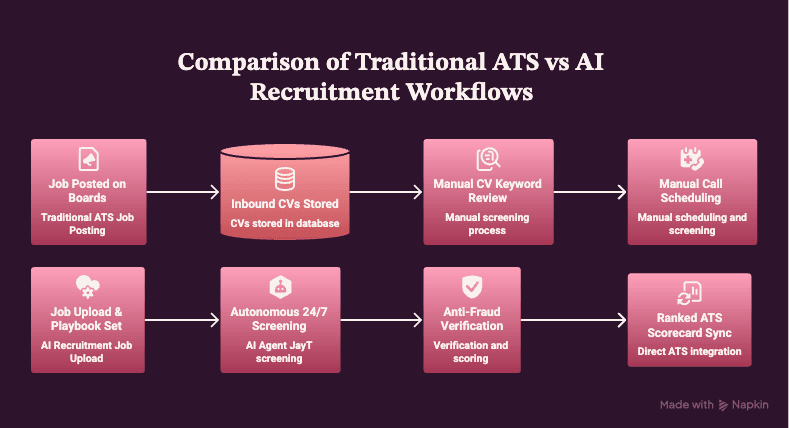
A traditional ATS acts as a passive database. It receives resumes, parses text fields into candidate profiles, and sits quietly until a recruiter manually reviews each PDF.
Conversely, an ai recruitment platform executes tasks autonomously. It evaluates candidates instantly upon application, engages them through interactive conversational workflows, and scores their competencies against role-specific benchmarks before a human ever opens a file.
Feature | Traditional ATS | AI Recruitment Platform |
Screening Mechanism | Static Keyword Search & Parser | Autonomous Avatar (e.g., JayT) |
Evaluation Depth | Resume Text Claims | Live Competency Demonstration |
Recruiter Manual Effort | High (10–15 mins/CV) | Zero (Auto-Scored) |
Practical Application
Instead of spending 15 hours a week conducting repetitive 15-minute introductory phone screens, TA teams deploy JobTwine’s autonomous AI avatar recruiter, JayT. JayT conducts two-way, conversational first-round interviews 24/7 across 16+ languages on the candidate's schedule. Recruiters wake up to a structured, objectively scored shortlist synced directly to their existing system.
Key Takeaway: An ATS stores candidate claims; an ai recruitment platform actively evaluates candidate capabilities.
2. Inflexible Keyword Matching vs. Contextual Competency Playbooks
Legacy ATS software relies on Boolean search logic and exact keyword parsing. If a job description calls for "Python" and a candidate lists "Django development" without explicitly writing the word "Python," a legacy ATS parser frequently rejects them. Candidates quickly exploit this simplicity by padding resumes with hidden keywords and AI-generated fluff.
An ai recruitment platform relies on semantic skills graphs and automated playbook creation. It analyzes the true context of a candidate's experience, mapping adjacent technical skills and assessing dynamic problem-solving capacity.
Practical Application
With JobTwine’s Smart Playbook Builder, uploading a job description instantly generates a full competency framework—complete with structured questions and evaluation rubrics tailored to the role. The platform evaluates how a candidate applies their knowledge in real time, ignoring resume keyword density entirely.
3. Vulnerable Self-Reporting vs. Built-in Anti-Fraud Intelligence
Traditional ATS solutions were designed when applicants manually typed resumes and attended every interview in person. They offer zero protection against modern candidate cheating tactics, such as:
Real-time LLM prompt generation during virtual interviews.
Hidden off-screen assistants whispering answers.
Teleprompter software and tab-switching during assessments.
An ai recruitment platform builds verification directly into the interview pipeline.
Practical Application
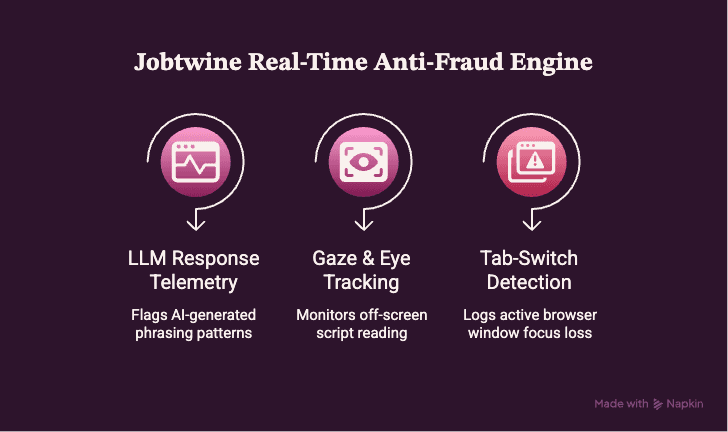
JobTwine’s Anti-Fraud Engine tracks candidate responses across both autonomous avatar rounds and live human interviews. The system monitors eye gaze metrics, flags synthetic voice phrasing, and detects browser tab switching. Every suspicious event receives a time-stamped log sent directly to your hiring panel.
4. Subjective Interview Notes vs. Live Copilot Guidance & Automated Scorecards
In a traditional ATS environment, post-interview feedback is notoriously unstandardized. Hiring managers submit brief, delayed notes like "Good culture fit" or "Felt a bit inexperienced," exposing the organization to unconscious bias and legal liability.
An ai recruitment platform transforms live human interviews from unstandardized chats into structured, objective evaluations.
Practical Application
During live video interviews, JobTwine’s Interviewer Copilot assists human hiring managers in real time. Copilot displays role-specific questions, suggests follow-up prompts based on candidate answers, and enforces anti-skip logic to ensure every required competency is covered. Once the interview concludes, complete transcripts and structured scorecards sync automatically back to your ATS.
Feature Comparison Matrix: AI Recruitment Platform vs Traditional ATS
This ai recruitment platform comparison highlights how capabilities differ across key operational metrics:
Functional Area | Traditional ATS | Modern AI Recruitment Platform | Impact on Talent Team |
First-Round Screening | Manual CV review & phone calls | Autonomous 24/7 AI Avatar (JayT) | 10X faster screening speed per candidate |
Candidate Shortlisting | Keyword filtering & manual sorting | Algorithmic competency ranking | Eliminates resume screening backlogs |
Fraud & Cheating Defense | None | Real-time LLM & eye-gaze tracking | Prevents bad hires from dishonest candidates |
Interviewer Guidance | Static email reminders | Live Interviewer Copilot nudges | Ensures 99% interview consistency |
System Architecture | Passive record storage | Active execution engine | Slashing hiring cycles by up to 80% |
Practical Deployment Strategy: Replacing vs. Layering
A common misconception among TA heads is that adopting an ai recruitment platform requires ripping out their existing ATS.
You do not need to replace your ATS to modernize your hiring workflow. The most effective enterprise strategy layers an intelligent execution engine on top of your current system of record:
Keep Your ATS as the System of Record: Retain platforms like Greenhouse, Workday, Lever, or SmartRecruiters to handle candidate record storage, offer letters, compliance documentation, and HRIS onboarding handoffs.
Deploy an AI Recruitment Platform as the Execution Engine: Position JobTwine at the front end of your hiring pipeline to manage screening, interviewing, anti-fraud checks, and scorecard generation.
Establish Bi-Directional API Sync: Automatically push job descriptions into JobTwine, run autonomous screening rounds, and write complete interview transcripts and scores back to your ATS candidate profiles.
Conclusion: Upgrading Your Hiring Execution
The debate between an ai recruitment platform vs traditional ats comes down to a simple operational choice: do you need software that merely records hiring history, or software that actively helps you execute it?
A traditional ATS remains useful for compliance logging and historical record-keeping. However, relying on an ATS alone to manage candidate screening, interview consistency, and pipeline velocity creates unsustainable administrative bottlenecks.
By integrating an ai recruitment platform like JobTwine into your recruiting technology stack, talent teams can cut hiring cycles from 44 days down to 8 days, eliminate candidate fraud, and ensure every candidate is evaluated fairly on true competency.