
Discover how recruitment workflow automation, live interview copilots, and human-in-the-loop vetting protect candidate experience.

Recruitment workflow automation has become a priority for companies that need to hire faster without lowering hiring quality.
Scheduling interviews, collecting notes, creating scorecards, moving candidates between stages, and updating applicant tracking systems are repetitive tasks that consume recruiter time. Automation removes much of this administrative work.
The challenge is deciding which parts of hiring should be automated and which still require human judgment.
Across the hiring technology market today, platforms generally fall into three categories:
Interview intelligence platforms
Fully automated AI interview platforms
Human-in-the-loop interview platforms
Understanding the difference helps companies choose technology that improves efficiency without sacrificing candidate experience or hiring quality.
The Market Landscape: Metaview vs. Brighthire vs. JobTwine
When evaluating an AI recruiting platform, most companies eventually compare solutions. Although these products all use AI to support hiring, they represent different product architectures and solve different problems. Understanding those differences is the first step toward selecting the right platform for your hiring workflow.
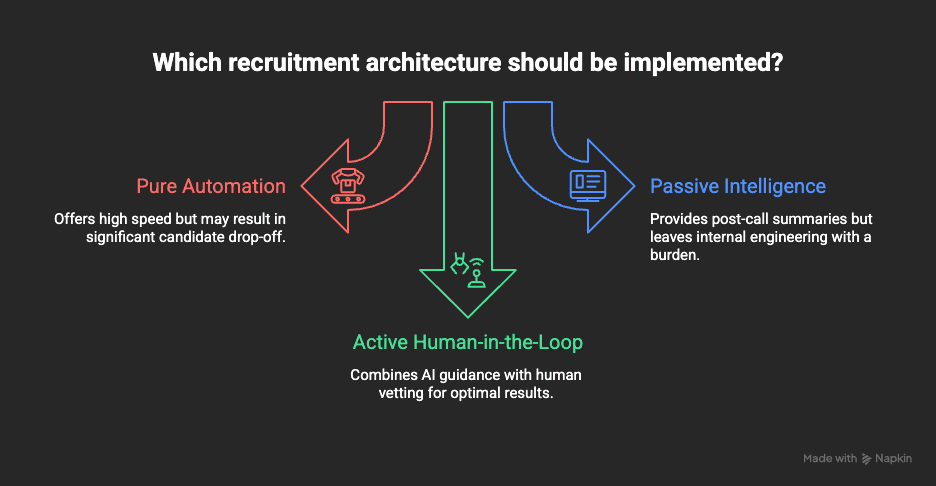
1. Passive Intelligence Platforms (Metaview and Brighthire Alternatives)
Platforms like Metaview and Brighthire function primarily as recorders. They sit in the background of your Zoom or Google Meet calls, transcribe the conversation, and generate post-interview summaries.
The Benefit: They remove manual note-taking and deliver a clean post-hoc record of the conversation.
The Flaw: They are passive observers. They do not guide the quality of the live interview, nor do they fix your core operational bottleneck: your internal engineering managers are still burning dozens of hours every week conducting repetitive, exhausting technical screens. They optimize the record, not the capacity.
Also Read: The Note-Taker Trap: Why Your Hiring Is Stalled to discover why relying solely on passive transcription tools leaves your core engineering capacity unsolved.
2. Pure AI Screening Bots
These tools use AI-generated voices or automated chat widgets to process volume.
The Benefit: Instant vertical scaling and low cost per conversation.
The Flaw: High top-of-funnel drop-off. Top-tier software engineers and product managers frequently refuse to interact with a mechanical script. You lose your ability to pitch your company culture early in the hiring process.
3. Active Human-in-the-Loop Automation (JobTwine)
JobTwine changes the dynamic entirely. Instead of just taking notes on your calls or forcing candidates to talk to an unfeeling script, JobTwine provides an active, modular infrastructure that handles the heavy lifting before, during, and after the conversation.
Comparison: Interview Intelligence vs Human-in-the-Loop Platforms
Category | Interview Intelligence Platforms | Human-in-the-Loop Platforms |
Primary goal | Documentation | Workflow execution |
Notes | Yes | Yes |
Interview guidance | Limited | Yes |
Structured playbooks | Sometimes | Yes |
Candidate scoring | After interview | During interview |
ATS sync | Yes | Yes |
Human interviewer | Required | Human supported by AI |
Workflow automation | Partial | End-to-end |
The Four Pillars That Make JobTwine Stand Out
To truly modernize your workflow while protecting candidate empathy and technical accuracy, an interview intelligence platform must do more than record audio. JobTwine solves the hiring problem through four distinct capabilities:
1. The Smart Playbook Builder
Consistency starts before the call. Our platform ingests your job description and automatically builds a customized, structured evaluation framework. It sets the exact core competencies, seniority-calibrated questions, and scoring parameters so every candidate gets evaluated on a perfectly level playing field.
2. An Active Live Interview Copilot
Unlike passive tools that only help after the call is over, the JobTwine interview copilot lives inside your video environment in real time. It dynamically prompts your interviewer with the next best question based on the playbook, alerts them if a candidate’s response requires deeper technical probing, and auto-captures structured scores as the conversation unfolds.
3. Real-Time Fraud & LLM Detection
With the explosion of generative AI, candidates increasingly use secondary screens to copy-paste interview questions into ChatGPT for real-time answers. JobTwine features built-in, real-time gaze detection, lip-sync verification, and copy-paste tracking. We flag AI-assisted responses instantly during the call, saving your team from advancing unqualified candidates.
4. Vetted Human Interview-as-a-Service (IaaS)
This is the ultimate operational relief. If your internal team lacks the bandwidth to run hundreds of initial technical screens, you can leverage JobTwine’s network of over 800+ global, vetted human technical experts. A live, highly skilled human conducts the interview using your specific playbook, protecting your candidate experience while completely reclaiming your internal team's productive coding hours.
The Operational Blueprint for High-Growth Teams
Modernizing your technical talent pipeline requires standardizing workflows into high-efficiency, human-backed phases:
Phase 1: Automated Playbook Creation
Input the role requirements. JobTwine generates the target competencies, behavioral alignment checks, and coding rubrics instantly.
Phase 2: Vetted Technical Screening
JobTwine handles the calendar scheduling automatically. A live human technical expert runs the call, backed by the AI Copilot and anti-fraud monitoring to ensure absolute evaluation accuracy.
Phase 3: Automated Candidate Shortlisting
Structured, objective scorecards and data-rich interview reports feed straight back into your ATS. Your internal hiring managers only spend time interviewing the absolute top-tier, pre-vetted talent.
Across implementations with engineering teams hiring at volume, the biggest efficiency gains rarely come from AI-generated interview notes. They come from eliminating repetitive first-round scheduling, standardizing interview quality, and ensuring hiring managers only spend time with candidates who have already demonstrated the required competencies.
Conclusion
Modernizing your recruitment workflow does not mean scrubbing away human intelligence or forcing your candidates to talk to empty digital avatars. The most effective talent acquisition teams use automation to strip away operational administrative work, generate objective evaluation data, and protect the human relationship.
If you are ready to see how an active, human-in-the-loop platform reclaims 60% of your engineering team's internal hours while elevating candidate experience, let us show you live. Book a JobTwine Demo Call Today.
FAQs
1. What is recruitment workflow automation?
Recruitment workflow automation uses software to automate repetitive hiring tasks such as interview scheduling, candidate communication, interview scoring, ATS updates, and candidate routing, allowing recruiters to focus on hiring decisions.
2. What is a human-in-the-loop interview platform?
A human-in-the-loop interview platform combines AI automation with recruiter oversight. AI assists with interview guidance, documentation, and scoring, while recruiters remain responsible for evaluating candidates and making hiring decisions.
3. How is an interview copilot different from an interview intelligence platform?
Interview intelligence platforms primarily record, transcribe, and summarize interviews after they occur. Interview copilots actively assist interviewers during live interviews by suggesting questions, capturing structured notes, and supporting competency-based evaluations.
4. Can recruitment workflow automation improve hiring consistency?
Yes. Structured interview guides, competency-based scorecards, and standardized evaluation criteria help reduce variation between interviewers and improve consistency across hiring teams.
5. Does recruitment workflow automation replace recruiters?
No. Most enterprise platforms automate administrative work while recruiters continue making hiring decisions, conducting later interview rounds, and evaluating overall candidate fit.
6. Which companies benefit most from recruitment workflow automation?
Organizations hiring across multiple roles, locations, or hiring managers often benefit the most because automation standardizes interview processes, reduces administrative work, and improves hiring efficiency.