
Looking for Brighthire alternatives? Discover why simple AI note-takers fail and how end-to-end recruitment automation software drops your time-to-hire.

AI note-takers feel like a relief when you first roll them out. Saving your Talent Acquisition (TA) team from typing up hours of interview notes feels like an instant win.
Platforms like Metaview or BrightHire rescue recruiters from the documentation tax. They transcribe conversations and organize text into clean summaries. However, if you are actively researching metaview alternatives or brighthire alternatives, it is usually because you have noticed a frustrating pattern. Your recruiters are still working late. Your time-to-hire remains stuck. Candidates still stall out in the middle of your funnel.
Because you have a process problem.
Automated transcripts give you a clean record of what happened during a conversation. But notes cannot make a decision, check for fraud, or move a candidate to the next stage. When you rely solely on note-taking tools, you fall into The Note-Taker Trap: you spend less time typing, but you spend just as much time managing a broken process.
Why Your Team Is Still Chasing Interviewers
The biggest drain is acting as an administrative project manager. When a standard note-taker creates a summary of an interview, it sits in an inbox waiting for human review. The recruiter still has to:
Slack-ping the hiring manager to approve the draft.
Manually check if the interviewer stuck to the required rubric.
Review the text after the fact to spot potential compliance issues.
Manually update the candidate's stage inside the Applicant Tracking System (ATS).
The note-taker changes how the data is written, but it does not change who has to chase the data down. The administrative burden stays on the TA team.
Why a Transcript Cannot Protect Your Pipeline
A passive recording tool only looks backward. It tells you what happened after the call is already over. This creates two distinct risks for high-volume hiring:
1. Integrity Issues Are Found Too Late
If a candidate uses a proxy or looks up answers on a second screen, a standard note-taker simply transcribes the answers. It does not sound an alarm. Your team only discovers the fraud during a manual audit days later, forcing you to restart the cycle and waste time.
2. Standardisation Is Completely Optional
A note-taker cannot force a human interviewer to follow your structured framework. If the interviewer goes off-script or asks non-compliant questions, the AI will document those errors flawlessly. It creates a formatted record of a flawed interview.
Shift from Passive Documentation to Active Automation
To drop your time-to-hire, you must remove the manual hand-offs between the interview, the integrity check, and the ATS update.
This requires a shift from passive note-takers to an active recruitment automation software platform like JobTwine. True intelligence does not happen after the call; it happens during it. Moving your stack to a complete interview intelligence platform handles the heavy lifting that note-takers leave behind:
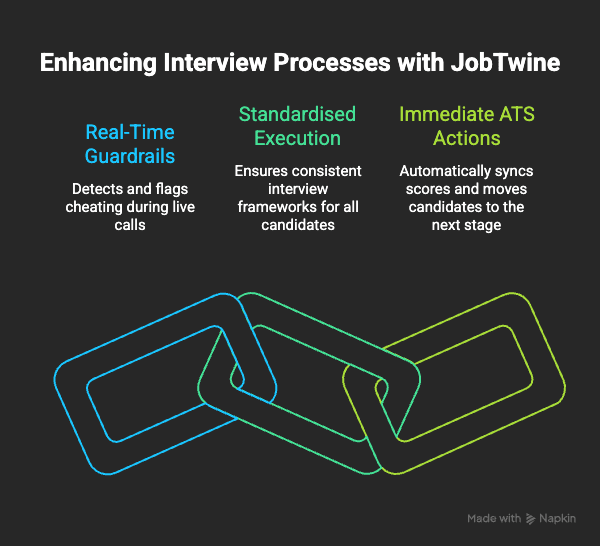
Real-Time Guardrails: Instead of reading a transcript to find cheating hours later, JobTwine handles fraud detection during the live call, instantly flagging tab-switching or external assistance.
Standardised Execution: Features like the JobTwine Interviewer Copilot guide interviewers live, ensuring every candidate faces the exact same structured framework. This removes human bias before the data hits your system.
Immediate ATS Actions: The moment an interview finishes and meets your baseline criteria, the platform syncs the scorecards and moves the candidate to the next stage automatically inside your ATS.
Build a Defensible Audit Trail
From a legal standpoint, enterprise companies cannot rely on AI tools that try to predict candidate capability based on text summaries. You need hard, unchangeable process data.
Before you launch your next high-volume campaign, look at how your tools handle information. You want a system that builds a clear, compliant path from the initial call to the final offer without requiring constant human intervention.
Stop spending your budget on tools that merely document your bottlenecks. Invest in architecture that eliminates them.