
Compare live interview copilot software with asynchronous recorded review tools. Discover which AI interview intelligence model eliminates context drift, speeds up hiring, and improves candidate experience.

Modern hiring pipelines face a persistent challenge: balancing evaluation rigor with candidate velocity. Talent acquisition leaders who have moved beyond manual note-taking often find themselves at a critical technology crossroads: choosing between a live interview copilot and an asynchronous recorded review workflow.
While both approaches leverage artificial intelligence to capture candidate data, they solve fundamentally different operational problems. Choosing the wrong architecture leads to context drift across interview rounds, interviewer fatigue, and elevated drop-off rates among top-tier candidates.
This comparative guide analyzes the structural mechanics, cognitive tradeoffs, and pipeline dynamics of a real time interview copilot versus recorded video review systems—helping you select the right engine for your recruiting tech stack.
Understanding the Core Structural Differences
To evaluate these platforms, talent teams must distinguish between post-hoc document analysis and in-flight conversational guidance.
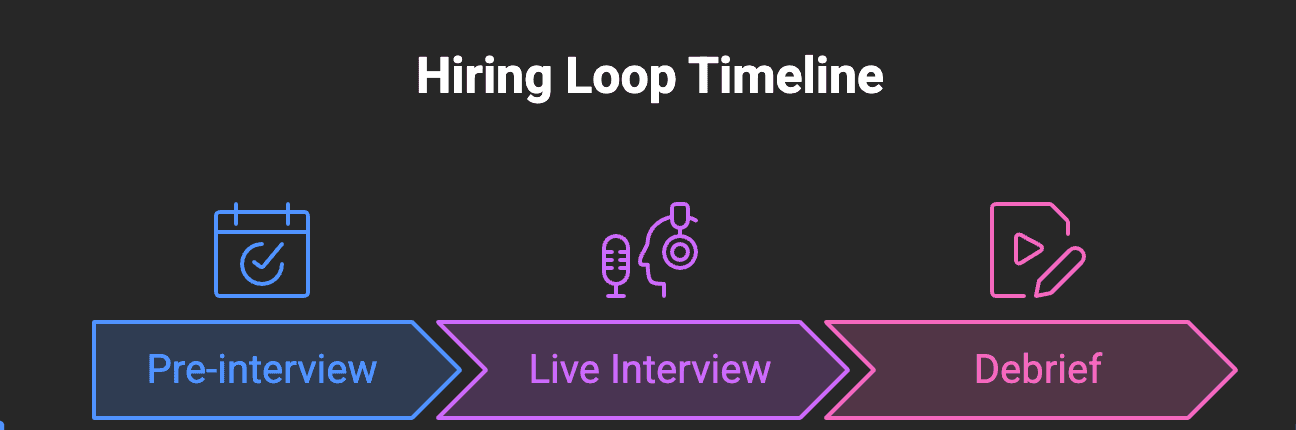
The Recorded Review Model (Post-Hoc Analysis)
A recorded review system acts asynchronously. It records the session, generates a verbatim transcript, and uses large language models (LLMs) post-meeting to produce summaries, sentiment analysis, and timestamped highlights.
How it operates: The interviewer conducts the conversation unassisted. Once the video call ends, the platform processes the media file and delivers a video player paired with an interactive transcript.
Primary objective: Documentation, compliance auditing, and asynchronous feedback sharing across non-attending team members.
The Live Interview Copilot Model (In-Flight Guidance)
A live interview copilot operates as an active evaluation layer inside the video interface (Zoom, Microsoft Teams, Google Meet). It dynamically tracks covered skills, surfaces role-specific follow-up prompts, and links prior round notes in real time.
How it operates: The live interview copilot analyzes the live audio stream alongside the role's competency rubric. It discreetly alerts the interviewer when key skills remain unverified or when a candidate's answer requires deeper probing.
Primary objective: Active bias mitigation, cross-round context carryover, and instant evidence-backed scorecard generation.
1. Context Drift and Cross-Round Alignment
The most costly failure point in enterprise hiring loops is context drift—the breakdown of candidate evidence as a candidate moves from recruiters to functional panels and executive reviewers.
The Recorded Review Gap
When relying on recorded reviews, context transfer remains manual. A round-three interviewer rarely watches 45 minutes of recorded video from round two. At best, they skim a generated summary. Consequently:
Candidates are repeatedly asked identical background questions.
Critical technical gaps flagged in round one remain unverified in final rounds.
Panelists score candidates based on isolated impressions rather than cumulative proof.
The Real Time Interview Copilot Solution
A real time interview copilot acts as a thread connecting every stage of the hiring loop. Before the conversation begins, the copilot synthesizes notes from earlier rounds and presents a concise briefing:
"Round 1 confirmed System Design basics. Probe deeper on distributed caching and database sharding during this session."
During the call, the copilot continuously checks off verified skills against the job description. This eliminates redundant questioning, respects the candidate's time, and ensures every panelist contributes unique diagnostic value to the evaluation.
For teams aiming to refine their evaluation design, our guide on [Your Website/building-structured-hiring-rubrics] offers frameworks for mapping competencies across multi-stage loops.
2. Interviewer Cognitive Load and Candidate Engagement
Interviewing is a demanding double-task. An unassisted interviewer must actively listen, formulate insightful follow-ups, evaluate technical logic, and take detailed notes—all while maintaining warm eye contact.
Recorded Review: High In-Meeting Burden
Recorded review systems relieve the post-meeting documentation burden by auto-generating summaries. However, during the call itself, the interviewer is still on their own. If a candidate provides a vague answer regarding project ownership, the interviewer must notice the ambiguity, remember to push for specifics, and manually keep track of time constraints.
Live Interview Copilot: Low Cognitive Load
An interview copilot serves as a second driver in the room. Because the system transcribes and categorizes evidence live, interviewers can close their notepad windows and engage directly with the candidate.
If the candidate shares a STAR-method response that skips the measurable outcome ("Results"), a live interview copilot discreetly highlights the missing element, prompting the interviewer to ask: "What was the metric impact of that deployment?"
According to research published by the Society for Human Resource Management (SHRM), structured interviewing supported by standardized evaluation criteria significantly improves prediction accuracy while reducing subjective bias.
3. Speed-to-Hire and Debrief Efficiency
Time-to-fill directly affects engineering velocity and revenue operations. Delaying scorecards by even 24 hours increases the probability of losing top-tier candidates to competing offers.
Feature / Dynamic | Asynchronous Recorded Review | Live Interview Copilot |
Primary Interaction Point | Post-interview video playback & transcript analysis | In-meeting guidance & real-time competency tracking |
Context Carryover | Manual skimming of prior session summaries | Automated cross-round gap synthesis & live briefing |
Scorecard Completion Time | 2 to 24 hours post-call | Instantly pre-filled upon call completion |
Interviewer Focus | Split between conversation & manual note-taking | 100% focused on candidate rapport and deep probing |
Candidate Drop-Off Impact | Higher risk due to repetitive multi-round questions | Lower risk; fast, tailored, and progressive candidate experience |
Stores recording URLs and static transcript links | Pushes quote-backed competency ratings directly to ATS scorecards |
The Post-Meeting Playback Trap
With recorded reviews, talent teams often fall into the "asynchronous playback trap." Instead of writing scorecards immediately, busy hiring managers push evaluation work to the end of the day or week. They must then re-watch portions of a 60-minute video or read dense transcripts to piece together their feedback, introducing substantial decision latency.
Instant Scorecard Generation
A real time interview copilot generates an evidence-backed draft scorecard the moment the video call ends. Ratings are automatically mapped to role-specific rubrics and backed by direct candidate quotes. The hiring manager simply reviews, adjusts, and approves the scorecard in under two minutes, syncing it directly into ATS platforms like Greenhouse, Workday, or Lever.
Strategic Decision Matrix: Which Architecture Fits Your Pipeline?
Neither solution is universally superior; selection depends on your organization's hiring volume, technical complexity, and recruiting team structure.
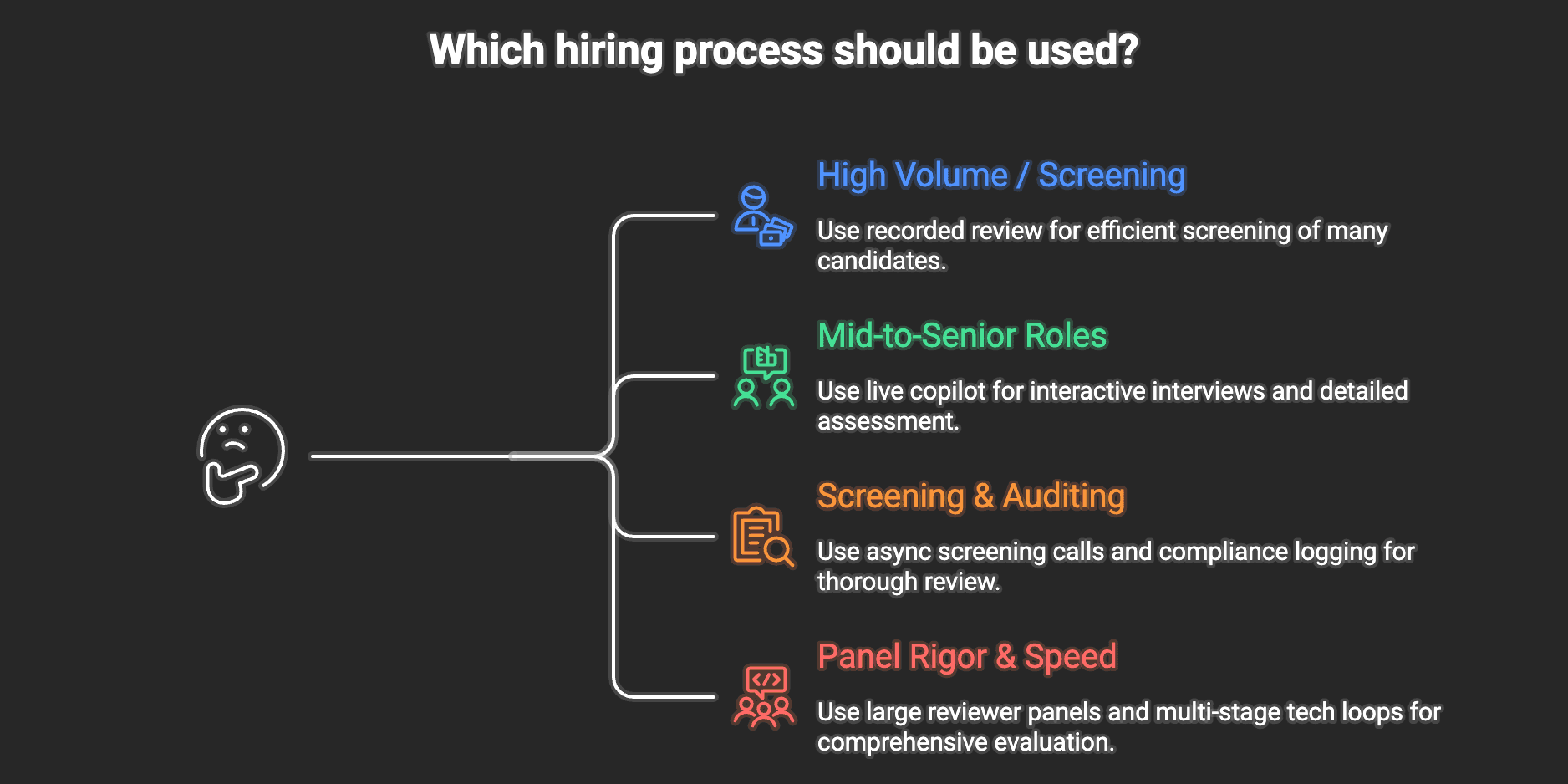
When Recorded Review Fits Best
Asynchronous Initial Screening: Early-stage volume screening where candidate responses are reviewed asynchronously before scheduling live panel interviews.
Quality Assurance & Training: Organizations focused on training junior recruiters by having senior staff review raw call footage after the fact.
Strict Compliance Auditing: Legal frameworks requiring exact video logs of candidate interactions for regulatory record-keeping.
When Live Interview Copilot Fits Best
Technical & Specialized Hiring: Engineering, product, and enterprise sales roles where deep probing and technical validation require active focus.
Multi-Stage Panel Loops: Complex hiring loops where preventing repetitive questions across rounds is critical to candidate experience.
Competitive Executive Recruitment: Senior hiring where slow offer turnaround times result in lost executive talent.
Decentralized Hiring Teams: Engineering or business units where non-recruiter panelists require live guardrails to maintain interview structure and compliance.
FAQs: Operational & Compliance Nuances
The following frequently asked questions address enterprise security, candidate privacy, and integration architecture considerations not typically covered in general overviews.
How do live interview copilots maintain candidate privacy and data compliance under GDPR/CCPA?
Enterprise-grade interview copilot platforms utilize real-time local encryption and transient memory processing. Unlike standard meeting bots that record and store raw video/audio files indefinitely, live copilots process audio streams in memory to extract text evidence, mapping it directly to scorecards. Once the scorecard syncs to your ATS, the raw ephemeral stream can be automatically purged according to your company's data retention policies, minimizing storage risk under regulations enforced by the European Data Protection Board (EDPB).
Will using a live interview copilot distract the interviewer during high-stakes technical sessions?
No. High-performing live interview copilot tools feature minimalist, edge-anchored interfaces designed specifically for low visual cognitive load. Rather than displaying continuous scrolling text, they surface subtle visual badges (e.g., green checkmarks for covered competencies, muted notifications for unverified gaps). This design ensures the interviewer maintains visual connection with the candidate while benefiting from structured real-time prompts.
Can a real time interview copilot detect technical depth in software engineering or domain-specific interviews?
A real time interview copilot tracks whether key concepts (e.g., microservices architecture, concurrency, unit testing) were discussed and evaluates response structure. However, it does not replace expert engineering judgment. Instead, it ensures the interviewer systematically asks the candidate to explain design tradeoffs, capturing exact quote snippets so technical leads can verify depth during debriefs.
How do live copilots handle candidate accents, fast speech, or multi-lingual panels?
Modern live interview copilot software leverages multi-lingual transformer speech-recognition models tuned specifically for technical vocabulary and diverse accents. By filtering out conversational acoustic noise and focus-indexing key industry terms, these models maintain transcript accuracy above 95% across global hiring loops.
What is the ROI differential between implementing a live copilot versus a post-hoc recorded review platform?
While recorded review tools primarily save time on post-meeting transcription skimming, a live interview copilot targets the entire hiring pipeline yield. According to talent acquisition benchmarks reported by Harvard Business Review, structured real-time evaluation reduces bad-hire rates by up to 30% and decreases offer drop-offs by accelerating scorecard turnaround times from days to minutes.
Transform Your Hiring Loop with Real Time Intelligence
Choosing between a live interview copilot and a recorded review system comes down to where you want your hiring advantages: post-hoc administrative convenience or in-flight diagnostic precision.
If your team struggles with context drift across rounds, slow debriefs, and inconsistent candidate evaluations, migrating to a real-time copilot architecture delivers immediate pipeline ROI.
Ready to eliminate context drift and elevate your candidate experience? Explore how our live interview copilot platform integrates directly with your existing ATS to streamline panel evaluations today.