
Can AI hiring platforms reduce bias? Explore the data on algorithmic bias and learn how structured playbooks, AI interviews, and transparent scoring can support fairer hiring.

Over the last several years, the promise of the ai hiring platform was sold to human resources executives as a silver bullet: replace flawed human intuition with objective machine logic, and unconscious bias will instantly vanish.
Yet, as candidate-side artificial intelligence floods pipelines with hyper-optimized resumes, talent acquisition leaders face a stark dilemma. A survey conducted by Gartner reveals that only 26% of job candidates trust AI to evaluate them fairly. Meanwhile, academic audits confirm that uncalibrated algorithms often replicate historical human prejudices at scale.
This raises a fundamental question: can ai hiring platforms reduce bias, or do they simply automate it?
Data from top management consultancies, industry research bodies like SHRM, and academic studies confirm that software alone does not eliminate bias. However, when engineered around structured competency playbooks and transparent evaluation logic, an ai hiring platform can significantly outperform human-only screening.
At JobTwine, we build agentic interview intelligence systems. We analyze screening data across thousands of hiring rounds to help talent acquisition leaders build fair, data-driven candidate pipelines.
Below is an executive breakdown of what current research reveals about algorithmic bias, where legacy tools fail, and how modern talent teams build truly objective hiring workflows.
The Core Dilemma: Unconscious Human Bias vs. Algorithmic Replication
The Raw Data: Human Intuition Is Deeply Flawed
To understand whether technology can reduce bias, talent acquisition heads must first confront the baseline error rate of human-driven hiring.
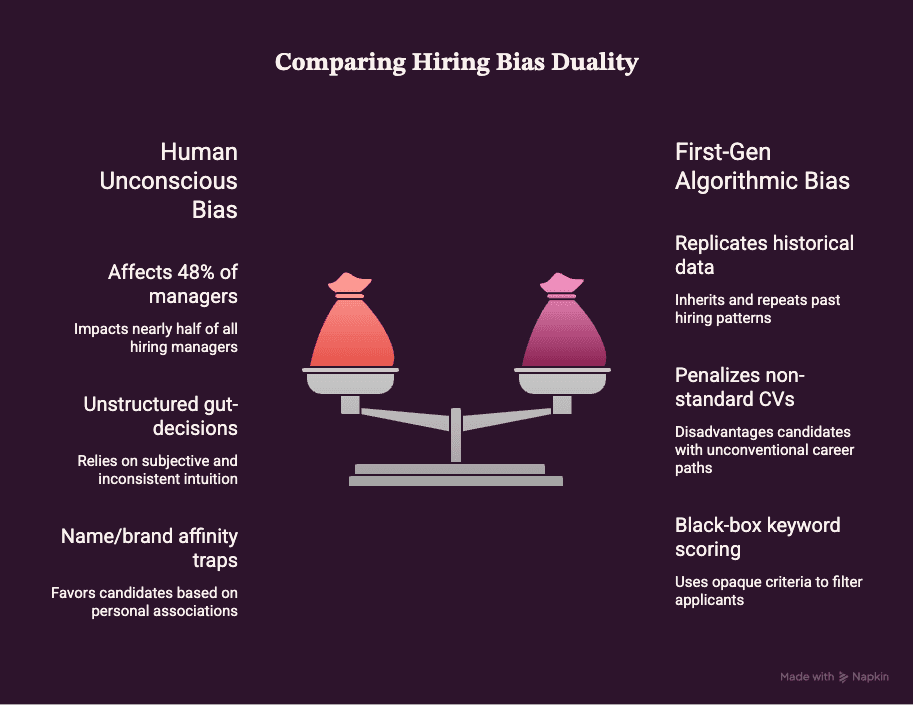
Research published by the Society for Human Resource Management (SHRM) shows that 48% of HR managers admit unconscious bias influences their hiring decisions. This bias manifests early in the funnel: classic audit studies demonstrate that resumes with white-sounding names receive 9% more callbacks than identical resumes with Black-sounding names.
Furthermore, unstructured interviews exacerbate these biases. When hiring managers rely on "gut feeling" or conversational flow, they routinely hire for rapport over skill. The financial cost is steep:
The U.S. Department of Labor estimates the cost of a bad hire at up to 30% of an employee's first-year salary.
Managers waste roughly 26% of their time coaching underperforming, mismatched hires.
The Takeaway: Human-only hiring is not an unbiased control group; it is an unstandardized process prone to subjective error.
Why First-Generation AI Sourcing Tools Failed the Equity Test
Early attempts to automate screening relied on supervised machine learning trained on historical company data. The logic seemed sound: feed 10 years of top-performer resumes into a model and let it identify winning patterns.
However, training models on historical hiring data reproduces historical hiring biases. If a company historically hired male engineers from specific universities, the algorithm learned to penalize female applicants or candidates with non-traditional educational backgrounds.
Evaluation Metric | Legacy Keyword AI | Modern Agentic AI |
Training Source | Historical Resumes | Role Competencies |
Primary Focus | Credentials & Titles | Live Demonstration |
Educational Bias | High (Filters pedigree) | Zero (Scored on skill) |
Candidate Experience | One-way passive screening | Interactive, 2-way conversation |
Fraud Prevention | Minimal / Post-hoc | Real-time behavior verification |
Auditability | Black-box matching score | Transparent, rubric-based scorecard |
A study on recruitment software showed that uncalibrated keyword screeners exhibited measurable gender bias up to 44% of the time. Legacy systems evaluated who the candidate was on paper rather than what the candidate could actually do.
How Modern Agentic Platforms Eliminate Bias at Scale
Modern platforms overcome these limitations by replacing keyword parsing with structured competency evaluation.
Rather than reviewing static resume claims, an agentic ai hiring platform tests candidates against calibrated job requirements:
A. Standardized Playbooks Replace Unstructured Questions
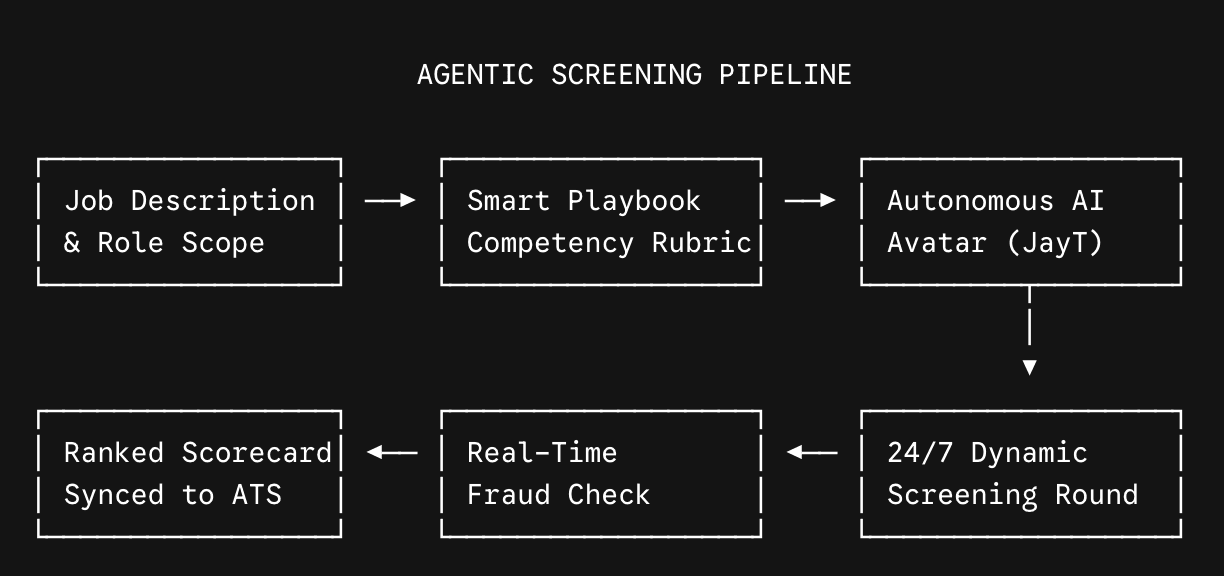
Platforms like JobTwine use smart playbook generators to translate job descriptions into structured interview rubrics. Every applicant answers the exact same core competency questions, eliminating off-script tangents where affinity bias thrives.
B. Autonomous First-Round Screening
Instead of a recruiter scanning a resume for 6 seconds, an autonomous AI avatar—such as JobTwine's JayT—conducts interactive, two-way initial interviews 24/7 across 16+ languages. JayT evaluates problem-solving depth against pre-set rubrics without knowledge of age, gender, or ethnicity.
C. Real-Time Copilots for Human Panel Rounds
During live video interviews, an Interviewer Copilot guides human managers in real time. It displays standardized questions, suggests follow-ups, and enforces objective scoring rules to keep the panel focused on job-relevant skills.
The Regulatory Imperative: Auditability and Transparency
Under legislation like the EU AI Act and local municipal audit mandates, employers using automated evaluation tools must prove algorithmic fairness.
To remain compliant, talent acquisition leaders reviewing ai hiring platform reviews must look for three non-negotiable features:
Explainable Scoring Logic: The platform must explain why a candidate received a specific score based on clear rubric criteria.
Built-In Anti-Fraud Verification: With candidate-side generative AI usage at an all-time high, platforms must detect real-time teleprompter reading, tab switching, and LLM prompting without unfairly penalizing neurodivergent speech patterns.
Independent Bias Audits: Vendors must provide third-party audit data proving their evaluation algorithms comply with EEOC guidelines and international equity standards.
Summary Checklist: Evaluating Platform Objectivity
When researching software across ai hiring platform reviews, use this framework to verify if a tool actually reduces bias:
Evaluation Feature | Legacy ATS / Keyword Tool | Agentic AI Hiring Platform |
Primary Evaluation Method | Resume keyword matching | Live competency demonstration |
Interview Structure | Unstructured, manager-dependent | Standardized playbooks & rubrics |
Bias Mitigation | Blind resume masking only | Objective scoring & live copilot guidance |
Screening Consistency | Variable recruiter availability | 24/7 autonomous avatar screening (JayT) |
Compliance & Audit Trail | Black-box keyword scoring | Transparent, explainable scorecard logs |
Conclusion: Combining Algorithmic Consistency with Human Judgment
So, can AI hiring platforms reduce bias?
The data shows that technology alone cannot eliminate bias if it simply automates historical resume screening. However, when an ai hiring platform uses structured playbooks, autonomous screening avatars, and live copilot guidance, it removes subjective guesswork from candidate evaluation.
By shifting from passive keyword filtering to agentic competency evaluation, talent teams can protect their hiring bar, satisfy global compliance mandates, and deliver a fair candidate experience.