
Every recruiting tool calls itself an "AI hiring platform" now. Here's why the label means nothing and the one question that still does.

Every recruiting vendor calls itself an AI hiring platform now. The tool that records your Zoom calls and writes a summary, AI hiring platform. The voice bot that calls a candidate at 9pm and asks three scripted questions, also an AI hiring platform. The enterprise suite with live video interviews and fraud detection, same label. Even Spark Hire, which says outright that it won't let AI make hiring decisions, shows up in "best AI hiring tools" lists next to the bots running the whole interview.
Because the label has no fixed meaning,and that ambiguity costs money. Vendors get full commercial credit for automating the easy 10% of your funnel (parsing resumes and writing call summaries), while you remain buried in the manual 90% (reading between the lines on screening calls and chasing ghosting candidates).
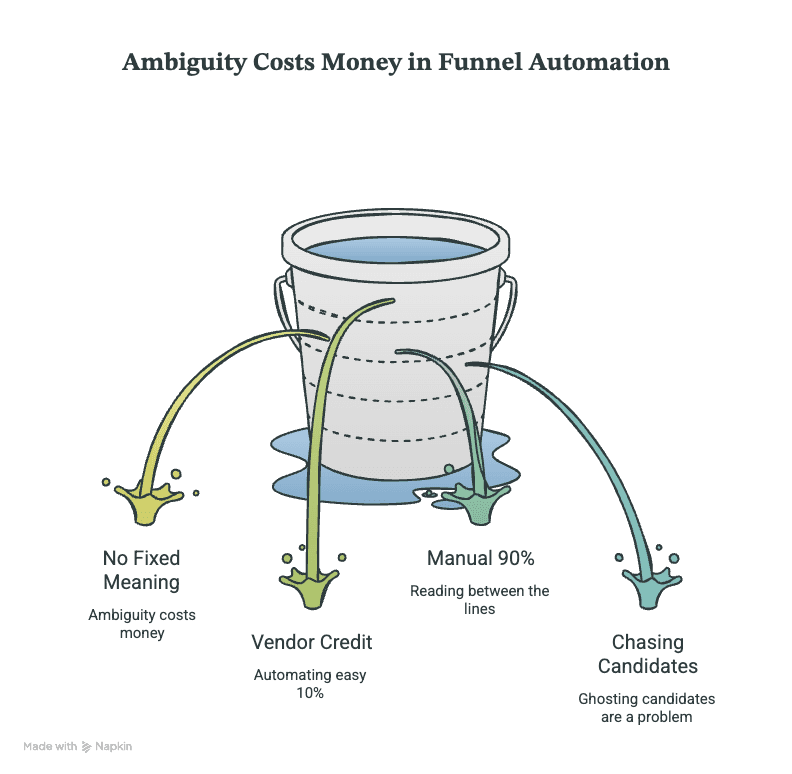
What a Term With No Definition Actually Costs You
When a single search for "AI hiring tools" returns a transcription notepad, a 24/7 robotic dialer, and an end-to-end interview pipeline all wearing the same label, sorting out the noise costs you real operational resources:
Evaluation hours: Every vendor call starts from absolute zero because the generic category tells you nothing the homepage doesn't already oversell.
A wasted pilot: Greenlight the wrong tool and you will spend an entire quarter discovering it only automated a step that was never your actual bottleneck.
Credibility with leadership: You pitched a platform to fix time-to-hire; now you are stuck explaining to the executive team why the needle did not move.
A 3-month pilot should not end with the exact same workload and a new software budget line you now have to defend. Stop asking whether a tool "uses AI." Ask which specific step it removes from your week, and whether that step was ever the one eating your time.
A label that means everything to vendors and nothing to buyers is a costume.
What's Actually Behind the Wrapper that companies call AI Hiring Platform
Strip the marketing language off the tools usually filed under AI hiring tools and you get five different products:
What it's called | Examples | What it actually does | What it doesn't do |
Records and analyzes interviews a human is already running | Doesn't conduct an interview or move a candidate forward | ||
Voice screening bots | Calls every candidate and runs a scripted conversation, 24/7 | Stops at a transcript — a recruiter still reads it and decides | |
Full enterprise suites | Interviews, scheduling, and fraud checks in one platform | Enterprise pricing, slow setup, thinner audit trail than advertised | |
AI-assisted, not AI-decided | One-way video with AI transcription | Won't let AI make or suggest a hiring decision, by design | |
Interviewer + proctor | Runs the interview and flags likely cheating | Also runs an unrelated AI-data-labeling business under the same brand | |
End to end | Runs the interview, checks for fraud in real time, and moves the candidate's ATS stage automatically | Nothing left to hand off — interview, integrity check, and decision happen in one pass |
Every one of these calls itself an AI hiring platform somewhere on its own site. They are not solving the same problem.
Shifting Focus from Processing Speed to Actionable Evidence
Forget AI versus no AI. The only split worth caring about is evidence versus speed.
To transition from a simple keyword parser to a true, predictive AI recruiting platform, the system must produce actionable, verifiable capability data. On your next demo, ask the vendor for a real candidate output — not a mockup, an actual one. Then check what lands on your screen:
If you're looking at speed, the output is one of these:
A sentiment or confidence score with no breakdown of what produced it
A culture-fit percentage
A summarized transcript with no link back to a specific skill or task
A green/yellow/red flag with no reasoning attached
If you're looking at evidence, the output is one of these:
A recording of the candidate actually doing something — solving a problem, writing code, walking through a real scenario
A graded work sample tied to the job, not a generic personality test
A pass/fail on a named competency, with the specific moment in the interview that earned it
If what you got handed was the first list, the tool got you to a guess faster. If it was the second, you have an interview intelligence platform output you could defend to a hiring manager or in a legal audit.
Greenhouse's 2025 research found that only 8% of job seekers think AI makes hiring fairer, while 70% of hiring managers say they trust it to make faster, better calls. That gap is that most of what they are experiencing is the first list: a faster opinion about them, with no visible proof behind it. If your tool only ever produces speed, you are asking candidates to trust a process they have every reason not to, in states that are starting to legally require you to show your work.
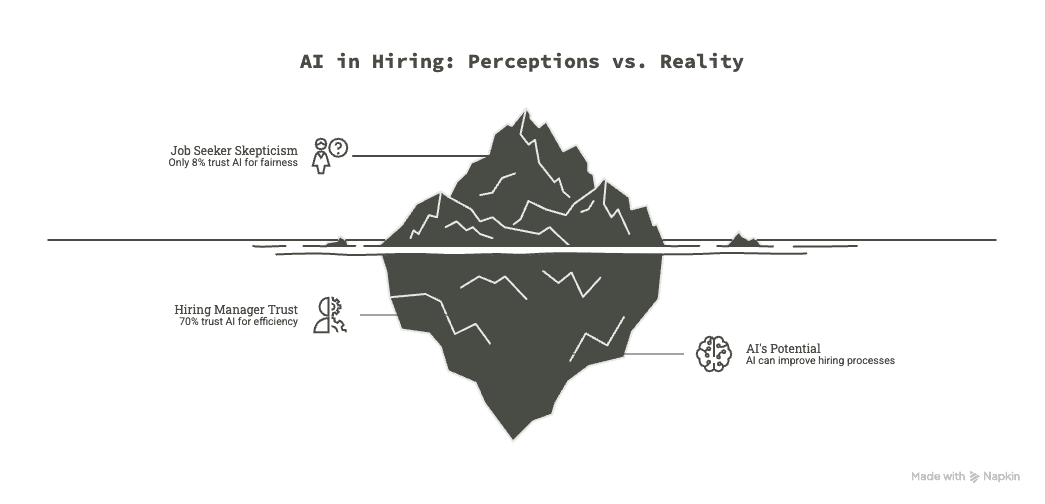
The Interview Gap Test
Skip the demo small talk. Run any tool claiming to offer AI recruitment intelligence through three questions:
Does it close the gap between resume and evidence, or just digitize the resume? Faster keyword matching is still keyword matching.
Does it act on what it finds, or hand you another dashboard? If a human still reads the output and moves every candidate by hand, the platform automated the paperwork, not the decision.
Does it check what it's been told, or trust it by default? No answer for AI-coached answers or identity mismatches means the score is built on data nobody checked.
Pass all three, and the label stops mattering, you already know what you're buying. Fail all three, and no amount of "AI-powered" copy changes the fact that it's the same manual process, dressed up.
FAQ
Is an AI hiring platform the same as an ATS?
No. An ATS like Greenhouse or Lever holds your candidate records. An AI hiring platform plugs into it to source, screen, or interview — and the good ones write results back in, not just read from it.
Do AI interview tools remove bias?
They reduce some of the inconsistency that drives bias in unstructured human interviews. They don't remove bias — several audited tools have introduced their own. "Reduces some inconsistency" is the honest claim. "Removes bias" isn't.
Is it legal to use AI to interview candidates in the US?
Generally yes, with growing disclosure rules. New York City already requires bias audits and candidate notice for automated hiring tools, and more states are following. This isn't legal advice — check what applies in your state before deploying.