
Can an AI avatar interview accurately evaluate software engineers? Discover how AI avatar technical interview platforms measure code quality, logic, and system thinking.

An AI Avatar Interview evaluates candidate technical competency by combining natural language processing, dynamic rubric probing, and structured code analysis. While avatars cannot replace late-stage human system design debates, an AI avatar technical interview platform accurately measures core data structures, algorithmic logic, and architectural reasoning during early screening, saving engineering teams over 80% of manual screening hours.
Can an AI Avatar Interview Accurately Evaluate Complex Engineering Capabilities?
Yes, an ai avatar interview effectively evaluates baseline engineering capabilities when configured with structured scoring rubrics and adaptive probing logic. Rather than grading candidates on memorized syntax, modern avatars ask candidates to explain trade-offs, refactor suboptimal code, and justify architectural decisions in real time.
Engineering recruitment suffers from a persistent operational bottleneck: senior developers spending 5 to 10 hours per week screening candidates who lack essential technical foundations. When high-volume engineering roles receive hundreds of applicants, talent acquisition teams traditionally rely on static coding tests or brief recruiter phone screens. Neither approach effectively measures how a candidate thinks, communicates, or solves problems.
An AI avatar technical interview platform bridges this gap by conducting interactive, face-to-face technical screening conversations autonomously. Powered by specialized conversational engines, the avatar presents technical scenarios, asks follow-up questions when responses lack detail, and evaluates candidate reasoning against calibrated rubrics.
However, AI avatars are not designed to eliminate human engineering leadership from final hiring decisions. Their true value lies in converting uncalibrated early-stage candidate chatter into standardized, evidence-backed evaluation scorecards before senior engineers step in.
How Does an AI Avatar Technical Interview Platform Work Under the Hood?
An ai avatar technical interview platform operates through four coordinated technical layers: speech recognition, conversational intelligence, lifelike avatar rendering, and rubric-driven evaluation engines. These layers analyze spoken answers and submitted code simultaneously to generate explainable candidate scorecards.
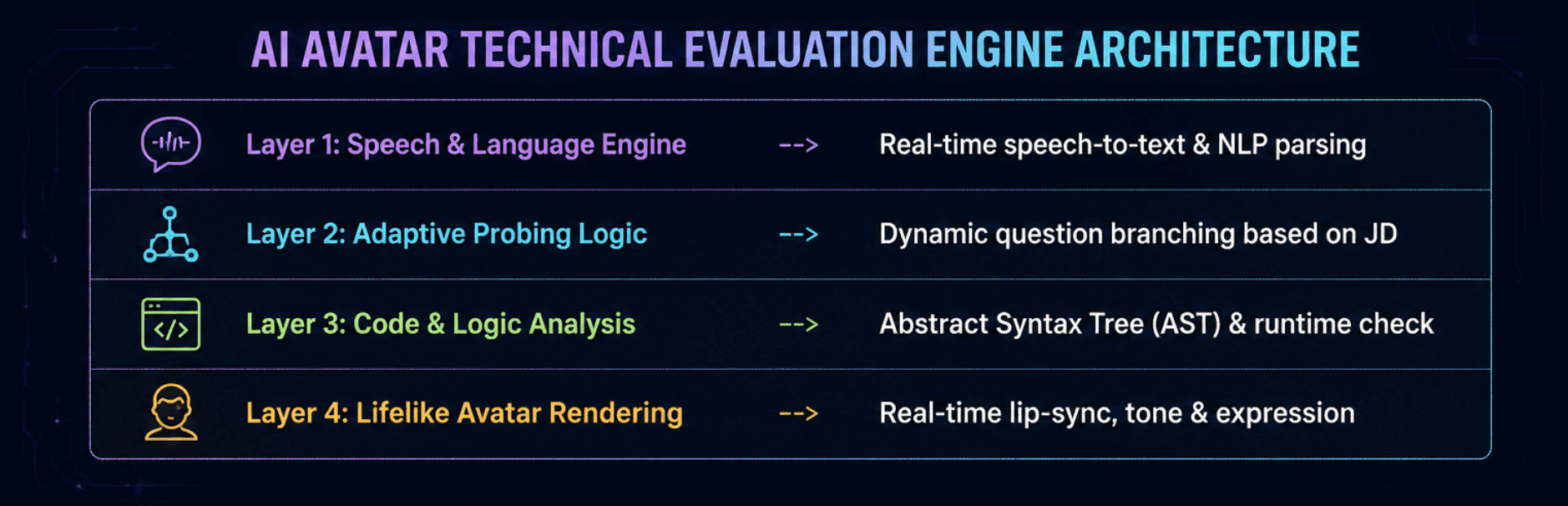
1. Speech Recognition and Semantic NLP Parsing
When a candidate speaks, speech-to-text models process audio streams into structured text at low latency. Natural Language Processing (NLP) models then analyze the semantic meaning of the candidate's explanation, checking for key domain concepts, architectural terms, and logical sequences.
2. Adaptive Probing and Follow-Up Logic
Unlike static video recordings that follow rigid scripts, ai avatar technical interview automation software adapts to candidate answers. If a candidate provides a brief overview of an API implementation, the avatar detects missing criteria—such as error handling, concurrency, or database caching—and prompts: "How would your service handle unexpected spike traffic or network timeouts?"
3. Code Parsing and Runtime Evaluation
In technical screening modules, the candidate writes or refactors code inside an integrated environment while explaining their logic to the avatar. The engine evaluates code efficiency (Big-O time and space complexity), edge-case handling, and structural cleanliness using Abstract Syntax Tree (AST) parsing.
4. Real-Time Avatar Rendering and Lip-Sync
The visual avatar provides an approachable, conversational interface featuring synchronized lip movements, natural pacing, and multi-language support. This visual presence gives candidates a structured, interactive format that feels more engaging than plain text forms or silent timers.
What Are the Differences Between AI Avatars, Asynchronous Video, and Static Coding Tests?
Static coding tests measure isolated syntax, while asynchronous video tools capture static recorded clips. An ai avatar technical interview platform combines conversational engagement with technical analysis, allowing dynamic probing into candidate decision-making.
TECHNICAL SCREENING FORMAT COMPARISON MATRIX
Evaluation Variable | Static LeetCode/Coding Tests | Asynchronous Video Screening | AI Avatar Technical Interview Platform |
Primary Focus | Algorithmic puzzle solving | One-way communication & soft skills | Conversational technical reasoning & code explanation |
Candidate Probing | None (Static pass/fail) | None (Fixed question list) | Real-time adaptive follow-ups based on rubrics |
Cheating & AI Fraud Risk | High (LLM code generation) | Moderate (Off-screen scripts) | Low (Integrated telemetry, gaze & audio biometrics) |
Candidate Drop-Off | High (Sterile, high-stress format) | High (Awkward talking to camera) | Low (Interactive, face-to-face dialogue) |
Engineering Time Saved | High | Low (Recruiters must watch hours of video) | High (Instant ATS scorecards & summaries) |
The JobTwine Technical Avatar Evaluation Framework
JobTwine’s Technical Avatar Evaluation Framework structures technical screens into four standardized phases: Job Description Playbook Generation, Autonomous Avatar Interview, Multi-Vector Fraud Detection, and ATS-Ready Evidence Delivery. This workflow ensures every candidate undergoes an identical, objective evaluation.
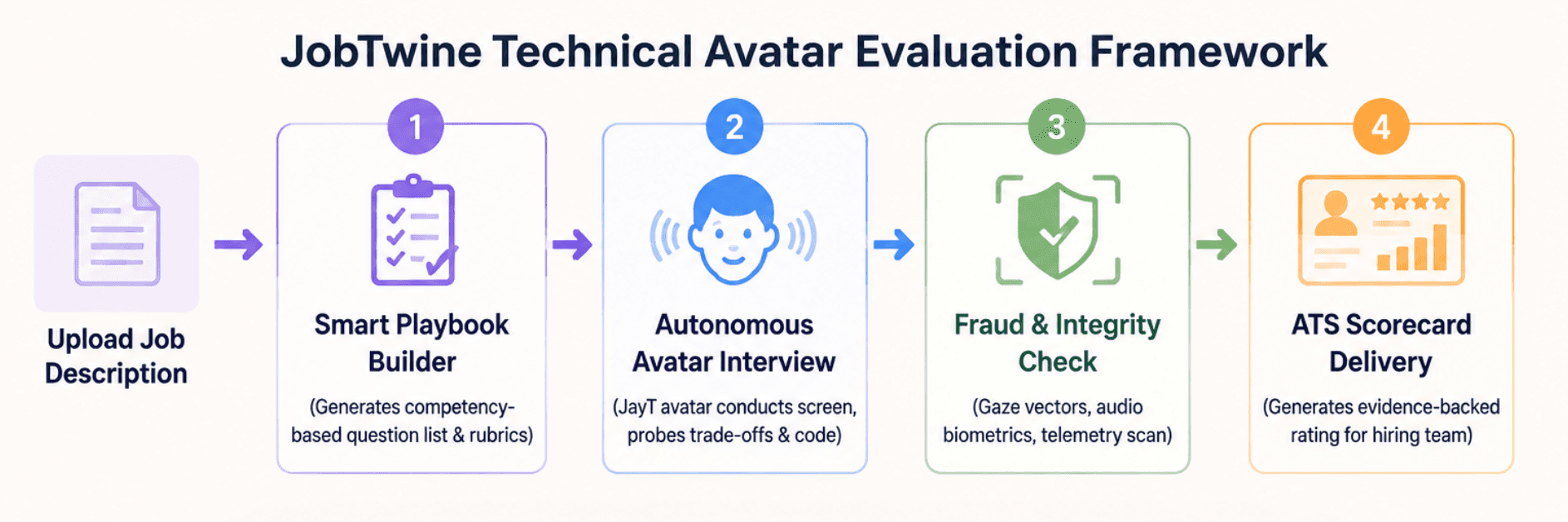
Phase 1: Smart Playbook Generation
The recruiting team uploads a job requisition or job description. JobTwine’s AI Smart Playbook Builder automatically identifies core technical competencies, calibrates question difficulty to the role seniority level, and constructs structured evaluation rubrics.
Phase 2: Autonomous Interactive Interviewing
The AI avatar (such as JayT) conducts 1st-round technical screening 24/7 in 16+ native languages. The avatar asks core technical questions, evaluates code submissions, and asks follow-up questions whenever a candidate's answer lacks sufficient depth.
Phase 3: Integrated Integrity and Anti-Cheat Monitoring
Throughout the interview, automated proctoring features scan for proxy candidates, off-screen teleprompter reading via gaze tracking, and real-time LLM browser usage.
Phase 4: ATS Scorecard Generation
Immediately following the call, the platform synthesizes transcripts and code submissions into a structured scorecard. Candidates are ranked transparently against the job playbook, with detailed notes exported directly into 50+ mainstream ATS platforms (such as Greenhouse, Lever, Workday, and BambooHR).
To project potential team savings using this framework, calculate your metrics using the official JobTwine Interactive ROI Calculator.
What Are the Limitations and Risks of Using AI Avatar Technical Interview Automation Software?
Key limitations of avatar screening tools include potential candidate discomfort with synthetic avatars, risk of algorithmic bias if uncalibrated, and legal compliance obligations under privacy statutes. Organizations mitigate these risks through transparent candidate disclosures, accommodation options, and human review.
1. Candidate Perception and Adoption
Some candidates, particularly senior engineering leads, may find talking to a synthetic avatar unfamiliar during initial screens. Offering clear pre-interview preparation guides and explaining how automated screening accelerates hiring timelines improves candidate adoption.
2. Algorithmic Bias and Training Calibration
If an evaluation model is trained on biased historical hiring data, automated scoring can perpetuate underlying disparities. To maintain fairness, platforms should utilize skill-focused, de-identified rubrics that evaluate concrete problem-solving evidence rather than accent, tone, or subjective speech mannerisms.
3. Regulatory and Data Privacy Compliance
Deploying automated hiring tools requires strict compliance with privacy frameworks, including the EU AI Act, EEOC Title VII guidance, NYC Local Law 144, and India's DPDP Act. Employers must provide transparent candidate consent prompts, offer alternative evaluation pathways, and maintain full human oversight over final outcomes..
How Should Engineering Teams Implement AI Avatar Screening Without Damaging Candidate Experience?
Engineering teams succeed by using AI avatars exclusively for early-stage Round 1 technical screening while keeping human engineers in final system design rounds. Clear candidate communication and instant interview scheduling maximize satisfaction.
Implementation Best Practices:
Define Clear Evaluation Boundaries: Reserve AI avatars for 1st-round screening (verifying core technical skills, language proficiency, and fundamental architecture knowledge). Route top-ranked candidates directly to live human interviews for advanced architectural and cultural alignment rounds.
Eliminate Scheduling Delays: Allow candidates to complete their avatar screen on demand at their convenience, eliminating multi-day scheduling back-and-forth.
Maintain Human-in-the-Loop Governance: Ensure hiring managers review the structured scorecards, video snippets, and transcripts generated by the avatar before rejecting or advancing applicants.
Use Live AI Copilots in Human Rounds: Extend AI intelligence into later rounds using tools like JobTwine's AI Interviewer Copilot, which assists human engineering leads with real-time playbook guidance and automated note-taking during live calls.
Conclusion: Elevating Engineering Recruitment Quality
An AI avatar technical interview platform serves as an effective multiplier for modern recruiting teams. By taking over repetitive early-stage technical screening calls, avatars evaluate candidate problem-solving logic, code structure, and communication skills with consistent objectivity.
When combined with human-in-the-loop oversight and clear candidate disclosure, deploying ai avatar technical interview automation software reduces cost-per-hire, accelerates time-to-offer, and protects valuable engineering time.
Strategic Frequently Asked Questions (FAQ)
Can I evaluate live coding and software architecture during an AI avatar interview?
Yes. Modern avatar interview platforms integrate live coding environments and architecture drawing boards alongside conversational avatars. Candidates write code or explain system design trade-offs while the avatar evaluates both the output syntax and spoken reasoning against role rubrics.
How does an AI avatar handle candidate accents or non-native English speakers?
Advanced avatar platforms utilize multi-lingual natural language processing models calibrated across diverse global accents and speech patterns. By evaluating response content and semantic reasoning rather than phonetics, the engine maintains unbiased, objective scoring.
Should I replace human engineering managers with AI avatars during technical hiring?
No. AI avatars should conduct early Round 1 technical screening to filter unqualified applications. Human engineering leads should remain focused on late-stage technical system design, team culture alignment, and candidate closing.
What happens if a candidate attempts to game or cheat an AI avatar interview?
Integrated anti-cheat telemetry monitors the interview environment in real time. Systems track window focus events, clipboard paste activity, gaze vector anomalies, and voice biometrics to detect proxy test-takers or hidden AI assistance.
Accelerate Your Engineering Hiring Today
Ready to eliminate screening bottlenecks and save your engineering team hundreds of interview hours every quarter?
Book a Personalized JobTwine Demo to experience our JayT AI Avatar Recruiter, Smart Playbook Builder, and live AI Interviewer Copilot in action.