
Compare AI hiring tools for lifelike avatar interviews, screening automation, candidate engagement, fraud detection and end-to-end recruiting workflows.

AI hiring tools with lifelike avatar interviews use conversational AI to conduct candidate screening, ask contextual follow-up questions and capture structured interview data at scale. The strongest platforms combine the avatar experience with recruiting workflows, interview playbooks, fraud detection and ATS integrations rather than treating video interviewing as an isolated recording tool.
TL;DR
AI avatar interviews feel human only when they use intelligent probing, real-time acknowledgments, and dynamic turn detection—most tools still run on rigid scripts.
JobTwine’s JayT AI avatar recruiter runs fully autonomous first-round interviews, scores transcripts against structured playbooks, and syncs data straight into your ATS.
JayT delivers up to 80% faster time-to-hire, 94% interview completion rates, and robust fraud detection across high-volume pipelines.
Legacy platforms act as point solutions; JobTwine acts as an end-to-end AI hiring platform from job description to decision.
You can experience a lifelike AI avatar interview directly on the JobTwine platform without any signup, and see how it fits into your existing workflow.
Traditional asynchronous video tools fail because they automate recording, not conversation, which creates a rigid, one-way candidate experience that breaks under volume.
When enterprise talent acquisition scaling fails, the bottleneck is almost always localized in the initial screening round. Recruiters spend hours coordinating calendars across time zones, asking identical baseline technical and behavioral questions, and dealing with ghosting or late-stage drop-offs.
To break this bottleneck, operational strategies have evolved toward 24/7 automated candidate screening, often delivered through point-solution video tools that simply ask questions and record answers. The problem is that candidates stare at a blank screen, record into a void, and exit feeling disconnected from your employer brand and hiring team.
If your “automation” still requires recruiters to manually copy data out of a video platform into spreadsheets or ATS notes, the operational bottleneck has simply shifted, not disappeared. A modern AI hiring platform must automate both the interaction and the workflow, from first touch to structured scorecard handoff.
What Separates a Rigid Recording from a Lifelike Avatar Interview
Most legacy screening systems follow a hard-coded script. They ask question one, record for two minutes, and move to question two. A human recruiter never works this way.
For an AI recruiter agent to build genuine engagement and elicit real signal, the system must deploy three core capabilities:
Intelligent Probing: The avatar must listen contextually. If a candidate mentions a specific system migration challenge, the agent must ask spontaneous follow-up questions—such as "How did you align your cross-functional engineering team around that timeline?" rather than shifting to an unrelated topic.
Acknowledgement Handling & Dynamic Turn Detection: Humans naturally use short phrases like "Got it," "That makes sense," or "Let’s dive into that." A lifelike avatar processes natural speech pauses, distinguishes between a candidate thinking mid-sentence versus finishing their thought, and responds with real-time vocal confirmations.
Comprehensive Risk and Fraud Detection: With the rise of large language models, candidates frequently game early screens by reading real-time generative responses or switching browser tabs. A robust enterprise system must analyze eye-movement metrics, background acoustics, and linguistic delivery patterns to ensure evaluation data remains uncompromised.
High-Volume AI Interview Platform Comparison
The current market consists of a few distinct structural architectures. When auditing these systems, human resources leaders must analyze whether a tool acts as an isolated point solution or integrates directly into an end-to-end operational framework.
Platform | Primary Core Architecture | Strengths | Operational Gaps |
JobTwine (JayT AI Recruiter Agent) | Continuous conversational depth, real-time probing, unified workflow matching, and built-in advanced anti-cheating guardrails. | Highly optimized for structured business, tech, and enterprise roles; not designed for unscripted creative arts evaluations. | |
CodeSignal Avatars | Developer Assessment Focused Platform | Integration into code-execution sandboxes and live technical coding reviews. | Focused on technical validation; lacks broader multi-department organizational playbook mapping. |
JobMojito | Standalone Prescreening Portal | Easy link sharing for basic high-volume applicant funnel intakes. | Operates primarily as an isolated front-end tool rather than an integrated hiring engine. |
Why JobTwine Re-architects the Entire Recruiting Engine
At JobTwine, we recognize that an isolated front-end avatar does not solve the broader administrative problem. If your team has to manually copy data out of an external video system to update your core hiring tracker, the automation breaks.
We built JayT, our autonomous AI avatar recruiter, to function as an organic component of your overarching pipeline strategy.
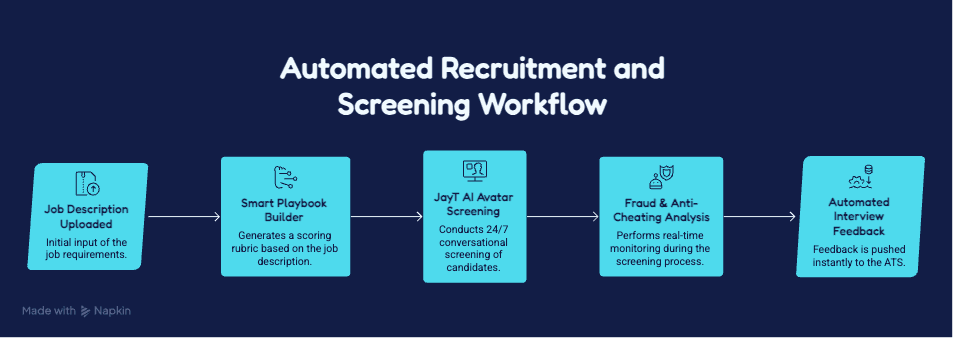
1. Unified Playbook Execution
Before JayT speaks with a single candidate, our platform utilizes a centralized workspace to parse your job description and generate a structured interview playbook. This defines the precise competencies, core role criteria, and target performance rubrics for the position. The avatar does not guess; it interviews directly against your exact internal engineering or operational benchmarks.
2. High Completion Rates Through Fluid Interaction
JayT is trained across tens of thousands of real enterprise interviews. It speaks, listens, and conducts dialogue in over 16 languages and regional dialects natively, not via delayed text translations. Because the interaction feels like a fluid conversation with an elite technical sourcer rather than a fill-in-the-blank form, our avatar screens achieve an average 94% interview completion rate, far exceeding legacy industry standards.
3. Immediate, Actionable Interview Feedback
The moment the candidate closes their browser session, the operational workload ends. The system analyzes the transcript, maps concrete behavioral quotes directly back to the initial playbook rubric, and populates clear, score-validated interview feedback. This structured intelligence routes straight into your native Applicant Tracking System (ATS), allowing your team to walk into the office each morning with a pre-vetted, highly qualified short list.
How does JobTwine improve time-to-hire, fraud detection, and completion rates?
JobTwine improves outcomes by compressing screening time, catching high-risk behavior early, and keeping candidates engaged long enough to gather meaningful signal—all inside one platform.
Because JayT runs fully autonomous first-round interviews, recruiters can move from application to decision-ready short list in days instead of weeks. It reduces scheduling delays, ghosting risk, and calendar collisions by handling hundreds of concurrent sessions.
Below is a simple view of how key metrics typically shift when teams move from legacy workflows to an AI recruiting platform like JobTwine:
Metric | With JobTwine | Typical legacy baseline |
Time-to-hire (enterprise roles) | ~8 days from application to offer | ~42 days with manual screening and coordination |
Interview completion rate | ~94% of invited candidates complete avatar interviews | ~60–75% completion in static video tools |
High detection across eye movement, browser behavior, and linguistic patterns | Minimal or manual detection; often discovered only post-hire |
Automating the structural work—calendar coordination, baseline questioning, and cross-role consistency—means recruiters can spend their human hours on what actually closes talent: tailored pitch conversations, stakeholder alignment, and negotiation.
Crucially, JobTwine’s automation is designed not to lower talent standards; it raises them by applying the same structured rubric across every applicant, reducing the variance of human fatigue and bias in early screening rounds.
Restoring Human Hours to Strategy
Automating your screening funnel should never mean lowering your talent standards. Transitioning to a comprehensive AI recruitment platform allows your organization to build an elastic interviewing infrastructure that expands to meet volume spikes, treats every applicant with identical structural fairness, and respects candidate time by removing scheduling delays entirely.
By offloading repetitive structural verification to dedicated digital agents, your human recruitment teams stop chasing calendars and start closing top-tier talent.
To see how automated candidate screening scales without losing your brand's conversational touch, explore the full agent capabilities directly on the JobTwine platform today.
For a complete visual walkthrough of how an intelligent copilot and conversational system restructures your day-to-day talent pipelines, check out this comprehensive JobTwine Product Explainer. This resource details how structured playbooks connect seamlessly with real-time automated scoring environments.
FAQs: What do recruiters ask about AI avatar hiring?
1. How does an AI hiring platform work from job description to final decision?
An AI hiring platform works by parsing your job description into a structured interview playbook, running autonomous avatar interviews against that playbook, and then pushing scored transcripts and recommendations directly into your ATS for final human decisions. In JobTwine’s case, JayT detects fraud risk, scores competencies, and routes candidates into shortlists or rejection queues with evidence attached, so recruiters can focus on final-stage conversations and hiring manager alignment.
This JD-to-decision loop is designed to replace manual first-round screens entirely, not just partially reduce workload.
2. What makes JayT’s avatar interviews more lifelike than legacy video tools?
JayT's avatar interviews are designed to feel more lifelike by combining intelligent probing, real-time acknowledgment, dynamic turn detection and multilingual conversational support.
Instead of cycling through fixed questions, JayT listens to how candidates respond and asks follow-up questions tailored to their examples, making the interaction closer to what they’d experience with an experienced recruiter. This conversational depth significantly increases completion rates and candidate satisfaction, particularly in high-volume and multi-region hiring programs.
3. Can AI hiring tools detect candidates using ChatGPT or other AI during interviews?
AI hiring platforms can use signals such as browser behavior, response timing, gaze patterns and linguistic patterns to identify potential indicators of AI-assisted cheating. These signals should be treated as risk indicators rather than definitive proof, with human review used before consequential decisions.
When candidates read answers off another screen or rely on real-time generative prompts, it often produces detectable patterns in eye movement, timing, and phrasing that an AI interviewer can flag.
JobTwine’s fraud detection systems focus on catching these behaviors in the moment so scores reflect true capability rather than test-taking tricks.
4. Will AI avatars replace human recruiters?
AI avatars can automate repetitive early-stage screening tasks while leaving strategic and relationship-driven recruiting work with human recruiters.
In practice, this means avatar interviews handle the baseline qualification and data gathering, while recruiters still own stakeholder alignment, nuanced candidate evaluation, and closing conversations. Organizations that adopt avatar-based screening generally end up using their recruiters’ time more strategically, not less.
5. How does JobTwine support structured and consistent interviews?
JobTwine supports structured and consistent interviews by using playbook-based questioning, defined competencies and rubric-driven evaluation. Standardizing the interview structure can reduce variation between interview sessions, while human recruiters remain responsible for reviewing evidence and making hiring decisions.
This structure also makes it easier to audit outcomes for bias and fairness, because every rating maps back to standardized criteria rather than subjective impressions.
6. Which teams get the most value from AI recruiter agents?
Teams that handle high-volume, multi-location hiring for structured business, tech, and operations roles get the most value from AI recruiter agents like JayT. These environments tend to suffer most from calendar bottlenecks, baseline screening fatigue, and inconsistent early evaluation across multiple recruiters. By automating the first round in a conversational way, they can maintain high hiring standards while freeing human time for final-stage interviewing and offers.