
Learn why recruitment workflow automation can create legal risks and how JobTwine uses AI interview screening with auditable human oversight.

TL;DR: The Core Argument
Purely automated screening software creates systemic legal liabilities under Title VII, the ADA, and evolving state laws.
Software that makes standalone "pass/fail" or ranking decisions operates as a black box, exposing employers to class-action discrimination lawsuits without intent.
Modern tools must shift from automation (replacing human choices) to augmentation (supplying humans with transparent, structured interview intelligence).
88% of businesses use AI in candidate screening, but regulatory enforcement now targets platforms that remove meaningful human oversight.
Why is automation the wrong framework for candidate screening?
Automating candidate screening implies removing human oversight to maximize speed, whereas good software should focus on enhancing human decision-making with objective data. When tools are built to autonomously reject or rank applicants, they inherit the biases of historical training data and create immense legal vulnerabilities.
The hiring industry focus must change from recruitment workflow automation to workforce augmentation. True efficiency is achieved when an ai recruiting platform serves as an operational infrastructure layer—streamlining data capture, generating transcripts, and organizing evaluations, while leaving final candidate choices entirely to talent teams.
What legal risks do fully automated hiring tools face?
Fully automated hiring tools face immediate legal risk because federal and state regulators now hold both employers and software vendors liable for algorithmic bias. Under the Equal Employment Opportunity Commission (EEOC) guidelines, employers face strict liability if their third-party recruitment automation software creates an adverse disparate impact on protected groups.
The legal landscape has shifted through landmark actions and legislation:
Mobley v. Workday (2026): A California federal court ruled that AI hiring vendors can be legally sued as "agents" of the employer if their independent tools handle traditional screening and rejection functions.
Proxy Discrimination Checks: The same Mobley ruling allowed claims to proceed regarding algorithms that weed out applicants using proxy indicators like medical-related employment gaps.
State Enforcement: Illinois Human Rights Act amendments explicitly ban AI-driven discrimination (including generative models) and prohibit sorting by geographic proxies like zip codes. Simultaneously, Colorado's AI Act mandates annual impact assessments for high-risk employment systems.
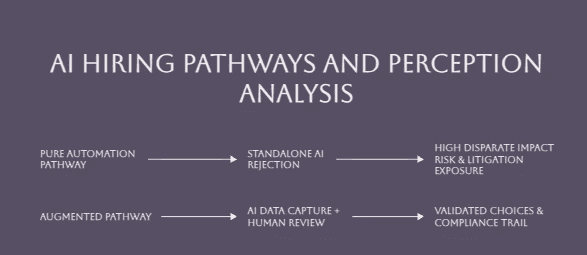
Augmentation vs. Automation: A Shift in Approach
True talent acquisition efficiency does not come from letting an ai recruiter agent make hiring decisions. It comes from using an interview intelligence platform to scale human capabilities.
The differences between an automated process and an augmented process are distinct:
Operational Metric | Pure Automation Approach | Augmented Approach (JobTwine) |
Core Goal | Remove humans to maximize screening speed. | Support humans with objective data. |
Decision Ownership | The algorithm ranks, scores, and rejects. | The human evaluates structured AI insights. |
Data Transparency | Black-box matching scores. | Clear transcriptions and clear evidence. |
High risk under state bias laws. | Auditable, human-in-the-loop workflow. |
How does an augmented recruitment workflow function safely?
An augmented recruitment workflow functions safely by using technology solely to standardize data collection while keeping human recruiters as the ultimate decision-makers. Instead of utilizing a black-box resume shortlisting tool to screen out talent, an ai hiring platform acts as a structured administrative companion.
The sequence below illustrates how to implement a legally defensive, augmented pipeline:
Phase 1: Standardize Evaluation Benchmarks
Utilize an ai interview questions generator to establish identical, job-related criteria for every applicant. This eliminates unstructured interviewer bias before conversations begin.
Phase 2: Deploy Objective Data Capture
Conduct initial assessments using an ai interview platform or a conversational ai recruiter agent. The platform captures audio, video, and text inputs without filtering or hiding candidates behind an algorithmic rank.
Phase 3: Review Fact-Based Feedback
Analyze the output of the structured interview intelligence platform. The tool delivers comprehensive ai interview feedback, compiling direct quotes and transcription logs mapped against your pre-set hiring playbook.
Phase 4: Execute Candidate Shortlisting
Human talent teams review the objective evidence logs to perform the final candidate shortlisting step. No applicant is advanced or archived without manual validation.
What is the role of an AI interview copilot?
An ai interview copilot or video interview assistant acts as a real-time listening helper for live interviewers, surfacing behavioral prompts and tracking time allocation across your structural framework. It does not grade or rank the candidate's personality; it ensures the human interviewer captures valid, job-related evidence during the session.
For companies evaluating software footprints, this distinction sets advanced tools apart from legacy systems:
Platform Category | Core Technical Mechanism | Primary Output | Regulatory Alignment |
Legacy Video Screening | Asynchronous recording | Video file storage | Passive |
Automated Black Boxes | Independent algorithmic scoring | Standalone pass/fail grade | High Exposure |
Hiring Intelligence (JobTwine) | Real-time transcription & indexing | Auditable, evidence-based data logs | Defensible |
Deploying an ai avatar recruiter or a platform to scale early-stage interactions is highly effective, provided the agent feeds verified transcript data directly into a human-managed dashboard. This architecture eliminates the hidden filtering systems currently targeted by class-action lawsuits.
The Compliance Threshold: Under California's Civil Rights Council rules, if your talent team cannot produce a clear, auditable trail detailing exactly why a candidate was prioritized or deprioritized, the underlying software fails compliance standards.
Frequently Asked Questions
What is the difference between recruitment automation and recruitment augmentation?
Recruitment automation passes decision-making authority to a software algorithm, while recruitment augmentation uses technology to extract structured insights so humans can make better decisions. Augmentation protects companies from compliance risks by ensuring every final hiring action is human-verified.
Can employers be held liable for bias in third-party AI recruiting tools?
Yes, federal guidelines and recent federal court rulings state that employers are directly liable for any disparate impact caused by third-party systems. Courts treat these software systems as legal "agents" of the employer, making vendor selection a core compliance duty.
How do proxy indicators create bias in automated candidate screening?
Proxy indicators are neutral data points—like long employment gaps or specific zip codes—that algorithms use to filter applications. In practice, these indicators frequently correlate with protected characteristics like medical disabilities or race, triggering unintended, systemic discrimination.
What should I look for in an interview intelligence platform comparison?
Prioritize platforms that deliver transparent transcriptions, structured feedback, and auditable data logs rather than proprietary "black-box" matching scores. The tool must serve as a system of record that supports human review, rather than an automated gatekeeper.