
Stop chasing scattered interview feedback in random docs. Discover the best tools to centralize your team's candidate evaluations at JobTwine.

Ask five people on a hiring panel where their interview feedback lives, and you'll get five different answers. One person has it in a Google Doc. Another typed it into Slack right after the call, while it was still fresh, and it's now buried under forty other messages. Someone filled out the ATS scorecard, eventually. Someone else has it in their own personal notes app, because that's just where they think.
This happens when interview feedback does not have a real home. Every one of those formats works fine in isolation. The problem is there's no one place. By the time the debrief happens, someone is always playing detective, "wait, did Sarah ever send her notes?", instead of discussing the candidate.
What scattered feedback actually costs you
This isn't just an annoyance. It shows up as four real costs:
Slower decisions
Debriefs turn into a scavenger hunt for notes instead of a conversation about signal. The candidate is left waiting while your team reconstructs what already happened.
Worse decisions
Without a consistent structure, feedback turns into vibes. The most confident interviewer in the room tends to win the debate, not the most accurate one. Recency bias creeps in — whoever interviewed last gets remembered best, regardless of who actually had the sharpest read on the candidate.
If a hiring decision ever gets questioned — internally or externally — "it's somewhere in a doc Mike made three months ago" is not an answer anyone wants to give.
Lost institutional memory
When an interviewer leaves the company, their calibration, their notes, their sense of what "strong" looks like for a given role — all of it tends to leave with them, because none of it lived anywhere durable.
What "centralized" has to mean
It's tempting to think the fix is just "put everything in one shared folder." That's not centralization — that's just a bigger pile.
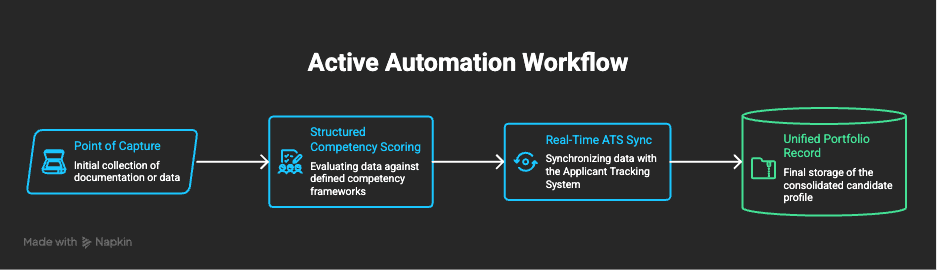
Real centralization means four things:
Structured, not just stored. If every interviewer fills out feedback in their own format, you can't actually compare across them. Structure is what makes feedback comparable instead of just collected.
Tied to the candidate, not floating in a separate tool. Feedback should live next to the actual interview and the candidate's profile — not in a doc you have to go find and match up manually.
Captured close to the moment. Interview feedback decays fast. "I'll fill it out by Friday" is where your most accurate signal quietly disappears.
Searchable later. Centralized feedback should be retrievable a year from now — across interviewers, across roles, across hundreds of candidates — not locked inside one doc that only the original author can find.
Why docs and spreadsheets quietly fail at this
It's not that your team is being careless. Docs and spreadsheets fail at this structurally:
There's no structure enforcement, so free text becomes the default, and free text doesn't compare across interviewers. There's no single source of truth, so feedback fragments across whoever happens to own which file. There's no connection to candidate context, so the reviewer is stuck flipping between the ATS, the resume, and three different tabs. And there's no real retrieval — feedback becomes write-only. Once a hiring decision is made, almost nobody goes back and rereads it, which means all of that effort produces zero compounding value.
Moving from scattered interview notes to structured data is critical for data-driven hiring and recruitment workflow automation.
What to Look For in a Feedback Tool
If you are evaluating a platform to fix this, look past basic feature lists. Enterprise-grade evaluation tracking requires five core programmatic capabilities:
In-Flow Scorecard Generation: The tool must eliminate the extra step of opening an external form. JobTwine solves this by embedding structured scorecards directly into the interview flow. The moment an interview concludes, our system automatically populates an evidence-backed evaluation report. The interviewer doesn't have to write notes from scratch.
Multi-Layer Competency Mapping: The platform must pair structured data inputs directly alongside qualitative fields. JobTwine turns unstructured observations into consistent, criteria-based scores mapped directly to your specific role requirements and seniority levels.
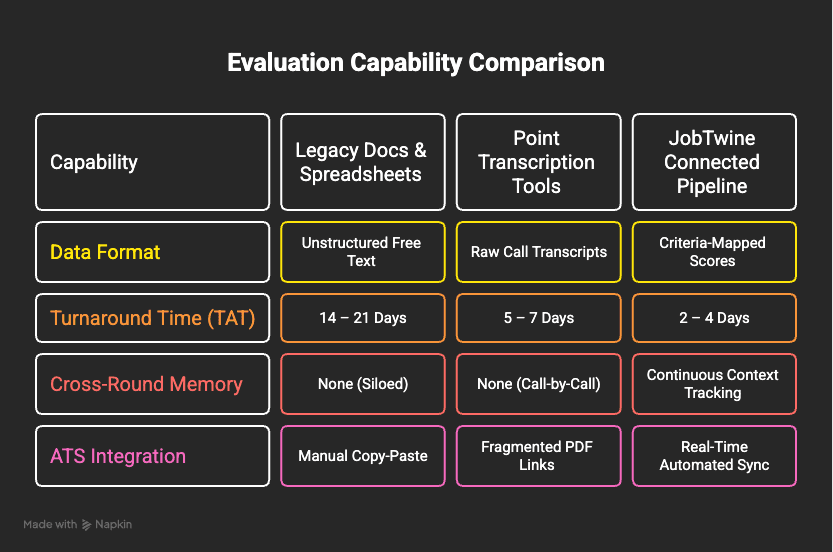
Cross-Round Shared Memory: Point solutions force every interview stage to start from a completely clean slate. JobTwine’s engine tracks context across rounds, highlighting what has already been proven and guiding the next interviewer to systematically target remaining skill gaps.
Direct, Automated ATS Sync: JobTwine features native, automated sync across 50+ major Applicant Tracking Systems (including Greenhouse, Workday, Lever, Ashby, and iCIMS). Per-criterion scores, timestamped transcripts, and verbatim candidate quotes are pushed to your ATS the exact second a call wraps up—completely eliminating manual data entry.
Conclusion
The fix for disjointed candidate tracking isn't a prettier form or a sterner slack nudge from your recruitment coordinators. The fix is removing the operational gap between the interview happening and the feedback existing.
By automating the capture phase, JobTwine compresses the standard post-interview feedback turnaround time from weeks down to just 2 to 4 days.
Feedback that is difficult to find is feedback that doesn't get used. Don't ask your technical team to be more organized. Remove the friction entirely, and inssssent home.