
Compare AI hiring platforms vs traditional recruiting software to see how active AI screening, interview intelligence, fraud detection, and structured scorecards improve enterprise hiring.

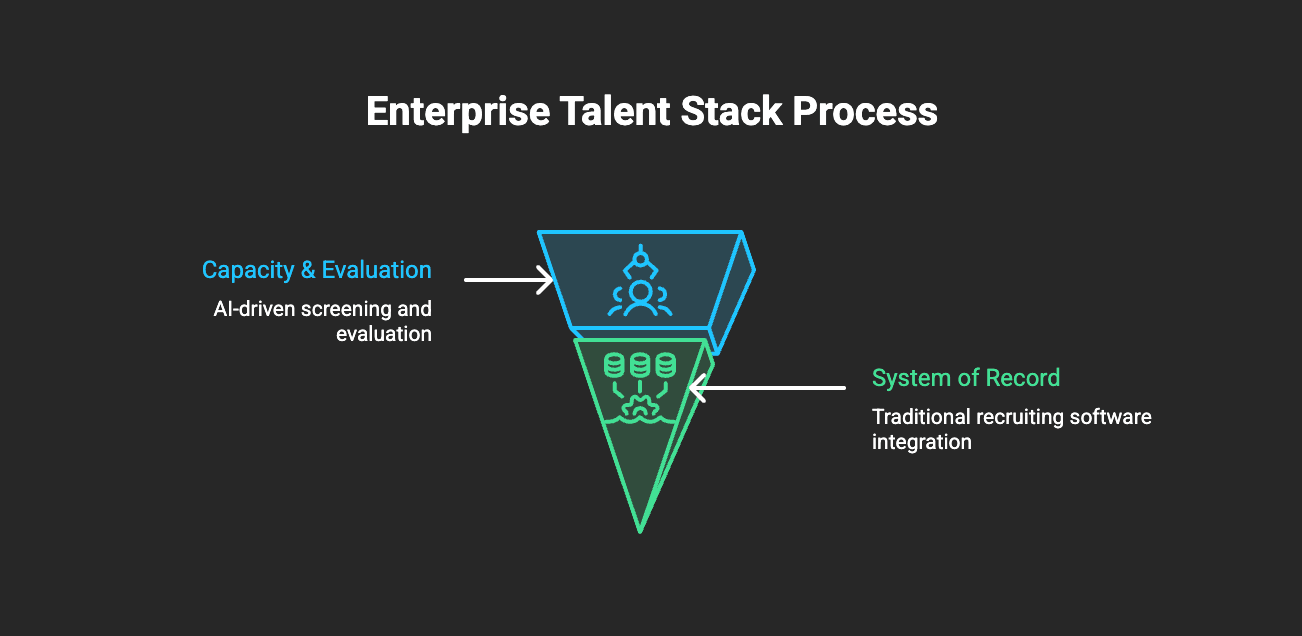
An AI hiring platform acts as an active evaluation and execution engine, whereas traditional recruiting software operates as a passive system of record. While an ATS manages requisitions, compliance, and candidate pipeline logistics, an AI based hiring platform conducts dynamic candidate screening, guides live interview panels, detects generative AI cheating, and synthesizes structured competency evidence directly into existing enterprise workflows.
Talent executives who have managed enterprise hiring over the past decade know the historical tech cycle well. We migrated from legacy ERP modules like Taleo and SuccessFactors to modern systems of record like Greenhouse, Lever, and Workday.
However, the core architecture of these Applicant Tracking Systems (ATS) remained unchanged: they are passive, relational databases built to store static records, track requisition workflows, and log legal compliance data.
In 2026, candidate-side generative AI rendered keyword-based resume filtering ineffective. When applicants deploy automated scripts to instantly rewrite CVs against job specifications, passive tracking systems don't filter noise—they magnify it.
Evaluating an AI hiring platform vs traditional recruiting software isn't about replacing your pipeline database; it is about deploying an active evaluation layer that verifies candidate competence before human engineering or business panels burn expensive capacity.
The Architectural Divide: System of Record vs. System of Execution
The fundamental limitation of traditional talent acquisition technology is its reliance on asynchronous, self-reported data. An ATS sits downstream of candidate applications, waiting for resumes to arrive and using basic string-matching algorithms to score them.
An ai hiring platform operates as an active execution engine. It sits upstream of and alongside your ATS, interacting directly with candidates through adaptive conversations, evaluating problem-solving mechanics in real time, and outputting structured evidence directly to your hiring panels.
Structural Breakdown: AI Hiring Platform vs Traditional Recruiting Software
For talent operations leaders auditing tech stacks, the operational differences between passive databases and active execution systems span every phase of candidate evaluation.
Architectural Domain | Traditional Recruiting Software (ATS) | Modern AI Hiring Platform (e.g., JobTwine) |
Operational Role | System of record for application lifecycle & compliance | Active evaluation layer & screening execution engine |
Data Processing Model | Static text parsing & Boolean keyword matching | Contextual skill analysis & live conversational evaluation |
First-Round Screening | Recruiter phone screens or static, asynchronous video forms | Autonomous AI avatar recruiters conducting live, 2-way interviews |
Panel Support | Unread static PDF rubrics attached to interview calendar invites | Live interviewer copilot prompting follow-ups in real time |
Integrity & Anti-Cheat | Zero built-in defense against proxy candidates or LLM prompts | Multi-vector monitoring of audio latency, gaze, and tab activity |
Post-Interview Output | Unstructured notes prone to recruiter/hiring manager bias | Playbook-mapped ATS evidence scorecards with candidate quotes |
3 Core Operational Shifts Driving Enterprise Adoption
1. The Collapse of Resume-Based Shortlisting
When candidates use AI applications to generate tailored applications, resume keywords lose their signal-to-noise ratio. Traditional screening software relies on historical claims. An ai based hiring platform shifts focus from historical self-reporting to demonstrated capability. Understanding an AI recruitment platform vs traditional ATS highlights how active conversational screening verifies candidate depth before recruiter bandwidth is spent.
2. Conversational Intelligence vs. Static Video Prompts
First-generation automated screening relied on recorded video responses driven by rigid timers. Candidates universally despised this experience, causing drop-off rates approaching 50%. Modern architectures leverage natural language processing and dynamic turn-taking. If an applicant gives a superficial answer, an interactive AI interviewer probes deeper into specific architectures, trade-offs, and metrics.
3. Mitigating Interviewer Fatigue and Evaluation Variance
The largest hidden cost in enterprise hiring is the engineering and product hours lost to unstandardized interviewing. Unprepared hiring managers ask off-script questions, leading to subjective scoring and inconsistent data. Modern platform architectures use live copilots during human rounds, ensuring every panelist stays anchored to verified competency rubrics while capturing transcripts for instant ATS scorecard synthesis.
Automated screening does not necessarily identify the most qualified candidate; it identifies the candidate who best presents the evidence the system is designed to recognize. An ai hiring platform transforms passive claims into active, auditable evidence.
Coexistence Strategy: Integrating AI Execution Over Legacy ATS Infrastructure
For enterprise TA leaders managing established compliance frameworks, adopting an ai hiring platform does not require a costly "rip-and-replace" of your core HRIS or ATS.
Maintain the System of Record: Retain Workday, Greenhouse, or Lever for regulatory audit trails, EEO/OFCCP compliance reporting, offer workflows, and HRIS integration.
Deploy the System of Intelligence: Layer an execution engine like JobTwine at the front end to run automated candidate screening, enforce rubric consistency across human panels, and detect generative AI cheating.
Synchronize via API: Allow job requisitions to build automated interview playbooks, while pushing structured evaluation scores, transcripts, and fraud metrics back into candidate records.
Frequently Asked Questions
What is the structural difference between an ai hiring platform and traditional recruiting software?
Traditional recruiting software (ATS) is a system of record designed for candidate data storage, pipeline tracking, and compliance management. An ai hiring platform is an active execution layer that conducts dynamic candidate screening, guides human interviewers, detects fraud, and generates structured evaluation evidence.
Does an ai based hiring platform compromise OFCCP or EEOC compliance?
No, advanced enterprise platforms enhance compliance by enforcing structured, objective evaluation rubrics across all applicants. Unlike human interviewers, who introduce subjective bias, conversational AI tools evaluate every candidate against identical competency frameworks, producing transparent, auditable selection metrics.
How does an AI hiring platform integrate with our existing enterprise ATS?
Modern platforms connect via bi-directional APIs. Open requisitions in your primary ATS automatically trigger role playbook creation. Once candidate screening and live panel evaluations are completed, structured scorecards, audio transcripts, and anti-cheat scores push back directly to the candidate’s ATS profile.
How do conversational AI platforms protect technical screens from generative AI cheating?
Modern execution platforms use multi-vector integrity engine checks. During both autonomous avatar interviews and human-led rounds, the platform silently tracks signals such as tab-switching, secondary monitor usage, audio response latency, and real-time LLM speech patterns to flag proxy test-takers directly on candidate scorecards.