
AI avatar interview guide for candidates covering what to expect, how AI interviews work, evaluation criteria, follow-ups, and tips to prepare confidently in 2026.

When you receive an invitation to an AI avatar interview, you may not know what to expect. It is different from a one-way video interview in which you record answers to fixed questions.
An AI Avatar Interview is an interactive, is a video interview conducted by a digital interviewer. The avatar asks role-related questions, listens to your answers and may ask follow-up questions. Your responses are recorded and organized for the hiring team to review.
Quick Answers
This guide breaks down the shift from legacy, asynchronous one-way video screens to modern, two-way interactive AI avatar interviews in candidate screening workflows.
Details real-time natural language turn-taking, adaptive follow-up probing, multi-vector integrity/anti-cheat defense, and structured competency mapping.
Explains how candidate responses are evaluated using objective STAR-method evidence mapping and NYC Local Law 144 / GDPR compliant human-in-the-loop oversight models.
Outlines a 4-step preparation framework covering metric-driven communication, gaze/audio optimization, handling dynamic follow-ups, and post-interview Q&A.
When candidates receive an invitation to an AI avatar interview, their first reaction is often confusion or anxiety. Most job seekers assume they are about to record one-way video monologues against a mechanical two-minute timer.
In reality, modern interview technology has evolved past static, recorded video forms. Today's talent acquisition teams use interactive digital screeners to replace asynchronous forms with real-time conversations.
For candidates, completing an ai avatar job interview is remarkably similar to talking with a human recruiter over Zoom or Teams, with one key operational advantage: the digital recruiter never experiences interviewer fatigue, evaluates every candidate against identical competency standards, and offers 24/7 scheduling flexibility.
What Happens During an AI Avatar Job Interview?
An ai avatar job interview follows a structured, conversational workflow designed to evaluate candidate depth, verify resume claims, and generate objective evidence for human hiring managers.
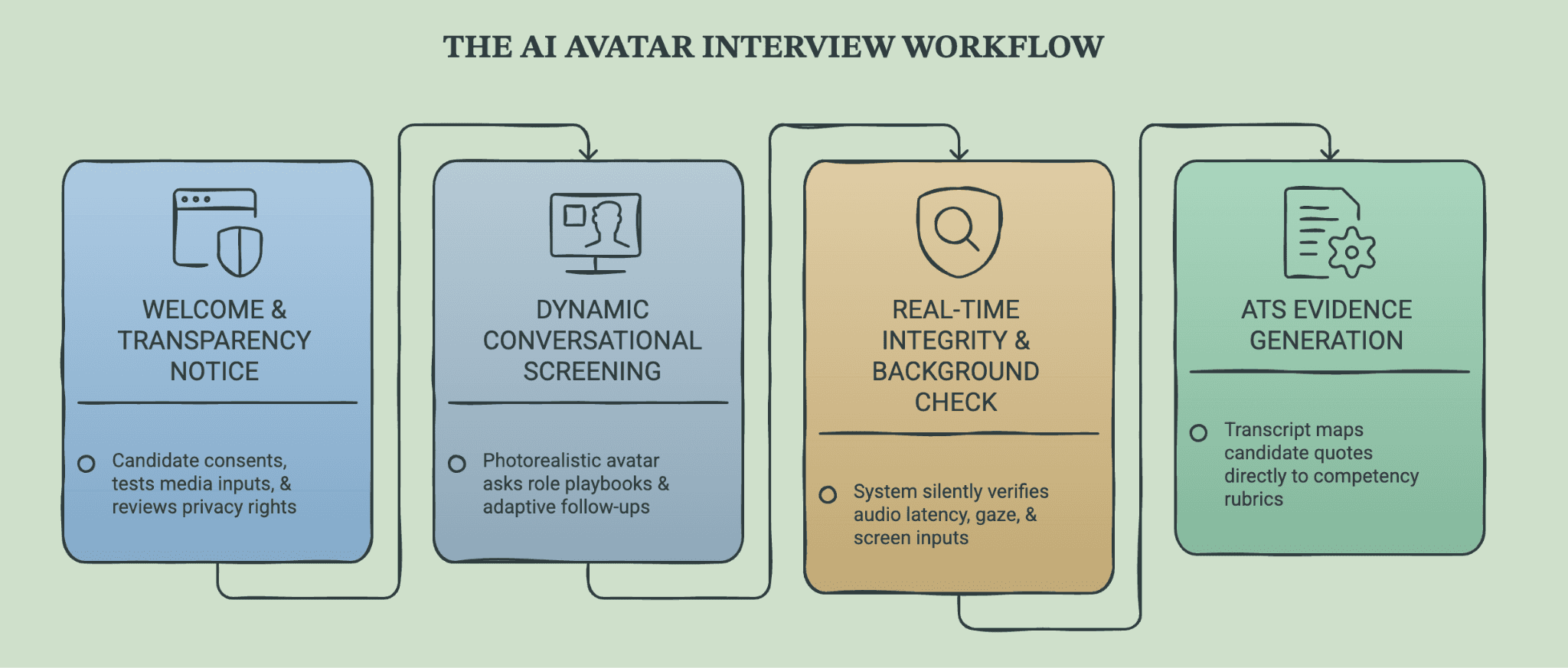
Most AI avatar interviews follow four steps:
You open the interview link.
You may need to confirm your identity and test your camera, microphone and internet connection.The avatar explains the process.
You should receive information about the interview format, recording and expected length.You answer role-related questions.
The avatar may ask follow-up questions when it needs more detail or clarification.The hiring team reviews the results.
Depending on the employer, recruiters may review your recording, transcript, summary or structured scorecard before deciding on the next step.
If your answer to a technical question is too high-level, the avatar references the hiring playbook and asks a targeted follow-up question. For instance, if you mention managing a database migration, the avatar may ask: "What specific downtime mitigation strategies did you implement during that transition?"
Interactive AI Avatars vs. Legacy Asynchronous Video Screens
Understanding how conversational digital interviewers differ from early-generation recorded video screens helps candidates prepare effectively.
Feature | AI avatar interview | |
|---|---|---|
Format | Candidate records answers to fixed prompts | Candidate responds to a digital interviewer |
Follow-up questions | Usually unavailable | May be asked based on the response |
Timing | Completed independently | Completed independently, often through an interactive session |
Output | Recorded video responses | Recording, transcript and structured summary |
Human involvement | Recruiters review the recording | Recruiters review the interview results |
Candidate questions | Usually limited | May be supported, depending on the system |
Privacy | Depends on the employer and platform | Depends on the employer and platform |
Unlike old one-way screens that recorded videos for recruiters to skim through later, an AI avatar recruiter processes speech in real time. It evaluates the specific evidence behind your claims rather than facial expressions or vocal tone.
How Are Candidates Evaluated by an AI Interview Avatar?
An AI Interview avatar does not make automated hiring or firing decisions. Under regulatory compliance frameworks like New York City's Local Law 144 and European Union AI regulations, automated systems serve as decision-support tools, preserving human oversight for final hiring calls.
When evaluating responses, the platform analyzes three core dimensions:
Competency Evidence: The system matches your spoken answers against role-specific rubrics. It looks for concrete examples, metrics, and technical methodologies rather than generic buzzwords.
Behavioral Alignment: Using structured frameworks like the STAR method (Situation, Task, Action, Result), the software verifies whether your past experiences align with job requirements.
Response Integrity: In remote hiring environments, modern platforms evaluate background operational signals—such as real-time audio feeds and response latency—to ensure candidates are speaking authentically without secondary display scripts or proxy assistance.
Once your session concludes, the platform translates your conversation into an auditable scorecard. Hiring managers review direct candidate quotes mapped to competency requirements before deciding who moves to live panel rounds with an interviewer copilot.
How Candidates Should Prepare for an AI Avatar Interview: A 4-Step Checklist
Preparing for a conversational digital interview requires a blend of standard technical preparation and clear, structured communication.
1. Speak in Specifics, Not Buzzwords
Because the avatar's evaluation engine searches for verified competency evidence, general statements like "I am a great team leader" carry little weight. Structure your answers around concrete numbers, systems, and outcomes: "I led a team of four engineers to reduce API latency by 35% over six months."
2. Maintain Natural Eye Contact and Clear Audio
Treat the digital screener like a human executive. Sit in a well-lit room, use a reliable headset, and speak directly into your webcam. Avoid reading from off-screen notes or secondary monitors, as unnatural eye gaze patterns and delayed speech latency can trigger background integrity flags on candidate scorecards.
3. Embrace the Follow-Up Prompts
Do not be startled if the avatar interrupts or asks for clarification. In an AI recruitment platform vs traditional ATS environment, follow-ups are designed to give you credit for your depth of knowledge. If prompted for more details, view it as an opportunity to elaborate on your technical contributions.
4. Ask Questions at the End
Just like a human screener, an advanced avatar allows candidates to ask questions about company culture, team structures, and onboarding workflows at the end of the session. The system logs your questions, offering hiring teams valuable insight into your engagement level.
Frequently Asked Questions
Can I request a different interview format?
You can ask the employer whether another format or reasonable accommodation is available. The process and applicable requirements depend on the employer, role and location.
Does an AI avatar evaluate my face or accent?
It depends on the system being used. Review the employer’s notice or ask the recruiter what information the platform processes and whether facial, voice or behavioral analysis is involved.
What happens if my internet connection drops?
Some platforms save your progress or allow you to restart. Check the instructions in your invitation and contact the recruiter if you cannot continue.
Who can see my interview?
Access depends on the employer’s privacy and retention policies. Ask who can review the recording, transcript or scorecard, how long the information is stored and whether it is shared with other providers.
Does the AI make the final hiring decision?
The employer should explain how AI contributes to the process and who makes the final decision. Candidates can ask whether a person reviews the interview results before an employment decision is made.