
Detect AI proxy cheating and candidate impersonation in high-volume hiring without false positives using JobTwine’s multi-vector anti-cheat engine.

Candidate impersonation and AI proxy fraud in interviews involve unauthorized third-party stand-ins, synthetic voice clones, real-time LLM teleprompters, or off-camera assistance during technical screens. Detecting fraud without triggering high false-positive rates requires an integrated, multi-vector analysis engine. Rather than using invasive proctoring locks, modern systems analyze content structure (via models like OpenAI GPT-4o), global transcript likeliness (via Google Gemini), multi-speaker audio profiling, and meeting client face/gaze telemetry. |
Key Takeaways
Remote candidate fraud has evolved beyond simple background notes into real-time LLM audio feeds, synthetic voice overlays, and proxy test-takers.
Aggressive proctoring flags natural human behaviors (like thinking out loud or looking away to compute complex code) as fraud, damaging candidate conversion rates.
True fraud detection isolates technical questions from basic HR screening and cross-references content, audio, and video logs simultaneously.
JobTwine’s multi-modal engine evaluates candidate authenticity using specialized sub-modules to deliver audit-ready, low-false-positive scorecards directly to your ATS.
The Modern Fraud Stack: Why Legacy Proctoring Fails
Enterprise talent leaders managing high-volume technical hiring face an unprecedented operational reality: generative AI tools allow underqualified candidates—or paid proxy interviewees—to pass technical screens undetected.
THE MULTI-VECTOR FRAUD VECTOR |
1. SYNTHETIC & LLM TELEPROMPTERS Audio feeds transcribed in real time; LLM streams perfect answers |
2. PROXY VOICE & SPEAKER INTRUSION Off-camera experts whisper answers or take over audio streams |
3. CAMERA-OFF & GAZE MANIPULATION Reading structured scripts off-screen during technical questions |
Traditional proctoring software attempts to block browser tabs or force intrusive webcam locks. These legacy methods fail because they disrupt genuine candidates while missing stealthy audio routing and off-screen secondary displays.
The False-Positive Dilemma: Isolating What Matters
The single biggest failure of automated anti-cheat systems is flagging real talent. An over-sensitive algorithm that flags a candidate for looking at a whiteboard or pausing to think creates severe candidate churn and exposes organizations to bias liabilities.
To keep false positives near zero, an anti-cheat engine must enforce strict Question Tagging:
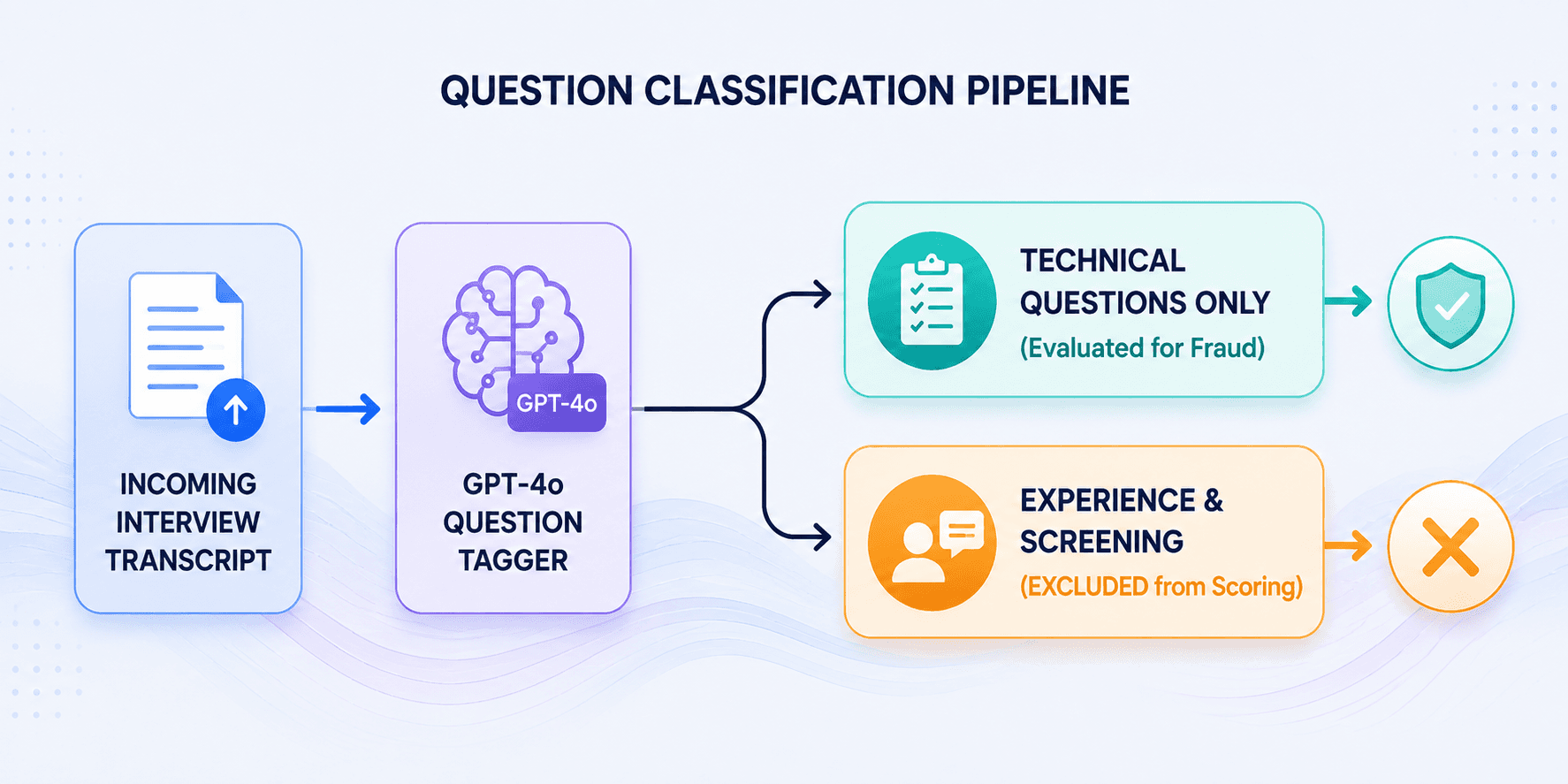
By explicitly isolating domain-specific, skill-testing questions and ignoring basic HR or logistics interactions, systems eliminate false-positive flags caused by casual chit-chat, stuttering, or basic background storytelling.
Inside JobTwine’s Multi-Vector Detection Engine
JobTwine combats candidate impersonation and AI proxy fraud through an asynchronous, multi-service architecture designed to evaluate evidence across four distinct operational vectors.
JOBTWINE MULTI-VECTOR DETECTION PIPELINE |
1. CONTENT ANALYSIS (GPT-4o) Evaluates technical Q&A pairs for LLM response patterns & gap timing |
2. AI LIKELINESS DETECTION Analyzes global transcript blocks for deterministic filler & syntax |
3. AUDIO ANALYSIS Detects third-party voices & matches against registered voice profile |
4. VIDEO TELEMETRY LOG ANALYSIS Correlates client gaze-deviation & camera-off events to Q&A timeline |
1. Content Analysis & AI Suspicion Scoring
Using OpenAI GPT-4o, JobTwine evaluates each technical Q&A pair individually. The system generates an AI Suspicion Score (0–100) along with a transparent reasoning string, flagging pairs that exceed a threshold score of 55.
Signals Evaluated: Unnaturally encyclopedic structure, perfect recall lacking personal hesitation markers, mismatch between question complexity and answer fluency, and unnatural response-gap/utterance-gap timing inconsistent with human cognitive load.
Batch Efficiency: All Q&A pairs in an interview are evaluated in a single API call to optimize pipeline processing speed.
2. Global AI Likeliness Detection
Running concurrently with content analysis, Google Gemini analyzes the consolidated candidate transcript as a single block to evaluate overall bot assistance likelihood.
Deterministic Signals: Before calling the LLM, the system counts deterministic markers including filler-word frequency (e.g., "essentially", "certainly", "absolutely"), structural parallelism, and unnaturally balanced answer lengths.
LLM Inference: Gemini produces a blended score (
ai_likeliness_scorefrom 0.0 to 1.0), highlights suspicious transcript excerpts, and generates an executive summary.
3. Audio Multi-Speaker & Voice Profiling
JobTwine utilizes libraries to analyze transcript audio metadata, preventing voice proxies and off-camera assistance.
Third-Party Intrusion: Detects voices other than the candidate and interviewer, outputting an
audio_score(0–100), amultiple_speakersBoolean flag, and totalintrusion_timein seconds. Anaudio_scoreabove 50 applies a logarithmic boost to the final candidate suspicion score.Voice-Profile Matching: Calculates a
speaker_match_score(0–100) comparing the active speaker's audio against the candidate's registered voice profile. A match score below 40 applies a subtractive penalty in the final scoring blender.
4. Video Telemetry & Timeline Mapping
Rather than processing heavy raw video files, JobTwine analyzes structured face-detection and gaze-tracking logs forwarded directly by the meeting client interface.
Metrics Captured: Composite
video_score(0–100),face_missing_count,gaze_deviation_count, andcamera_off_count.Content Mapping: The engine maps video anomaly windows directly to the Q&A timeline. A sustained off-screen gaze event that occurs during a highly suspicious technical answer carries significantly higher weight than gaze deviation during a pause between questions. A
video_scoreabove 50 applies a logarithmic boost to the composite score.
Component Scoring Architecture
To deliver an accurate, audit-ready result to your ATS, JobTwine combines these component metrics into a single, balanced score:
SCORING BLENDER MATRIX | |
Content Score (0–95) | Primary driver based on flagged technical pairs |
Gemini Score (0–100) | Blended when confidence is ≥ 70% |
Audio Score Boost | Logarithmic multiplier applied when score > 50 |
Video Score Boost | Logarithmic multiplier applied when score > 50 |
Speaker Match Penalty | Subtractive penalty (0–15) if voice mismatches |
Automated fraud detection should never act as an automated rejection system. It functions as a decision-support layer, surfacing verified, timestamped evidence for human recruiter review.
Why Talent Operations Choose JobTwine
Enterprise recruitment teams trust JobTwine to secure their high-volume technical screening pipelines without sacrificing candidate experience or workflow speed.
Full Lifecycle Protection: JobTwine integrates anti-cheat protection across top-of-funnel JayT AI Avatar screening and live human panel rounds via the JayT Interviewer Copilot.
Zero-Disruption ATS Sync: Integrity scores, transcript snippets, audio intrusion alerts, and quote-backed evidence push automatically into candidate profile cards across Greenhouse, Workday, Lever, and 50+ enterprise systems via our native ATS integrations.
Enterprise Security & Compliance: Built on a SOC 2-compliant, SQS-based asynchronous pipeline with built-in retries and dead-letter queues (DLQ), ensuring complete data privacy compliant with GDPR, NYC Local Law 144, and DPDP frameworks.
Frequently Asked Questions
How does JobTwine prevent false-positive fraud flags?
JobTwine uses an automated GPT-4o question-tagging module that explicitly excludes HR, logistics, and general experience questions from fraud scoring. Only technical Q&A pairs are evaluated, ensuring natural hesitation or conversational pauses do not trigger false alarms.
How does the system detect candidate impersonation during an interview?
JobTwine's audio analysis engine uses audio tools to compare the candidate's active voice against their registered voice profile, generating a speaker_match_score. If a third-party proxy steps in or the voice signature deviates (score below 40), the system automatically applies a penalty to the candidate score card.
Does JobTwine store or process raw video files for anti-cheat analysis?
No. To protect candidate privacy and optimize pipeline performance, direct raw-video processing is disabled. JobTwine operates entirely on pre-extracted face-detection, gaze-tracking, and camera-state log data forwarded securely by the meeting client.
How do anti-cheat signals integrate into my ATS?
Anti-cheat metrics are consolidated into an audit-ready scorecard that syncs automatically with candidate profiles in your ATS (such as Greenhouse, Workday, or Lever), providing timestamped audio clips and transcript evidence for human review.
Secure your technical hiring pipeline against candidate impersonation and AI proxy fraud with JobTwine's multi-vector intelligence engine. Schedule a platform demo with JobTwine today.