
Why CFOs buy AI interview platforms: bad-hire costs, compliance risk, and why meeting-bot tools like Metaview fall short.

Every vendor in this category, us included, has sat across from a CFO who asks the question, why does this cost more than the recruiter's time it saves? Most HR teams answer this question wrong because they walk in with an hours-saved chart. The CFO nods, asks who approved the current ATS spend, and the deal stalls in procurement for a quarter.
We at JobTwine have watched this happen at enough companies to say it plainly, efficiency is not the argument that moves a finance leader. Risk is. Here is the case we'd actually make, and the one we think most interview platforms, including the AI notetakers built on top of Zoom and Meet, are not equipped to make.
Efficiency pitch is an HR metric wearing a finance costume
"Save your recruiters ten hours a week" is a real benefit but it is also not how a CFO evaluates a purchase order. Time saved by a recruiter does not show up on an income statement unless that time converts into fewer requisitions open, fewer agency fees, or fewer mistakes. A CFO has sat through a hundred software pitches that promise time savings and never show up in headcount or budget the following year.
The teams that get budget approved skip the hours-saved slide. They open with the number a CFO already tracks: cost per hire, and the much larger number sitting next to it that almost nobody puts in the deck.
What a CFO underwrites
A CFO's job is to price risk before it lands on the books. Three numbers do that job for hiring, and a finance leader will recognize all three immediately because they map to categories already in the budget.
First, cost per hire. Pull your last twelve months of job postings, recruiter time, agency fees, and tooling spend, and divide by hires made. SHRM's 2025 benchmarking puts the U.S. average at $5,475 for non-executive roles and $35,879 for executive roles, up 21% since 2022, useful as a sanity check against your own number, not as a substitute for it. This is the line finance already approves every year, because it is visible and predictable.
Second, and far larger: the cost of a bad hire. Take the salary of a role you had to backfill within the last year and multiply it by 0.5 to 2, the range SHRM uses for full replacement cost (the DOL's conservative floor is 0.3). A $90,000 hire that did not work out cost somewhere between $45,000 and $180,000 once you count the search, the ramp time, the lost output, and the manager hours spent on the exit. Run that math on the last two or three bad hires on your own team, add them up, and you have the figure to bring into the budget meeting. It will almost always be larger than the software you're trying to get approved.
Third, time-to-fill. Every week a seat sits open is a week of lost output, overtime, or work pushed onto other people, and finance already prices vacancy cost into headcount planning. Take your own average days-to-fill from the past year, multiply it by what an open seat costs your team per week, and you have a carrying cost a CFO will recognize immediately, no industry comparison required.
Put these three together and a CFO is not looking at a productivity tool. They are looking at a category where the company is exposed to five-figure to six-figure losses on a recurring basis, with no system in place to catch the mistake before it compounds. That is a risk conversation. CFOs fund risk mitigation differently than they fund convenience software, and they fund it faster.
The line item nobody puts in the deck
Here is the part most HR tech pitches skip entirely: the regulatory exposure sitting underneath every AI-assisted hiring decision made in 2026.
NYC Local Law 144 requires any employer evaluating a New York City resident with an automated employment decision tool to commission an independent bias audit, publish the results, and give candidates ten business days' notice before the tool is used. The law applies regardless of where the employer is headquartered. Penalties run $500 to $1,500 per violation, and every day a violation continues counts as a new one.
The Comptroller's December 2025 audit of enforcement found the city's own oversight agency had missed 17 of 32 cases of likely non-compliance in a small sample review. That gap is closing, not widening. Major employment law firms have told clients to expect stricter enforcement through 2026. And NYC was the pilot, not the ceiling: Illinois HB 3773 took effect this January, Colorado's AI Act takes effect this month, and New York State has a bill in progress to expand Local Law 144 statewide. A CFO who has priced litigation exposure once will not need this explained twice. Published bias audit results with an impact ratio under the EEOC's four-fifths threshold are discoverable evidence in a discrimination claim.
This is the risk a hiring tool either reduces or adds to. Most vendor conversations never get here, because most vendors are still pitching the hours-saved slide.
Why a meeting bot does not solve a CFO's problem
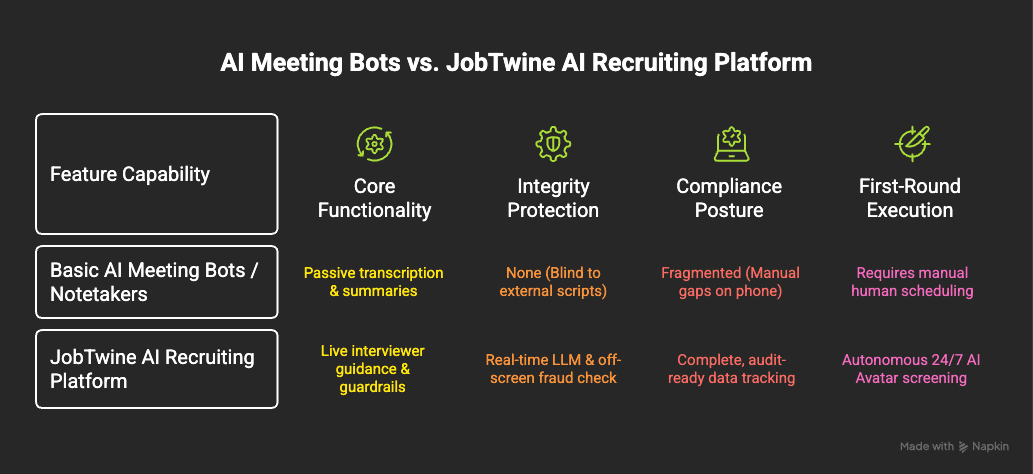
This is where we part ways with the category of tools built around Metaview and the wave of "Metaview alternatives" that followed it. These are AI notetakers. A bot joins the Zoom or Meet call, transcribes the conversation, and writes a structured summary back to the ATS. It is a real improvement over a recruiter typing at 70 words a minute. It is not what a CFO needs to see.
Three problems show up the moment you put this category in front of finance.
The bot is visible. On most platforms, a participant labeled "Notetaker has joined" or similar shows up in the call. Candidates notice, and some change how they answer once they know an AI system is recording them, which is a data quality problem before it is anything else. A reviewer testing seven recruiting notetakers in early 2026 found this exact pattern across multiple tools in the category.
The audit trail is incomplete by design. If the bot is removed from the call, or the interview happens by phone, no notes get generated at all. The workaround is a manual upload after the fact, which means the company's evaluation record for that candidate depends on a recruiter remembering to do an extra step. A documented, defensible hiring process cannot have a hole that opens every time a candidate prefers a phone screen.
A transcript is not an evaluation. Even the best notetakers in this category describe their output as a summary mapped loosely to a rubric. That is useful for a recruiter's memory. It is not the kind of structured, consistent, decision-grade record a bias audit under Local Law 144 requires, where selection rates and impact ratios need to be calculated against a documented process applied the same way to every candidate.
None of this is a knock on the product category solving the problem it set out to solve, which is recruiter note-taking. It is a mismatch between what these tools were built for and what a CFO, weighing risk, actually needs from a hiring system in 2026.
What a finance-ready interview platform has to prove
If you are building the case for finance, do not lead with the demo. Lead with three things a CFO can underwrite.
A documented process, not a transcript. Every candidate for a role should be evaluated against the same structured criteria, recorded the same way, every time, independent of whether the bot stayed in the call. That consistency is what turns "we think our hiring is fair" into "we can show our hiring is fair," which is the entire difference in a discrimination claim.
A compliance-ready audit trail by default, not by manual workaround. Notice, consent, and the data behind every score need to exist whether the interview happened on video, by phone, or in person. A system with gaps that open under normal interview conditions is not a system finance can rely on when a regulator asks for the record.
A number of finance already tracks moving in the right direction. Bad-hire rate, time-to-fill, and cost per hire are the three figures already in a CFO's model. The pitch is not "this saves recruiters time." The pitch is "this is infrastructure that reduces our exposure on a cost line already running into six figures a year, with regulatory penalties stacking on top of it."
The Ask
Stop asking a CFO to fund a productivity tool. Ask them to fund a control. The DOL and SHRM numbers tell you what a bad hire already costs the company, every quarter, with or without new software. Local Law 144 and the state laws behind it tell you that an undocumented or inconsistent process is a second, separate cost waiting to land. An interview platform built to produce a consistent, defensible record on every candidate is not a nice-to-have for recruiters. It is the same category of spend as insurance, internal controls, or a compliance hire: money that prevents a much larger number from showing up later.
That is the conversation that gets budget approved. Not the hours-saved slide.
FAQ
Why won't a CFO approve an AI interview platform based on time savings alone?
Time saved by a recruiter is an operational metric, not a financial one. It only matters to a CFO if it converts into a number they already track: cost per hire, bad-hire rate, or litigation exposure.
How much does a bad hire actually cost?
The U.S. Department of Labor sets the floor at 30% of first-year salary. SHRM puts full replacement cost at 50% to 200% of annual salary, rising to 200% to 213% for executive roles. On a $90,000 hire, that range runs $45,000 to $180,000.
What is NYC Local Law 144 and why does it matter outside New York?
It requires an independent bias audit, public disclosure, and candidate notice before using an automated employment decision tool to evaluate any NYC resident, regardless of where the employer is based. Illinois, Colorado, and a pending New York State bill extend the same model, so multi-state employers are exposed even without a New York office.
Are Metaview and similar AI notetakers the same as an AI interview platform?
No. Simple notetakers act as localized point solutions that transcribe and summarize a specific call. A finance-ready interview intelligence platform acts as an enterprise-wide system of record, ensuring process continuity, real-time interviewer guidance, fraud detection, and an unalterable audit trail across the entire recruitment cycle.
What should the budget pitch to a CFO actually say?
Frame the spend as a control that reduces a six-figure annual exposure already on the books (bad-hire cost, vacancy cost, compliance penalties), not as software that saves recruiter hours.
To see how we approach structured, audit-ready enterprise interviews that satisfy both talent acquisition and finance teams, explore the JobTwine Platform Overview or request a deep-dive look into our compliant AI Human Interviewer Copilot.