
Learn what automated candidate screening is, how it works, and how to set it up with ATS integrations, AI interviews, scoring, fraud detection, and compliance.

Automated candidate screening is an engine-driven evaluation process using artificial intelligence, natural language processing (NLP), and structured scoring rubrics to analyze job applicants immediately upon application submission. The system parses candidate data, assesses technical and behavioral competencies, executes interactive screenings, and syncs objective rankings directly to your Applicant Tracking System (ATS)—by passing manual resume filtering and reducing time-to-first-screen to minutes.
The Architecture of Modern Automated Candidate Screening
It is the systematic deployment of conversational intelligence, natural language understanding, and automated execution environments to filter, evaluate, and qualify applicants against standardized role playbooks without initial manual intervention.
Evaluating early-stage candidates at scale presents severe operational bottlenecks. High applicant volume often forces talent acquisition teams to spend up to 20 hours per week manually reviewing resumes. This manual process introduces several vulnerabilities:
Funnel Velocity Loss: High-performing candidates receive competing offers while sitting in unreviewed queues for days or weeks.
Evaluation Variance: Human review quality fluctuates based on evaluator fatigue, leading to inconsistent application of scoring standards throughout the hiring cycle.
Keyword Vulnerability: Legacy keyword parsing favors candidates who match exact job description phrases while penalizing qualified applicants who use non-standard terminology.
Modern screening platforms replace basic string-matching parsers with semantic natural language processing (NLP) models, Abstract Syntax Tree (AST) code analysis, and dynamic conversational engines that evaluate real-time problem-solving logic.
Operational Advantages for High-Scale Hiring Environments
Implementing an automated candidate screening architecture standardizes evaluation criteria across all candidates, reduces time-to-hire metrics, reclaims recruiter bandwidth, and generates objective, auditable candidate data.
1. Acceleration of Pipeline Velocity
Top-tier technical and specialized talent remains on the market for an average of 10 days. Automated screening platforms initiate contact immediately after an application is submitted, guiding qualified candidates through preliminary technical or conversational validation before manual review cycles begin.
2. Elimination of Administrative Overhead
Automating initial eligibility checks, preliminary competency questions, candidate updates, and scheduling flows reclaims up to 60% of recruiter administrative hours, allowing talent teams to focus on candidate engagement and late-stage conversions.
3. Standardization and Objective Scoring
Using structured, playbook-driven evaluation rubrics ensures that every candidate for a given role responds to identical core competency prompts under consistent conditions. Results are recorded as timestamped transcripts alongside evidence-backed scorecards.
5-Step Implementation Guide for Automated Candidate Screening
Deploying automated candidate screening involves five steps:
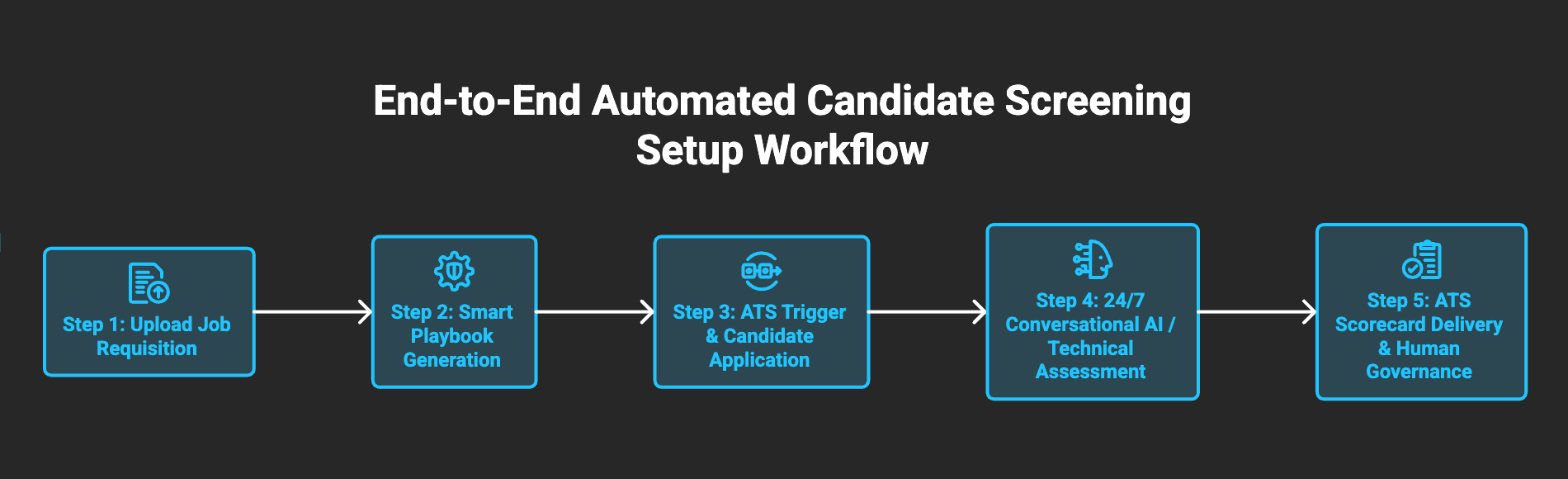
Step 1: Define Role Competency Playbooks
System setup requires transforming job requisitions into structured, measurable rubrics.
Isolate Measurable Criteria: Replace general requirements (e.g., "Strong background in cloud architecture") with explicit technical parameters (e.g., "Demonstrated capability in designing AWS serverless architectures using Lambda, API Gateway, and DynamoDB").
Assign Evaluation Weighting: Categorize requirements into Mandatory Gates (e.g., work authorization, core language requirements) and Scored Competencies (e.g., algorithmic complexity analysis, exception handling).
Step 2: Establish Bi-Directional ATS Webhooks
Integrating the candidate screening platform directly with your Applicant Tracking System (such as Greenhouse, Lever, Workday, or BambooHR) prevents data fragmentation.
API & Event Configuration: Configure webhooks so that updating a candidate's status to "Initial Screen" triggers an automated invitation via email, SMS, or messaging channels.
Data Mapping: Map screening outputs—including transcript links, code execution reports, and competency scores—back to the corresponding candidate record in the ATS.
Step 3: Configure Multi-Stage Screening Workflows
Construct evaluation stages suited to the operational requirements of the position:
Stage 1 (Eligibility Gate): Automated verification of location, shift availability, compensation alignment, and core prerequisites.
Stage 2 (Interactive Competency Assessment): A 15-minute asynchronous conversational or avatar-driven screen probing role-specific scenarios and technical trade-offs.
Stage 3 (Practical Validation): Integrated sandbox environments evaluating code execution, Abstract Syntax Tree logic, or domain-specific problem solving.
Step 4: Deploy Integrity and Anti-Cheat Telemetry
Remote screening requires active controls to detect proxy candidates, real-time generative AI assistance, and off-screen coaching:
Identity & Liveness Verification: Match candidate identity against official documents at the start of the session.
Gaze Tracking & Iris Motion Analysis: Track micro-saccadic eye movements to flag off-screen script reading or teleprompter usage.
System Environment Telemetry: Monitor browser focus events, tab switching, virtual camera drivers, and clipboard interactions.
Step 5: Establish Human-in-the-Loop (HITL) Governance
Automation provides data and initial filtering; human hiring managers maintain decision authority.
Calibrated Routing Thresholds: Set automatic score parameters that route high-performing candidates to immediate scheduling while queuing borderline profiles for manual review.
Auditable Evidence Links: Ensure every score in the generated report links directly to the corresponding timestamped video snippet, audio file, or line of code.
Technical Capability Comparison: System Selection Criteria
When selecting an enterprise candidate screening platform, evaluate capabilities against these core technical requirements:
Technical Variable | Basic Screening Software | Enterprise Candidate Screening Platform |
Parsing & Analysis | Static keyword matching | Semantic NLP & Abstract Syntax Tree (AST) parsing |
Interface Format | Standard text forms | Interactive AI Chatbots & Lifelike AI Avatars |
Proctoring Telemetry | Basic copy-paste prevention | Audio biometrics, gaze tracking & browser telemetry |
System Integration | One-way CSV exports | Bi-directional real-time API webhooks |
Compliance Standard | Unexplainable scoring models | Evidence-linked scorecards meeting EEOC & NIST standards |
Regulatory Frameworks and Ethical Governance
Enterprise deployment of automated candidate screening requires adherence to EEOC Title VII guidelines, the Americans with Disabilities Act (ADA), GDPR Article 22, and the NIST AI Risk Management Framework.
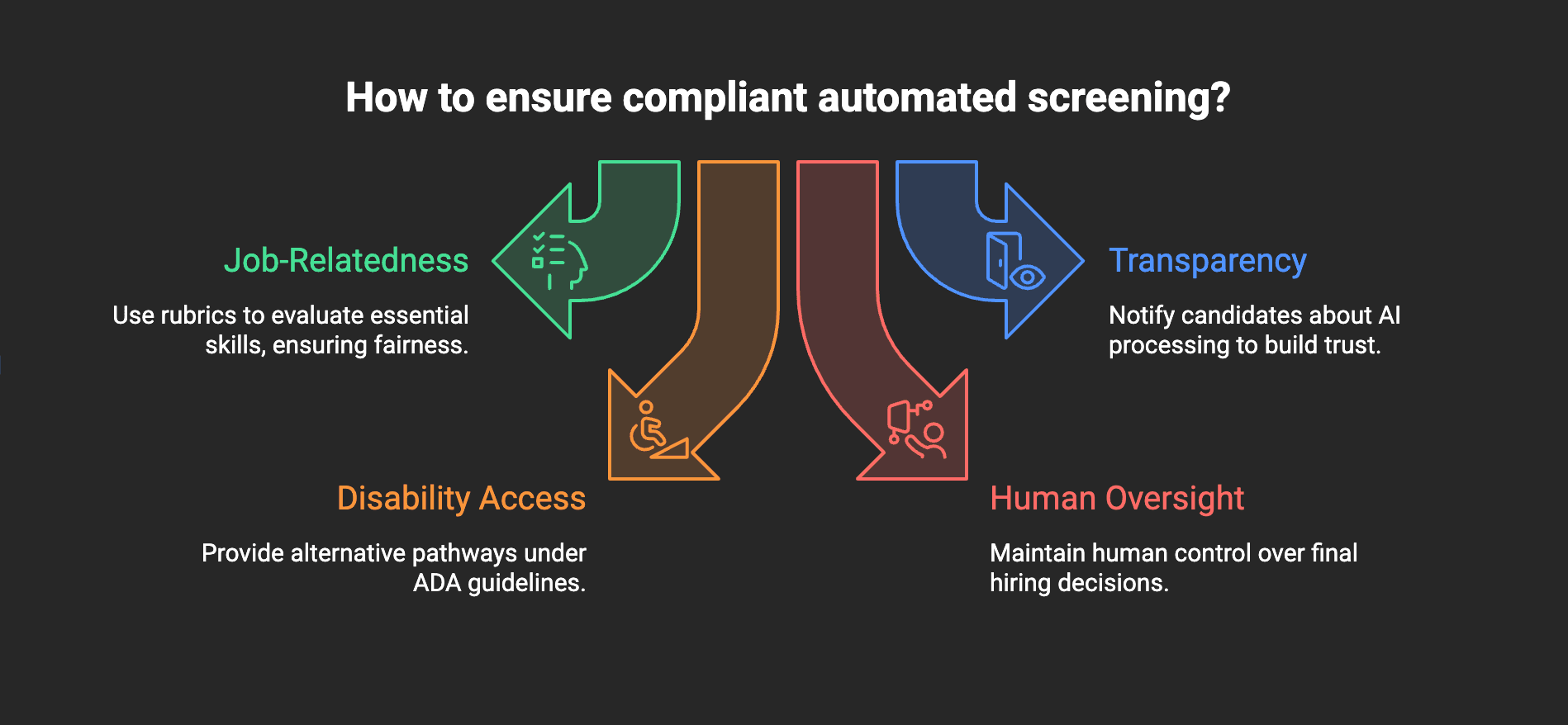
Automated screening implementations must satisfy established legal standards regarding algorithmic decision-making:
EEOC Title VII Disparate Impact Auditing: Selection criteria must be routinely audited to verify that automated thresholds do not produce statistically adverse impacts on protected demographic groups.
ADA Compliance & Accommodation Protocols: Platforms must inform candidates of automated evaluation mechanisms prior to testing and offer alternative evaluation paths to accommodate disabilities.
NIST AI Risk Management Principles: Automated evaluation architectures must be valid, reliable, explainable, transparent, and fair, avoiding black-box scoring logic that cannot be audited by human evaluators.
Conclusion
Integrating automated candidate screening replaces unstructured, manual resume reviews with standardized, evidence-backed evaluation workflows. By leveraging bi-directional ATS integrations, objective competency playbooks, and integrated proctoring telemetry, organizations increase pipeline velocity while maintaining compliance and candidate quality.
Frequently Asked Questions
What is automated candidate screening and how does it function?
Automated candidate screening uses artificial intelligence, natural language processing, and structured rubrics to evaluate job applicants upon submission. The platform parses candidate data, conducts interactive initial screens or technical assessments, scores responses against job playbooks, and updates the candidate's profile in the ATS.
How does automated screening impact candidate drop-off rates?
Automated screening reduces candidate drop-off by eliminating long waiting periods. Rather than waiting days for a manual resume review, applicants engage with an interactive assessment immediately after applying, allowing them to complete the process on demand.
How do systems mitigate algorithmic bias in candidate screening?
Systems mitigate bias by evaluating candidate responses against objective, skill-focused rubrics derived from job descriptions. Leading platforms analyze text transcripts rather than non-verbal facial expressions or vocal tone, redact demographic identifiers, and undergo adverse impact audits under EEOC guidelines.
Can automated screening platforms evaluate technical competencies for software engineering roles?
Yes. Enterprise platforms include code execution sandboxes, Abstract Syntax Tree (AST) parsing, and conversational AI models that evaluate code quality, algorithmic complexity, system architecture trade-offs, and edge-case handling in real time.
How does a candidate screening platform connect to an existing ATS?
The platform connects via bi-directional APIs and webhooks. Moving a candidate to a specific stage in the ATS triggers an automated assessment invite. Once the candidate completes the evaluation, the platform pushes scored transcripts, code samples, and recommendations back to the ATS candidate record.