
Discover what an AI recruiter chatbot is, how an AI recruiter platform works, and whether your hiring team should use one. Real use cases, risks, and a rollout checklist inside.

An AI recruiter is software that automates candidate-facing hiring tasks — screening, answering FAQs, scheduling — using NLP and machine learning. An AI recruiter chatbot is its conversational interface; an AI recruiter platform is the full system behind it, including matching algorithms and ATS integration. It works best for high-volume, repetitive hiring stages and worst when treated as a substitute for human judgment on final decisions.
If you've posted a single job opening this year, you've likely already interacted with an AI recruiter — a chatbot that screened you before a human saw your resume, or an algorithm that ranked your application before a recruiter opened your profile.
As of early 2026, SHRM data puts formal recruiting-specific AI adoption at 27% of organizations, with a broader benchmark across SHRM, LinkedIn, and Gartner data putting any AI use in HR at 43%. Adoption is real, but it's uneven and most of the content explaining it skips the part that actually matters: when it helps, when it backfires, and how to tell the difference before you sign a vendor contract.
What Is an AI Recruiter?
An AI recruiter is software that automates the parts of hiring that traditionally consumed a recruiter's time, sourcing, resume screening, candidate FAQs, and interview scheduling, using natural language processing and machine learning, and increasingly, large language models.
The distinction that matters most: an applicant tracking system (ATS) stores and filters applications. An AI recruiter actively engages. It can hold a conversation, answer a benefits question at 11pm, pre-screen a candidate against must-haves, and flag top matches for a recruiter's review — all without a human touching the first several steps.
What Is an AI Recruiter Chatbot vs. an AI Recruiter Platform?
An AI recruiter chatbot is the part candidates talk to. An AI recruiter platform is the full system behind it — the matching engine, the ATS integration, the compliance logging. The chatbot is the dashboard; the platform is the engine.
Most AI recruiter chatbots today handle five recurring jobs:
Initial engagement — confirming candidate interest and answering the first round of questions
Screening — years of experience, certifications, work authorization, availability
FAQ handling — compensation bands, remote policy, interview process length
Scheduling — syncing with recruiter calendars to book slots without email back-and-forth
Status updates — telling candidates where they stand instead of leaving them in silence
Candidate experience data tends to move in one of two directions depending on execution quality: it improves noticeably when the bot is well-scoped, and it drops sharply when candidates hit a loop the bot can't resolve — particularly during a rejection, which is the worst possible moment for a conversation to feel robotic.
How Does an AI Recruiter Platform Actually Work?
An AI recruiter platform runs on three layers: a language layer that understands candidate conversation, a matching layer that scores candidates against job criteria, and a workflow layer that connects the bot to your ATS, calendars, and offer tools. Vendors differentiate mainly on how tightly these three layers are integrated.
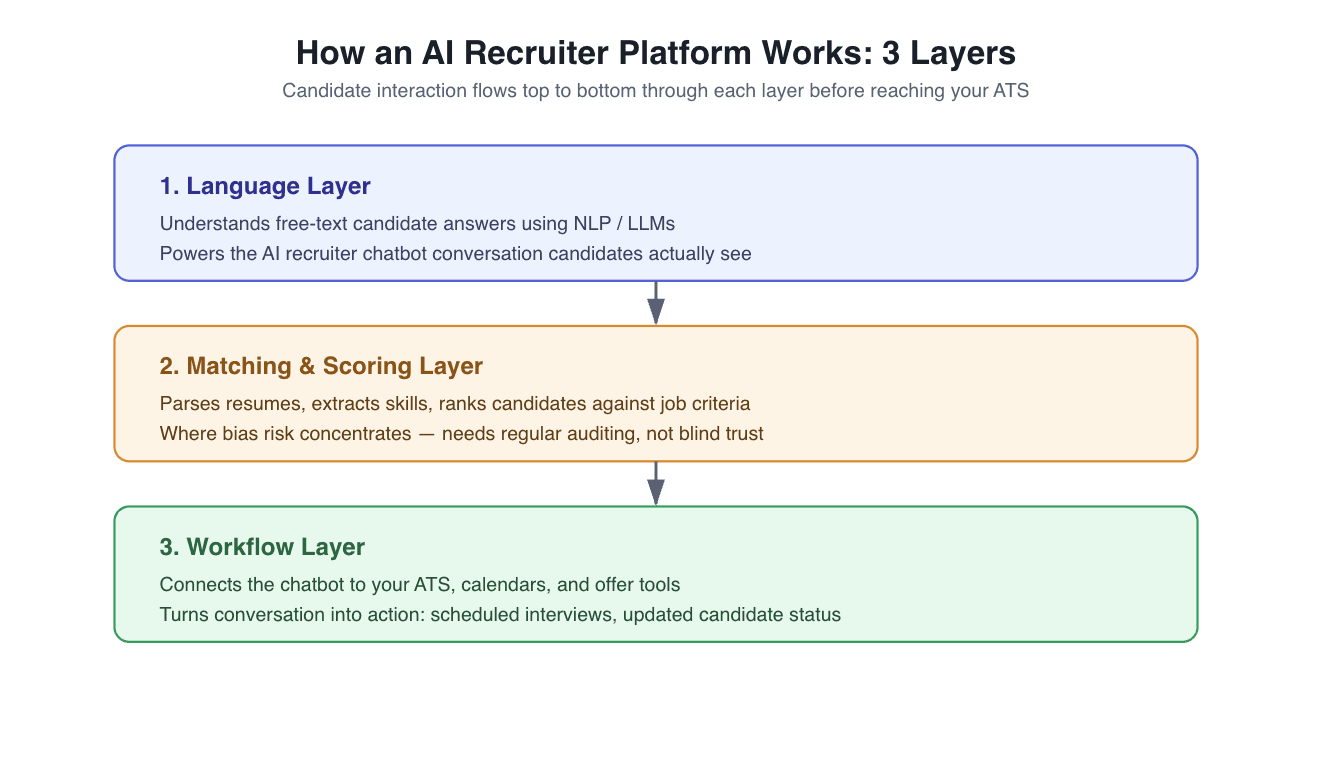
The language layer is what makes conversation feel natural rather than form-like. Modern platforms increasingly run this on LLMs, which is why 2026-era chatbots feel dramatically more fluent than the rule-based bots common five years ago.
The matching and scoring layer is where resumes get parsed, skills get extracted, and candidates get ranked. It's also where the most legitimate fairness concerns live — a scoring model is only as fair as the historical data and rules it was built on.
The workflow layer is what turns conversation into action: syncing with your ATS, your calendar tools, your background check vendor. Without this layer, a chatbot is a novelty. With it, a candidate can move from "applied" to "interview scheduled" with zero recruiter clicks.
Here's the part most comparisons skip: an AI recruiter does not find your best candidate — it finds the candidate whose application best matches the criteria you told it mattered. If those criteria were incomplete, outdated, or quietly biased, the tool won't catch that. It will execute it faster and at scale. That's the real reason the matching layer deserves more scrutiny than most teams give it, and it's the single biggest gap in most AI-recruiter buying guides.
What Are the Real Benefits of Using an AI Recruiter?
The strongest case for AI recruiter tools is speed and consistency at volume, not novelty.
High-volume hiring — retail, hospitality, seasonal staffing — is where AI recruiter chatbots show the clearest ROI. A bot can screen thousands of applicants in the time it takes one recruiter to review fifty resumes.
Silence is consistently one of the top reasons candidates sour on an employer. A bot that instantly confirms an application closes a gap that used to cost companies strong candidates to faster-moving competitors.
The realistic pitch isn't "replace recruiters" — it's freeing them from repetitive screening so they spend more time on judgment calls: negotiating offers, assessing fit, coaching hiring managers.
A chatbot asks every candidate the same screening questions in the same order. A recruiter on their fifteenth phone screen of the day might not.
What Risks Should You Know Before Adopting an AI Recruiter?
The two risks that matter most are algorithmic bias inherited from historical hiring data, and regulatory exposure that varies sharply by jurisdiction — both of which most "top AI recruiter tools" roundups leave out entirely.
Bias baked into training data. Amazon's scrapped internal recruiting tool remains the clearest cautionary example: it taught itself to downgrade resumes containing the word "women's" because it learned from a decade of male-dominated hiring history. It wasn't a fluke of one bad vendor — it's a structural risk anytime a model learns from imperfect historical patterns.
Regulatory exposure. New York City's Local Law 144 already requires a bias audit and candidate notice before using an automated employment decision tool on NYC-based roles. The EU AI Act classifies most recruitment AI as "high-risk," which triggers documentation, transparency, and human-oversight obligations. If your team hires across state or national lines, this isn't optional homework.
Candidates experience backlash. A bot that loops candidates or feels robotic during a rejection can do more brand damage than the efficiency gains are worth — and candidates talk, publicly, on review sites.
Over-reliance on scores. The single most common implementation mistake is treating an AI match score as a final decision instead of a starting point for human review.
AI Recruiter vs. Human Recruiter: What Should Actually Be Automated?
Automation earns its keep on repetitive, high-volume tasks; judgment calls should stay with a human recruiter regardless of how advanced the platform is.
Task | Good fit for AI | Needs a human |
Initial FAQ answering | ✅ | — |
Resume parsing & basic screening | ✅ | — |
Interview scheduling | ✅ | — |
✅ (with human review) | — | |
— | ✅ | |
Culture-fit assessment | — | ✅ |
Sensitive rejections / negotiations | — | ✅ |
Complex, ambiguous candidate questions | — | ✅ |
Should Your Team Use an AI Recruiter Chatbot?
Your team is a good fit for an AI recruiter if you're hiring at volume, already have measurable candidate-experience gaps, and can commit to auditing the tool's decisions — not just deploying it and walking away.
Work through these six questions before signing anything:
What's your hiring volume? Below roughly 10–15 roles a month, the ROI on a full platform may not justify the implementation lift.
Do you have a bias-audit plan? If you can't name who reviews screening decisions and how often, you're not ready to deploy at scale.
Is your ATS integration-ready? A chatbot that doesn't talk to your existing systems creates more manual work, not less.
Who owns candidate escalations? Define upfront when a candidate gets routed to a human, especially for accommodation requests.
What does your candidate experience data say? Existing complaints about response time or ghosting are a strong signal AI can help.
What's your compliance footprint? Hiring across NYC, the EU, or other regulated jurisdictions changes your obligations significantly.
If most of these have clear answers, a pilot on one role in one region for 60–90 days is the lowest-risk way to test fit before a company-wide rollout. Our guide to structuring a candidate experience audit walks through how to baseline your metrics before you compare them against a pilot.
How to Choose an AI Recruiter Platform
The right platform is the one you can explain, audit, and hand off to a human at the exact moment a candidate needs one — not the one with the most features on a demo call.
When evaluating vendors, go beyond the demo and ask about:
Transparency — can you see and explain why a candidate was scored the way they were?
Configurability — can screening criteria be adjusted per role, or is it one-size-fits-all?
Audit trail — does the platform log decisions for compliance review?
Human handoff — how smoothly does a conversation escalate to a live recruiter?
Data privacy — where is candidate data stored, and for how long?
Conclusion
An AI recruiter chatbot isn't a gimmick, and it isn't a recruiter replacement either — it's a tool that's genuinely strong at absorbing repetitive, high-volume work, and genuinely risky when treated as a substitute for judgment on decisions that affect people's livelihoods. Teams that get the most value deploy it narrowly, audit it on a schedule, and keep a human in the loop for anything that matters. If your hiring team is drowning in screening or scheduling, an AI recruiter platform is a legitimate answer. If your volume is low and your process is already tight, you may not need one yet — and that's a fine answer too.
Ready to see where automation would actually help your hiring process? Talk to JobTwine for a free workflow audit — a clear-eyed look at your funnel, not a sales pitch.
Frequently Asked Questions
Is an AI recruiter chatbot the same as an ATS?
No. An ATS stores and filters applications; an AI recruiter chatbot actively converses with candidates, answers questions, and can screen or schedule without human input. Many platforms now combine both functions.
Can an AI recruiter legally reject a candidate on its own?
In most places, yes, but best practice — and a legal requirement in New York City — is keeping a human review of final rejections, especially for candidates who may need accommodations under the automated tool.
How much does an AI recruiter platform typically cost?
Pricing ranges from a few hundred dollars monthly for small-team tools to six-figure annual enterprise contracts, depending on hiring volume, ATS integration depth, and how customized the underlying AI model is.
Should a small business use an AI recruiter, or is it only for enterprises?
Scaled-down, lower-cost versions exist for small teams, but ROI is strongest for companies hiring in higher volume or across several open roles at once — under that threshold, the setup cost often isn't worth it.
What happens if candidates distrust the AI recruiter chatbot?
Trust gaps show up as drop-off mid-conversation or negative reviews; the fix is usually a visible, fast handoff to a human recruiter rather than trying to make the bot seem more human than it is.