
Interview screening and candidate screening aren't the same thing. Learn the real difference, when to use each, and how to build a smarter hiring funnel.

Interview screening is a short, structured conversation used to verify a candidate's fit after they've already passed the broader candidate screening stage, which filters applications based on resumes, skills, and basic qualifications.
Key Takeaways
Candidate screening is the broad, upfront filter resumes, applications, and qualification checks.
Interview screening is a narrower, conversational step that validates fit, communication, and motivation.
Confusing the two creates bloated hiring funnels and slows time-to-hire.
A well-structured screening interview process cuts bad hires and saves recruiter hours.
The right sequence: candidate screening first, interview screening second, never the reverse.
Most hiring teams use "interview screening" and "candidate screening" as if they're interchangeable. They're not, and that confusion is costing recruiters time, budget, and good candidates. After reviewing hundreds of hiring workflows, one pattern shows up again and again: teams that separate these two stages hire faster and retain longer. This article breaks down exactly where candidate screening ends and interview screening begins — and why that distinction matters more than most job descriptions admit.
If you are building or auditing a hiring funnel, understanding this difference between a process that scales and one that quietly leaks good talent is important.
What Is Candidate Screening?
Candidate screening is the first filter in any hiring pipeline. It happens before anyone picks up a phone. Recruiters review resumes, cover letters, portfolios, and application answers to decide who moves forward.
This stage is about elimination, not evaluation. You're removing candidates who clearly don't meet the baseline; wrong experience level, missing certifications, location mismatch, salary misalignment.
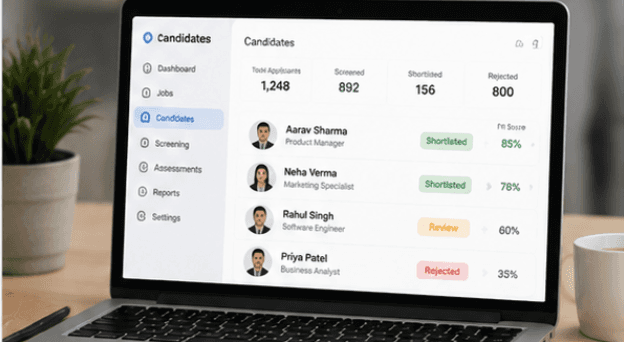
What Candidate Screening Typically Includes
Resume and application review
Automated keyword or ATS filtering
Basic qualification checks (degree, licenses, work authorization)
Skills assessments or pre-hire tests
Reference or background pre-checks in some industries
Candidate screening is largely document-driven. According to research by The Economist, recruiters spend an average of about six seconds scanning a resume before deciding to move forward or reject it. That speed is only possible because candidate screening relies on structured, scannable data.
What Is Interview Screening?
Interview screening — sometimes called a screening interview — is the conversational layer that comes after candidate screening. It's typically a short call, 15 to 30 minutes, conducted by a recruiter or hiring coordinator rather than the hiring manager.
The goal isn't to assess technical mastery yet. It's to confirm what the resume implied and catch what a document can't reveal.
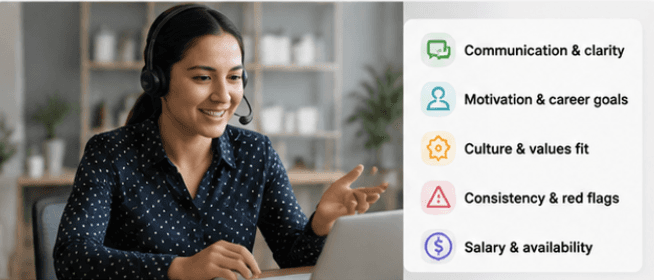
What Interview Screening Typically Covers
Communication style and clarity
Salary expectations and availability
Motivation for applying and career goals
Basic culture and values alignment
Red flags that don't show up on paper (unexplained gaps, inconsistent history)
Interview screening is where a candidate stops being a data point and starts being a person you're evaluating in real time.
Interview Screening vs Candidate Screening: The Core Difference
The simplest way to separate the two: candidate screening filters whose qualified; interview screening filters who's the right fit.
Factor | Candidate Screening | Interview Screening |
Format | Document review, automated tools | Live conversation (phone/video) |
Owner | Recruiter, ATS, or algorithm | Recruiter or hiring coordinator |
Timing | First stage, before contact | Second stage, after shortlisting |
Focus | Qualifications, keywords, basics | Communication, motivation, fit |
Volume | High (dozens to hundreds) | Low (a shortlisted handful) |
Output | Pass/fail against criteria | Recommend to hiring manager or reject |
Why This Distinction Actually Matters
Treating these stages as one blurs accountability. If a recruiter tries to assess "fit" while still sorting resumes, they slow down the top of the funnel. If a hiring manager conducts a screening interview meant only to confirm basics, they burn senior time on low-value conversations.
A 2023 LinkedIn Talent Solutions report found that the average time-to-hire across industries sits at roughly 44 days, with screening and interview stages accounting for the largest share of that timeline. Every extra, undefined step in that timeline compounds delay.
Separating candidate screening from interview screening solves three specific problems:
Faster shortlisting. Automated or document-based filters remove obvious mismatches before a human ever schedules a call.
Better interview quality. Recruiters conducting interview screening already know the candidate meets baseline criteria, so the conversation can focus on fit.
Clearer accountability. Each stage has one job. Nobody is trying to do two things at once.
The Screening Interview Process: A Practical Framework
A strong screening interview process follows a repeatable structure, not an improvised chat. Here's a framework recruiters can apply consistently.
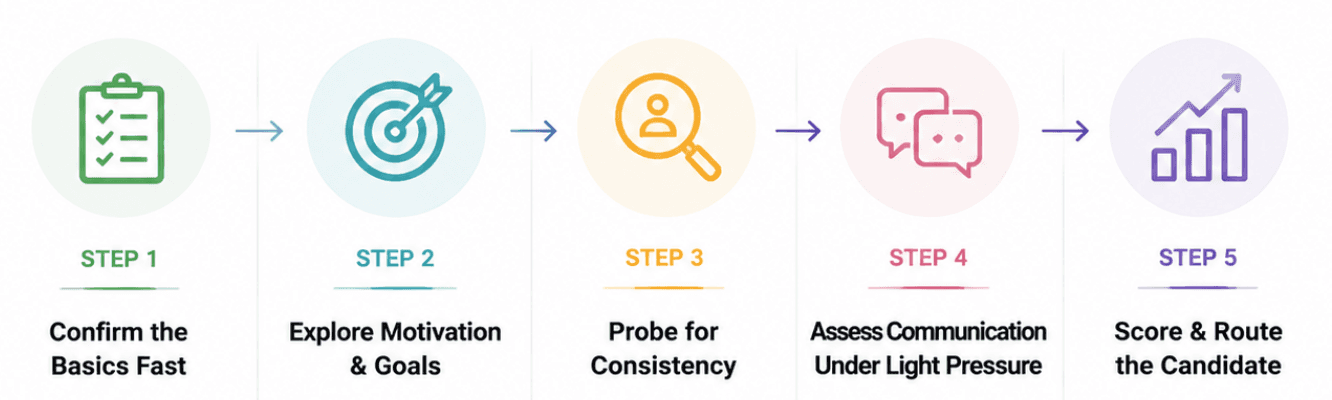
Step 1: Confirm the Basics Fast
Open with logistics — availability, location, work authorization, salary range. This should take under five minutes and rules out any late-stage surprises.
Step 2: Ask Motivation-Based Questions
Ask why the candidate applied and what they know about the role. Vague or generic answers often signal low genuine interest, even from a strong resume.
Step 3: Probe for Consistency
Compare what the candidate says against what's on their resume. Gaps, inflated titles, or vague explanations surface here, not later.
Step 4: Assess Communication Under Light Pressure
Ask one slightly open-ended question and note how the candidate structures their answer. This previews how they'll perform in a real interview or on the job.
Step 5: Score and Route
Use a simple rubric — pass, hold, or reject — and route the candidate to the hiring manager immediately if they pass. Delay kills momentum with strong candidates.
Common Mistakes Teams Make
Even experienced hiring teams blur these stages. The most frequent mistakes:
Using interview screening to re-do qualification checks already covered by candidate screening
Letting hiring managers conduct screening interviews, wasting senior bandwidth
Skipping candidate screening entirely and interviewing everyone who applies
No documented rubric, so interview screening becomes subjective and inconsistent
Treating a 45-minute deep-dive as a "screen" when it's really a full interview
Each of these adds friction. Fixing them usually just requires clearer stage definitions, not new tools.
How to Build a Screening Process That Scales
For teams hiring at volume, structure matters more than intuition. A few principles hold up across industries:
Define pass criteria for each stage in writing before you post the role.
Keep candidate screening automated where possible to protect recruiter time.
Cap interview screening at 30 minutes. Longer conversations belong to later rounds.
Use a consistent scorecard, not gut feel, to reduce bias and improve defensibility.
Review funnel drop-off rates quarterly to spot where good candidates are being lost.
FAQ: Interview Screening vs Candidate Screening
What is the difference between candidate screening and interview screening?
Candidate screening reviews resumes and applications to filter qualified candidates. Interview screening is a live conversation, usually by phone, that confirms fit, motivation, and communication after that initial filter.
Is a screening interview the same as a first interview?
Not quite. A screening interview is typically shorter and conducted by a recruiter to check basic fit, while a first interview often involves the hiring manager and covers role-specific skills in more depth.
Who usually conducts interview screening?
Recruiters or talent acquisition coordinators typically handle interview screening, reserving hiring managers for later, more technical interview rounds.
How long should a screening interview last?
Most effective screening interviews run 15 to 30 minutes. Longer calls usually indicate the conversation has drifted into a full interview.
Can candidate screening be fully automated?
Much of it can. ATS tools and skills assessments handle resume filtering well, but human review still catches context automation misses, especially for senior or specialized roles.
Conclusion
Interview screening and candidate screening solve different problems, and treating them as one stage slows every hire that follows. Candidate screening filters at scale; interview screening validates at a human level. Get the sequence right, and your funnel moves faster with fewer surprises down the line.
If your current process blurs these stages, that's the first place to fix. Ready to build a screening process that actually scales?