
Learn what an interview copilot is, how it brings cross-round context into live candidate calls, and how hiring managers can use it to run faster, fairer hiring loops.

A recruiter can spend two hours prepping a hiring manager for an interview loop and still watch them repeat round one from scratch. The hiring manager walks into the call with no clear idea of what the previous interviewer already validated, spends twenty minutes asking duplicate questions, and submits a scorecard that repeats baseline information instead of evaluating deeper role competencies.
An interview copilot is an AI assistant designed to solve this context loss by integrating directly into live video calls to capture evidence, map responses to job rubrics, and carry context across interview rounds.
While many talent acquisition (TA) teams buy an interview copilot to automate basic meeting notes, its core strategic value lies in preserving candidate context across the entire hiring process so interviewers can make faster, fairer decisions.
What Is an Interview Copilot?
An interview copilot is an AI-powered tool that runs alongside video conferencing software during job interviews to assist hiring teams. It transcribes conversations, maps live candidate evidence against job rubrics, and surfaces insights from previous interview rounds. Unlike basic meeting note-takers, an interview copilot focuses on cross-round context carryover, ensuring each interviewer builds upon prior evaluations rather than repeating them.
How Interview Copilots Differ from Traditional Hiring Tech
Many talent acquisition teams confuse an interview copilot with adjacent recruiting tools. While an Applicant Tracking System (ATS) manages candidate workflows administratively, and standard meeting transcription tools capture raw audio, an interview copilot operates specifically inside the active interview loop to structure evaluations.
Feature / Capability | Applicant Tracking System (ATS) | Standard Meeting Recorder | Interview Copilot |
Primary Focus | Pipeline management & candidate records | Raw transcription & meeting summaries | Live structured evaluation & context carryover |
When It Operates | Before and after candidate calls | Asynchronously post-meeting | Live during the candidate conversation |
Rubric Mapping | Static form templates | None | Active real-time competency tracking |
Cross-Round Context | Manual review of past scorecards | None | Automated synthesis of untested gaps |
What Is Context Drift and Why Does It Ruin Hiring Loops?
Context drift is the breakdown of candidate information as a hiring loop progresses from screeners to functional panels and executive reviews. When interviewers fail to digest previous round notes, candidate evaluations become fragmented, repetitive, and unreliable.
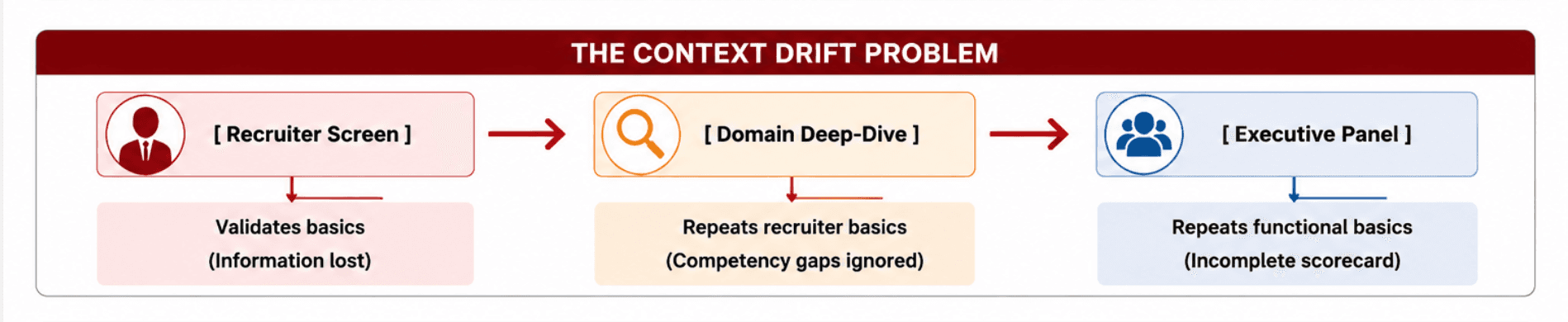
In a traditional hiring process, context drift leads to three operational failures:
Repetitive Candidate Experience: Candidates spend valuable time answering identical questions about their background across multiple rounds.
Incomplete Competency Coverage: Panelists waste time validating baseline criteria that were already confirmed, leaving technical or domain-specific competencies untested.
Duplicated Scorecards: Final interview scorecards reflect repeated impressions rather than a cumulative, multi-dimensional assessment of candidate fit.
An interview copilot prevents context drift by serving as the continuous thread between interview stages. It analyzes notes from earlier rounds, highlights unverified competencies, and prompts the hiring manager to focus on areas that require deeper evaluation.
How Does an Interview Copilot Work in Real Time?
An interview copilot operates across three distinct phases of an interview session, balancing automated data collection with human judgment.

1. Pre-Interview Context Synthesis
Before the meeting starts, the copilot pulls data from the ATS, the candidate's application, and notes from prior rounds. It presents the interviewer with a quick brief:
Validated Competencies: Skills and experiences confirmed in earlier stages.
Unresolved Gaps: Topics flagged by previous interviewers that require probing.
Suggested Focus Areas: Tailored questions designed to test remaining job requirements.
2. Live In-Meeting Guidance and Tracking
During the video call on Zoom, Microsoft Teams, or Google Meet, the copilot runs silently in an interviewer-facing panel:
Transcription and Evidence Tagging: Dialogue is transcribed and categorized against specified job competencies.
Rubric Coverage Monitoring: A visual tracker highlights which scorecard criteria have been addressed and which remain open.
Contextual Follow-Up Prompts: If a candidate gives a high-level response to a critical competency, the copilot suggests targeted follow-up prompts to help the manager probe deeper.
3. Post-Interview Evidence Synthesis
Once the call concludes, the tool generates an evidence-backed scorecard draft:
Quote-Backed Ratings: Candidate claims are linked directly to exact transcript quotes and timestamps.
Structured Summaries: Observations are organized by competency rather than a chronological transcript dump.
Automated ATS Sync: Draft scorecards and evidence summaries sync directly into systems like Greenhouse, Lever, or Workday for immediate recruiter review.
Essential Features of an Interview Copilot for Hiring Managers
When selecting an interview copilot for your hiring team, evaluate tools based on how effectively they assist in-room evaluation without introducing distraction or compliance risks.
Cross-Round Intelligence
The platform must synthesize insights across the entire candidate journey. If an interviewer in round three cannot see what was tested in rounds one and two, the system is simply an isolated transcription recorder.
Objective Rubric Mapping
An enterprise-ready copilot maps candidate responses directly to predefined scorecards and job requirements. This structure prevents generic summaries and ensures evaluations remain focused on measurable job criteria.
Quiet, Non-Intrusive UX
The in-meeting interface must be minimal. Complex notifications or pop-ups distract the interviewer from maintaining eye contact and building rapport with the candidate. Prompts should sit quietly in a side panel.
Compliance and Data Governance
Candidate evaluation tools must adhere to strict regulatory standards. Ensure any software platform provides:
Compliance with EEOC guidance on hiring technologies.
Alignment with global privacy laws, such as GDPR standards.
Automated candidate disclosure and consent workflows.
SOC 2 Type II data encryption and security protocols.
Strategic Benefits for TA Teams and Hiring Managers
Implementing an interview copilot changes how recruiters and hiring managers collaborate across candidate pipelines.

Saving Recruiter and Manager Hours
By eliminating manual pre-interview briefs and streamlining post-interview documentation, an interview copilot saves hiring teams an estimated 3 to 5 hours per candidate loop. Recruiters spend less time chasing missing scorecards, and hiring managers complete evaluations immediately after calls.
Grounding Decisions in Verifiable Evidence
Human evaluations are naturally susceptible to recency bias, halo effects, and personal interpretation. By tying every rating on a scorecard to timestamped transcripts and direct candidate quotes, debrief sessions become objective, evidence-based evaluations rather than debates built on vague impressions.
Elevating the Candidate Experience
Candidates notice when an interview panel is coordinated. When a manager opens a round by referencing earlier discussions—"I saw you walked through your architecture framework with Alex in round two; today I want to build on that and explore how you managed the deployment phase"—it signals an organized team and a respectful hiring process.
How to Use an Interview Copilot Responsibly
While AI software can streamline data capture, human judgment remains the essential foundation of accountable hiring.
Recommended Practices
Review Drafts Before Submission: Treat generated scorecards as an initial draft. Always review, edit, and confirm ratings before finalizing evaluations in your ATS.
Focus on Conversation: Use real-time note-taking to remain fully present during the call rather than typing continuously on screen.
Target Unverified Gaps: Use pre-call insights to focus your limited time on untested job criteria.
Practices to Avoid
Do Not Outsource Hiring Decisions: An interview copilot collects evidence and organizes data; it cannot determine cultural alignment, leadership potential, or final offer decisions.
Do Not Read Prompts Verbatim: Maintain natural conversational flow. Treat real-time prompts as optional reference points rather than a rigid script.
Do Not Bypass Consent: Ensure candidates receive clear notification and opt-in prompts regarding AI-assisted note-taking before the call begins.
Frequently Asked Questions
How does an interview copilot differ from standard meeting recorders?
Standard meeting recorders produce raw transcripts and generic summaries for general meetings. An interview copilot is built specifically for hiring, integrating with your ATS to map candidate responses against role-specific rubrics and carry context across interview rounds.
Can an interview copilot make hiring decisions?
No. An interview copilot does not make hiring decisions or pass/fail recommendations. It functions purely as an administrative and evaluative aid, gathering structured evidence while keeping final hiring accountability entirely with the recruiter and hiring manager.
Does an interview copilot help reduce hiring bias?
An interview copilot helps reduce subjective bias by anchoring candidate evaluations in verifiable evidence. Instead of relying on memory or personal impressions, hiring managers evaluate candidates using direct quotes and structured rubrics tied to job requirements.
How do candidates react to an interview copilot?
Candidates generally report positive experiences when informed upfront, as automated note-taking allows interviewers to maintain eye contact and stay engaged. Furthermore, cross-round context carryover prevents candidates from having to repeat basic background information across multiple interview stages.
Conclusion: Building a Connected Hiring Loop
An automated tool should not replace human evaluation in hiring—it should eliminate the administrative fragmentation that prevents high-quality evaluation from happening in the first place.
When hiring managers enter interviews without past context, they waste time repeating questions, frustrating candidates, and producing thin scorecards. An interview copilot bridges this gap by unifying candidate evidence across stages, eliminating repetitive administrative prep, and ensuring every conversation builds meaningfully upon the last.
By embedding cross-round context directly into live calls, organizations empower hiring managers to spend less time taking manual notes and more time conducting rigorous, evidence-based interviews.
Transform Your Hiring Loops with Contextual Intelligence
Eliminate repetitive questions and streamline your candidate evaluation process. Explore how an AI-powered interview copilot can align your hiring team, protect candidate context, and drive faster, fairer hiring decisions across every loop.