
How AI helps recruiters screen 1,000+ candidates without adding headcount through automated screening, AI interviews, human review, and ATS integration.

AI helps a fixed-size recruiting team screen 1,000+ candidates by automating résumé ranking, first-round interviews, structured scoring, fraud checks, and ATS updates. Recruiters review the supporting evidence, handle exceptions, and make final progression decisions instead of manually processing every application.
Why 1,000 Applications Overwhelm Traditional Screening
When an open role attracts 1,000 or more applicants, traditional manual screening breaks down under sheer volume:
The Recruiter Bottleneck: Reading 1,000 résumés at an average of 3 minutes per profile requires 50 hours of uninterrupted manual review—more than a full work week just for initial intake.
Review Fatigue: Human screening consistency drops sharply after evaluating 20 to 30 consecutive applications, leading to arbitrary filtering and missed talent.
Delayed Candidate Response: Slow processing stretches time-to-fill from days into weeks, causing high-performing candidates to drop out or accept alternative offers.
Superficial First-Round Interviews: When recruiters spend all their time on initial 15-minute phone screens, they lack time for strategic candidate engagement and hiring manager alignment.
The Mathematics of Screening 1,000 Candidates
To understand how candidate screening software and an AI interviewer scale your capacity, compare a manual workflow against an AI-assisted screening model using a standard 1,000-applicant pool.
1,000-Candidate Capacity Model (Illustrative Benchmark)
Stage | Candidate Volume | Primary Owner | Output | Manual Hours Required | AI-Assisted Hours Required |
Intake & Resume Assessment | 1,000 | ATS & AI candidate screening | Ranked applicants with evidence | 50.0 hrs (3 min/app) | 1.5 hrs (Audit & setup) |
First-Round Interviews | 300 | AI recruiter (e.g., JayT) | Interview reports & rubric scores | 150.0 hrs (30 min/screen) | 0.0 hrs (Automated execution) |
Evidence & Exception Review | 60 | Human Recruiter | Approved shortlist with scores | N/A | 10.0 hrs (10 min/candidate) |
Live Interviews | 20 | Hiring Team + Interview copilot | Top finalists | 20.0 hrs | 15.0 hrs (Assisted evaluation) |
Final Hiring Decision | 2–5 | Hiring Manager | Documented hiring decision | 5.0 hrs | 5.0 hrs |
Total Recruiter Hours | 1,000 | Hybrid Workflow | Qualified Hire | 225.0 Hours | 31.5 Hours |
Result: In this baseline model, recruiter handling time drops from 225 hours down to 31.5 hours, an 86% reduction in manual screening workload per 1,000 applicants.
The 1,000-Candidate AI Screening Workflow
Implementing automated candidate screening does not mean handing hiring decisions to an algorithm. A high-performing workflow divides tasks into automated, assisted, and human-owned touchpoints.
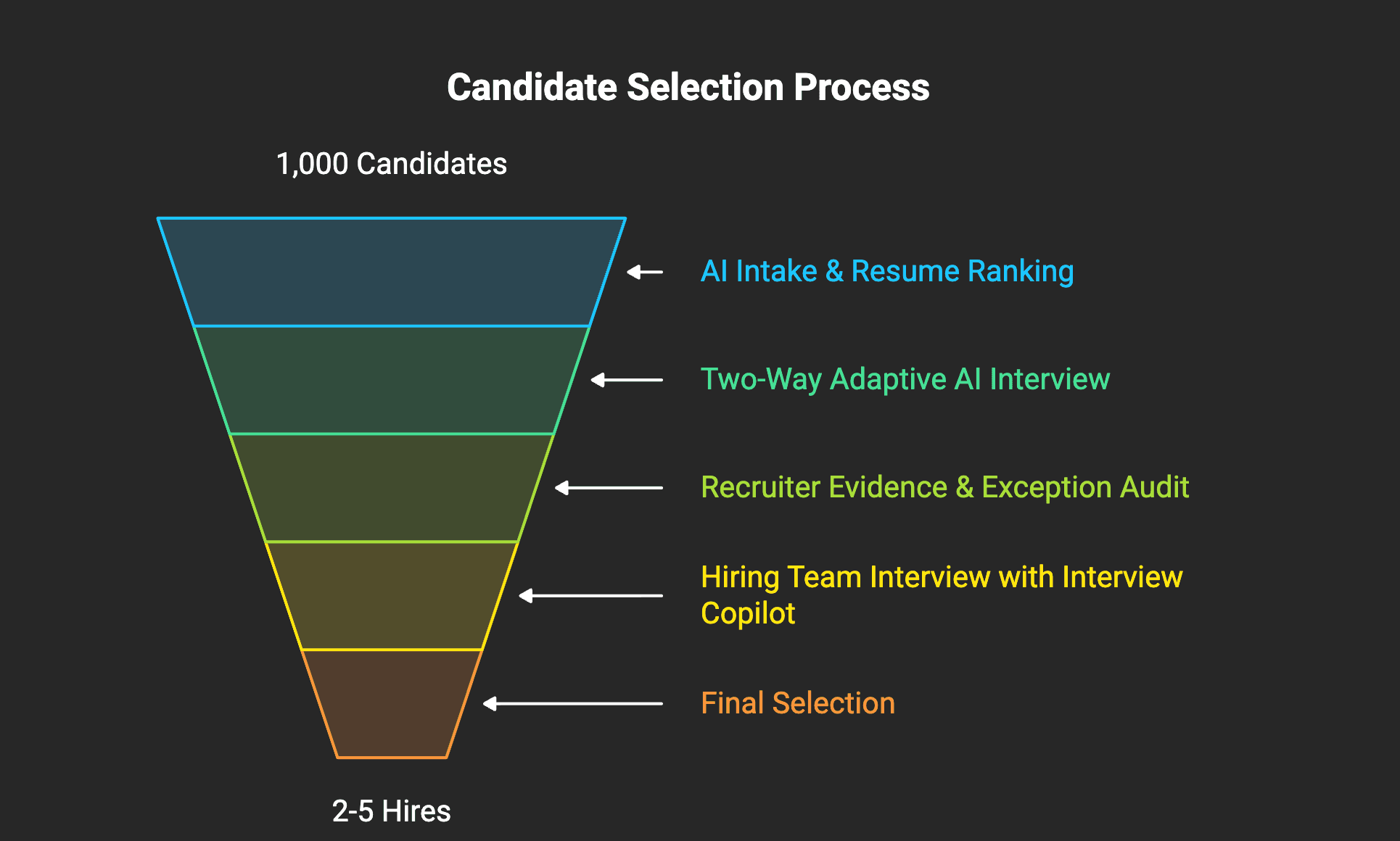
Workflow Stage | Primary Technology / Owner | Responsibilities & Deliverables |
1. Job Description & Rubric Design | Recruiter + Hiring Manager | Define core competencies, knock-out criteria, and scoring rubrics before posting the role. |
2. Intake & Eligibility Ranking | AI candidate screening | Screen out non-eligible profiles based on objective criteria (e.g., work authorization, licensing). Rank remaining applicants with score rationales. |
3. Asynchronous First-Round Screen | Execute automated 20-minute adaptive interviews evaluating role-specific competencies with real-time follow-ups. | |
4. Scoring & Fraud Audit | Interview intelligence platform | Synthesize technical performance, check fraud detection signals, and flag anomalies or exceptions. |
5. Shortlist Approval | Human Recruiter | Review evidence packages, transcript summaries, and video clips for top-scoring candidates to finalize live interview lists. |
6. Live In-Depth Interviews | Hiring Team + Interview copilot | Conduct structured live interviews using real-time prompt assistance and objective scorecards. |
What AI Should Automate—and What Humans Should Retain
Maintaining algorithmic safety and candidate trust requires strict operational boundaries between automated execution and human oversight.
Task / Responsibility | Fully Automated | AI-Assisted | Human-Owned | Operational Rationale |
Knock-out Qualification Checks | ✓ | Binary criteria (work rights, shift availability) can be objectively validated instantly. | ||
First-Round Technical & Soft Skill Screens | ✓ | AI recruiters deliver standardized, rubric-bound evaluations without interviewer bias or fatigue. | ||
Interview Summarization & Score Generation | ✓ | Interview intelligence tools extract key insights, but require human validation. | ||
Live Interview Question Generation | ✓ | An interview copilot dynamically suggests follow-up probes based on initial screening gaps. | ||
Shortlist Selection & Rejection Finalization | ✓ | Humans must audit exception cases, evaluate context, and approve final candidate progression. | ||
Final Hiring Decision & Offer Approval | ✓ | High-stakes employment decisions remain 100% human-owned to comply with NYC LL144 and EEOC directives. |
How to Maintain Quality at High Volume
Scalability is useless if screening accuracy degrades. To maintain high candidate quality across large applicant pools:
1. Objective Scoring Rubrics
Move away from open-ended recruiter notes. Build rubric-based scoring models where every candidate response is evaluated against fixed criteria (e.g., 1–5 scale with explicitly defined behavioral anchors).
2. Adaptive Two-Way Follow-Up Probing
Static video submissions or surface-level questionnaires allow candidates to memorize scripted answers. Modern AI recruiting tools use two-way conversational interviews: if a candidate gives a vague response, the AI interviewer dynamically asks a clarifying follow-up probe before scoring.
3. Evidence-Backed Scorecards
Never accept a bare numerical score. Require interview intelligence platforms to link every rating to verbatim transcript snippets and timestamped evidence.
[Candidate Score: 4.5/5 - Technical Architecture]
└── Supporting Evidence (04:12): "When scaling our microservices to 50k RPM,
we implemented Redis caching at the gateway level, reducing database load by 40%."
└── AI Reasoning: Candidate demonstrated practical application of distributed caching
and quantified performance impact.
How to Protect Candidate Experience at High Volume
High-volume applicant funnels often suffer from bad candidate communication ("resume black holes"). AI-driven workflows improve candidate sentiment when deployed responsibly:
Instant Updates: Provide immediate acknowledgment upon application submit and automated scheduling for first-round screens within minutes.
24/7 Screening Flexibility: Allow candidates to complete their adaptive first-round screen at their convenience across time zones and schedules.
Accessibility & Accommodations: Provide text-based screen alternatives, closed captioning, and clear pathways to request manual human accommodations.
Transparent Human Escalation: Inform candidates up front that an AI system supports first-round screening, and provide a direct contact path to a recruiter if technical or process issues arise.
Fraud, Cheating, and Identity Risks
High-volume remote screening faces increasing risks of fraud, proxy interviews, and AI-assisted cheating. Mitigate these risks using multi-layered verification:
Identity & Device Verification: Validate IP addresses, browser environments, and webcam integrity during the screen.
Behavioral & Telemetry Signals: Monitor window-switching patterns, copy-paste activities, and real-time audio/video sync anomalies.
Adaptive In-Depth Probing: Challenge memorized or LLM-generated responses by asking unexpected, scenario-based follow-up questions tailored to candidate answers.
Human Review Thresholds: Flag suspicious telemetry sessions automatically for manual recruiter audit before disqualification.
Note on Detection Limits: No automated system prevents 100% of proxy or cheating attempts. Detection signals must serve as risk flags for human review—not automatic, unappealable rejections.
A Practical Implementation Plan: Pilot to Production
Deploying an AI hiring platform across your organization requires a phased rollout to ensure compliance and team adoption.
Phase 1: Pilot & Calibration (Weeks 1–3):Establish baseline accuracy without affecting active candidate outcomes.
Run the AI candidate screening system in parallel with existing recruiter screens for a sample role (150–200 applicants). Compare AI scores against recruiter evaluations to calibrate rubrics and eliminate variance.
Phase 2: ATS Integration & Recruiter Playbooks (Weeks 4–5):Connect data pipelines and train recruitment operations.
Integrate the platform into your primary candidate screening software (ATS). Establish standardized playbooks detailing how recruiters audit exceptions, review scorecards, and approve shortlists.
Phase 3: Controlled Rollout (Weeks 6–8):Launch on high-volume requisitions.
Deploy automated screening across targeted high-volume roles (e.g., customer support, entry-level engineering, retail). Monitor completion rates, candidate feedback, and time-to-screen metrics weekly.
Phase 4: Full Production & Compliance Audit (Week 9+):Scale across volume roles and complete ongoing governance.
Expand platform coverage across all applicable funnels. Conduct quarterly bias audits and adverse impact reviews aligned with NIST AI RMF standards.
Key Metrics to Measure Success
Track these operational metrics to evaluate your AI screening implementation:
Time-to-Screen: Average hours elapsed from application submission to first-round score availability (Target: < 24 hours).
Recruiter Capacity Saved: Net reduction in manual screening hours per open requisition (Target: 70–85% reduction).
Screen Completion Rate: Percentage of invited candidates who complete the first-round AI screen (Target: > 80%).
Pass-Through Quality: Percentage of recruiter-approved shortlist candidates accepted by hiring managers for live interviews (Target: > 85%).
Adverse Impact Ratio: Four-fifths rule (80% rule) monitoring across protected demographic groups to ensure bias-free screening.
How JobTwine Approaches High-Volume Hiring
JobTwine simplifies high-volume talent acquisition with JayT, an autonomous AI recruiter built for scale, fairness, and operational control.
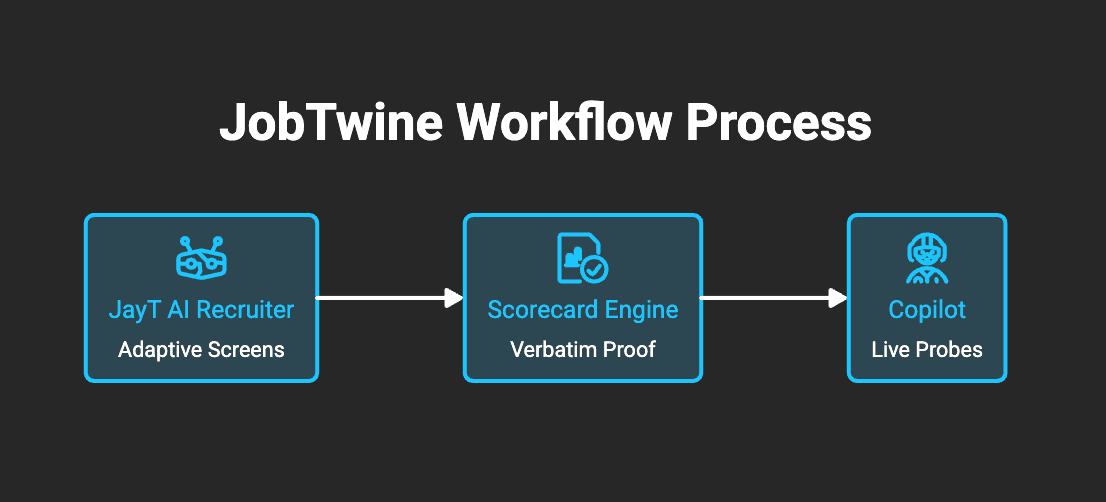
Adaptive 2-Way Interviewing: JayT conducts structured, natural conversations, evaluating candidate responses dynamically rather than relying on static question scripts.
For a product-level comparison, see how JobTwine compares with Spark Hire.
Evidence-Linked Scoring: Every candidate rating includes verbatim transcript citations and audio/video proof points, eliminating black-box scoring.
Human-in-the-Loop Workflow: JayT handles volume intake and initial screens while leaving final shortlisting, candidate communication, and hiring decisions in human hands.
Deep ATS Sync: JobTwine integrates directly into your existing ATS workflow, keeping candidate stages, scores, and status updates synchronized across your technology stack.
Frequently Asked Questions
How does AI candidate screening reduce bias compared to human resume reviews?
AI candidate screening applies fixed, rubric-based criteria to every candidate equally, ignoring demographic indicators, resume formatting variations, or interviewer fatigue. Continuous bias auditing ensures the system maintains compliance with guidelines like NYC LL144 and EEOC standards.
Does using an AI recruiter lower candidate completion rates?
No. When candidates can complete flexible, 24/7 screens on their own time without back-and-forth scheduling delays, completion rates regularly exceed 80–85%—higher than traditional phone-screening schedules.
Can an AI interviewer evaluate technical or domain-specific roles?
Yes. Platforms like JobTwine customize interview rubrics and adaptive follow-up questions to technical domains, coding practices, customer service scenarios, and leadership competencies.
How does AI screening integrate with our existing ATS?
Modern AI recruiting tools connect via standard REST APIs or pre-built integrations to push candidate scores, interview transcript links, and status changes directly into your system of record.
Disclosure: This guide is produced by JobTwine. While our platform (including our AI recruiter, JayT) provides the underlying infrastructure for this workflow, all calculations, guardrails, and compliance recommendations are grounded in primary sources and verifiable recruiter-hour benchmarks. Compliance Standards: Aligned with the NIST AI Risk Management Framework (AI RMF) and NYC Local Law 144 (AEDT) guidance. |