
Compare automated candidate screening vs manual screening for speed, accuracy, bias, and scale. See which approach fits your hiring strategy.

Automated candidate screening is faster than manual screening when application volumes are high because AI software can evaluate large candidate pools simultaneously, allowing recruiters to move from reviewing every application to reviewing the candidates who require meaningful human attention.
Speed is the most obvious advantage of automation, but it has a wider impact on the hiring process. Slow screening can delay shortlists, increase recruiter workload, create bottlenecks for hiring managers, and cause strong candidates to move elsewhere before the organisation responds.
SHRM's 2026 research on recruiting executives found that 85% expect automated resume screening tools to become more prevalent, while 87% expect broader AI and automation in recruiting to increase. The numbers explain why adoption is accelerating, but speed should not become the only measure of success.
A screening system that rejects relevant candidates in seconds is not an improvement over a recruiter who takes longer but makes better decisions. The objective should be to shorten the time between application and meaningful evaluation without lowering the quality of the candidate pool. For high-volume hiring, that means using automation to process the volume and recruiters to evaluate the context.
Does AI-Powered Candidate Screening Produce Better Shortlists?
AI-powered candidate screening can produce better shortlists when it evaluates candidates against clear, job-relevant criteria and is validated against real hiring outcomes. It is less effective when organisations automate vague requirements, rely on simplistic keyword matching, or treat AI recommendations as final decisions.
Manual screening has a genuine strength: human context. An experienced recruiter may recognise that a candidate has transferable skills, understand an unusual career transition, or see relevance that is not obvious from a job title or keyword.
However, manual screening also introduces inconsistency. Different recruiters may interpret the same requirements differently. The same recruiter may also evaluate candidates differently depending on workload, time pressure, or the number of applications already reviewed. AI can help standardise the initial evaluation, but only if the organisation has first defined what it is actually looking for.
This is why JobTwine's approach to AI-powered screening focuses on the relationship between job requirements and candidate evidence, rather than treating resume screening as a simple keyword search. A candidate should not be considered relevant merely because their resume contains the same words as the job description. The system should help recruiters understand whether the candidate's skills, experience, and background align with what the role actually requires.
Keyword matching looks for terms. AI-powered candidate screening should help interpret relevant experience in context.
Is AI-Powered Candidate Screening More Accurate Than Manual Screening?
AI-powered candidate screening is not automatically more accurate than manual screening, but it can improve consistency and reduce workload when its criteria are aligned with validated job requirements and its recommendations remain subject to human review.
Accuracy in candidate screening is often misunderstood. It is not simply about identifying more candidates or reducing the number of applications that reach recruiters. The real question is whether the process consistently identifies candidates who are genuinely qualified for the next stage.
A useful screening system should help recruiters distinguish between clear matches, clear non-matches, and candidates whose profiles require further human investigation. That third category is particularly important.
Candidates often have complex backgrounds. A person may have relevant experience under a different job title, have moved between industries, or possess transferable skills that are difficult to capture through rigid rules. When the evidence is ambiguous, the right response is not necessarily automatic rejection. It is human review. This is where AI and recruiters can complement each other.
AI can handle the scale and repetition involved in reviewing large candidate pools. Recruiters can investigate exceptions, interpret context, and challenge recommendations that do not appear reasonable.
The goal is therefore not to create a system where AI and humans always agree. The goal is to create a process where disagreement can be identified, investigated, and used to improve the screening framework.
Automated Candidate Screening vs Manual Screening: Which Is More Consistent?
Automated candidate screening is generally more consistent because the system can apply the same predefined criteria across a large candidate pool, while manual screening can vary between recruiters and across different stages of the hiring process.
Consistency matters because candidate evaluation is often influenced by human workload and interpretation. A recruiter reviewing the first 20 applications of the day may approach screening differently from someone reviewing the 200th application after several hours of repetitive work.
Automation can reduce some of that variation. But consistency alone is not enough.
A system can consistently apply the wrong criteria just as easily as the right ones. If the organisation has defined an unrealistic job profile or prioritised irrelevant qualifications, automation simply scales the problem.
This leads to a principle that should guide every AI screening implementation: Do not automate a screening process until you understand whether the process itself is producing the right outcomes.
The technology should follow the hiring strategy. It should not define the hiring strategy.
Before implementing automated candidate screening, organisations should establish which skills are genuinely required, which qualifications are mandatory, which experiences are preferred, and which factors should have no influence on the decision. That foundation determines whether automation creates meaningful consistency or simply creates consistent noise.
Does Automated Candidate Screening Reduce Hiring Bias?
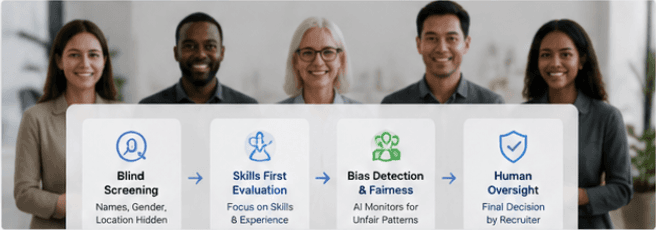
Automated candidate screening can reduce some forms of subjective inconsistency, but it does not automatically eliminate bias and can introduce new risks when historical data, poorly designed criteria, or unvalidated models influence candidate evaluation.
This is one of the most important considerations in the automated candidate screening vs manual screening debate.
Manual screening is not inherently objective. Recruiters can be influenced by names, schools, previous employers, career gaps, location, writing style, and assumptions about what a successful candidate should look like.
AI can reduce some of those influences when the screening process is deliberately structured around job-relevant evidence. However, AI systems can also reproduce patterns found in historical hiring data. If those historical decisions contain bias, automation can potentially make the pattern more consistent and more difficult to notice.
That is why responsible AI screening requires monitoring rather than blind trust.
Organisations should examine how candidates move through each stage of the hiring funnel and investigate whether certain groups experience materially different outcomes. They should also monitor false negatives, candidate pass-through rates, recruiter overrides, and differences between AI recommendations and final hiring decisions.
At JobTwine, we believe human oversight is essential for precisely this reason. AI should help recruiters process information and identify relevant candidates, but the recruiter must remain able to question the output and understand the basis for the recommendation.
How Does Automated Candidate Screening Change the Recruiter's Role?
Automated candidate screening changes the recruiter's role by reducing repetitive application review and allowing more time for candidate engagement, hiring manager collaboration, structured evaluation, and decisions that require human judgement.
This is where the value of automation extends beyond efficiency.
Recruiters do not create their greatest value by manually opening hundreds of resumes. Their expertise matters more when they understand what a hiring manager actually needs, engage candidates, evaluate complex profiles, manage stakeholders, and improve the hiring process.
SHRM's research found that 89% of HR professionals whose organisations use AI to support recruiting reported time or efficiency benefits. The research also found that 36% reported reduced recruitment, interviewing, or hiring costs, while 24% said AI improved their ability to identify top candidates.
The opportunity, therefore, is not to remove recruiters from screening. It is to remove the repetitive work that prevents recruiters from doing the parts of hiring that require expertise.
That is a distinction JobTwine considers central to responsible AI adoption. AI should increase the recruiter's capacity for judgement rather than remove the recruiter from the process.
Where Does Manual Screening Still Win?
Manual screening remains valuable when candidate context, transferable experience, unusual career paths, or nuanced judgement can materially affect whether a person is suitable for a role.
Consider senior or specialist hiring. A candidate may have an unconventional career path but possess highly relevant experience that does not map neatly to the language of the job description. A recruiter with industry knowledge may immediately recognise the value of that experience.
Manual review is also important when the evidence available to an AI system is incomplete or ambiguous. If an automated screening system cannot confidently determine whether a candidate meets the requirements, that should create an opportunity for human review rather than an automatic rejection.
The most effective approach therefore is automation for scale, human judgement for context, and structured processes to connect the two.
What Are the Biggest Risks of Automated Candidate Screening?
The biggest risks of automated candidate screening come from poor criteria, hidden bias, weak explainability, excessive reliance on AI recommendations, and insufficient human oversight rather than from automation itself.
The first risk is automating unclear requirements. If the organisation cannot clearly explain what makes someone qualified, the AI system will struggle to do so reliably.
The second is relying too heavily on historical hiring data. Previous decisions may reflect outdated preferences or bias that should not be reproduced.
The third is treating an AI recommendation as a final decision. A screening recommendation should give recruiters useful evidence, not remove their responsibility to evaluate the candidate.
There is also a risk of creating a process that recruiters cannot explain. If a candidate challenges a decision and the recruiter cannot understand why the system ranked or rejected them, the organisation has created an accountability gap. This is why explainability matters.
A recruiter should be able to understand the basis of an AI-assisted screening recommendation well enough to review it, challenge it, and communicate the decision process when necessary.
The most dangerous implementation is therefore not one that uses too little AI. It is one that uses AI without sufficient visibility, validation, or accountability.
How Should Companies Combine Automated Candidate Screening With Human Review?
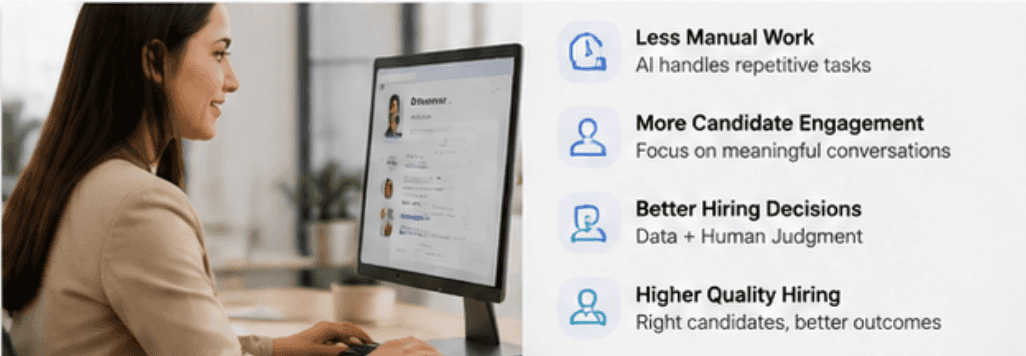
Companies should use automated candidate screening to process high-volume, repeatable evaluation while keeping recruiters responsible for reviewing ambiguous cases, challenging recommendations, and making accountable hiring decisions.
A practical workflow begins with a clear job description and a defined set of competencies that genuinely matter for success. Organisations should distinguish between essential requirements and preferred qualifications before configuring screening criteria.
The AI system can then evaluate and prioritise the candidate pool, allowing recruiters to spend less time reviewing every application and more time examining the candidates who require meaningful judgement.
Recruiters should also review borderline cases rather than allowing automation to create an invisible rejection layer. After implementation, organisations should compare AI recommendations with recruiter decisions and eventual hiring outcomes.
This creates a feedback loop that improves the process over time. The result is a human-led process supported by AI. That distinction is fundamental to how JobTwine approaches AI in recruiting.
What Should Recruiters Measure After Implementing Automated Candidate Screening?
Recruiters should evaluate automated candidate screening by the quality of the candidates it surfaces and the outcomes those candidates produce, rather than measuring success only by processing speed or the number of resumes screened.
Time to shortlist is useful, but it is only one measure. Teams should also examine qualified candidate rates, interview-to-offer ratios, quality of hire, false negatives, candidate pass-through rates, recruiter overrides, candidate drop-off, and hiring manager satisfaction.
One metric deserves particular attention: the human override rate.
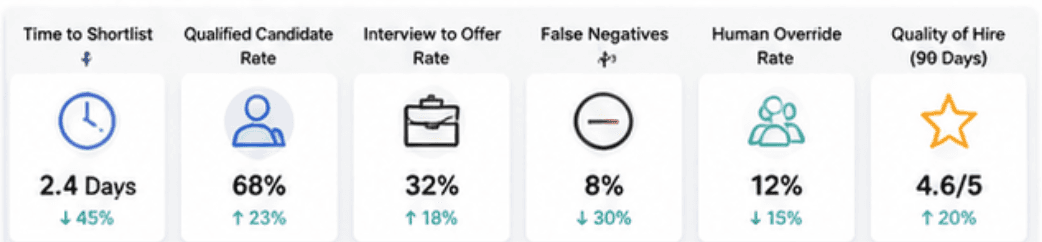
If recruiters frequently reject AI recommendations, the system may not reflect the organisation's actual hiring criteria. If recruiters almost never challenge the recommendations, that may also deserve investigation. A healthy AI-assisted process should allow disagreement and make it possible to understand why the disagreement occurred.
The objective is not to make humans and AI agree all the time. The objective is to make the overall hiring process better.
Automated Candidate Screening vs Manual Screening: Which Should Your Company Choose?
Companies should choose automated candidate screening when they manage high application volumes, need faster shortlists, or want greater consistency in early-stage evaluation. Manual screening remains important when roles require significant contextual judgement, and most organisations will benefit from combining both approaches.
Hiring Situation | Recommended Approach |
Small candidate pool for a specialist role | Manual or hybrid |
Hundreds of applications | Automated screening with human review |
Thousands of applications | AI-powered screening with structured oversight |
Highly regulated hiring | Automated screening with strong human governance |
Executive hiring | Human-led with technology support |
High-volume frontline hiring | Automated screening with structured validation |
Complex specialist hiring | Hybrid screening |
Repetitive qualification checks | Automation |
The more repetitive and high-volume the screening task, the stronger the case for automation. The more nuanced and context-heavy the decision, the more important human judgement becomes. The best recruiting teams will not ask whether AI should replace manual screening.
They will ask which parts of the process should be automated, which should remain human, and how the two can work together without creating an accountability gap.
The Future of Automated Candidate Screening Is Not Less Human. It Is More Intentional.
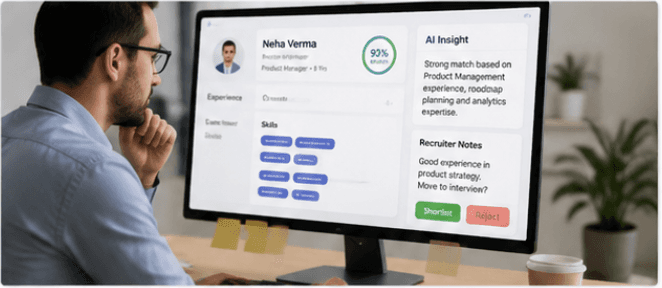
The real value of automated candidate screening is not that it replaces manual screening. It is that it changes where recruiters spend their limited time and attention.
Recruiting teams will continue to face large candidate pools, pressure to move faster, and expectations to deliver better hiring outcomes with fewer resources. AI can help address those challenges, but the organisations that benefit most will not necessarily be those that automate the most.
They will be the organisations that understand what should be automated and what should not. Manual screening provides context. Automation provides scale. AI-powered candidate screening can connect the two by processing large candidate pools against structured criteria and directing recruiters toward the candidates who deserve closer attention.
But that model only works when humans remain accountable for the process.
At JobTwine, our view is straightforward: AI should reduce the operational burden of screening without turning hiring decisions into a black box. Recruiters should be able to use AI to move faster while retaining the ability to understand, question, and validate the recommendations they receive. That is the real answer to the automated candidate screening vs manual screening debate.
The future of recruiting is not about choosing between humans and AI. It is about building hiring workflows where AI handles scale and repetition, while recruiters retain the context, judgement, and accountability that make high-quality hiring possible.
If your team is still spending hours manually reviewing resumes before every shortlist, the important question is whether your recruiters are spending their time on the work where human judgement actually makes a difference.
Frequently Asked Questions
Is automated candidate screening better than manual screening?
Automated candidate screening is generally more effective for high-volume hiring because it can process applications faster and apply consistent criteria across a large candidate pool. Manual screening remains valuable for complex roles where context and human judgement can materially affect the evaluation. A hybrid approach often provides the strongest balance.
Can AI-powered candidate screening replace recruiters?
AI-powered candidate screening can reduce repetitive resume review, but it should not replace recruiters. Recruiters still need to review ambiguous profiles, challenge AI recommendations, interpret context, engage candidates, and remain accountable for hiring decisions.
Does automated candidate screening reduce bias?
Automated candidate screening can reduce some forms of subjective inconsistency, but it does not automatically eliminate bias. Poor criteria, biased historical data, or weak model validation can create new risks. Organisations should monitor outcomes, pass-through rates, false negatives, and differences between AI recommendations and human decisions.
How accurate is automated candidate screening?
The accuracy of automated candidate screening depends on the quality of the job requirements, screening criteria, candidate data, and validation process. Organisations should evaluate systems using real hiring outcomes, qualified candidate rates, false negatives, recruiter overrides, and quality of hire rather than relying on a single accuracy score.
What is the best way to implement automated candidate screening?
The best approach is to use AI for high-volume initial screening while keeping human review for ambiguous and high-impact decisions. Organisations should define job-relevant criteria before deployment, monitor screening outcomes, review AI recommendations, and continuously improve the process based on evidence.