
How to evaluate an AI interviewer platform for natural conversation, relevant follow-ups, candidate trust, accessibility and human oversight.

An AI interview can feel human when the system listens, understands context, asks relevant follow-up questions and gives candidates room to clarify their answers. A realistic avatar can improve the sense of presence, but appearance alone is not enough. Recruiters should test the quality of the conversation, candidate control, accessibility, evidence provided and human oversight before choosing an AI interviewer platform.
Can an AI Interview Feel Human? What Recruiters Should Evaluate Before Choosing a Platform
The rapid shift toward automated hiring tools has left many talent acquisition leaders asking a fundamental question: Can an AI interview platform deliver a screening experience that actually feels like a human dialogue?
Most recruiters have experienced the alternative — one-way video screening tools that ask candidates to record mechanical answers to a ticking clock, or rigid chatbots that break the moment a candidate offers an unexpected nuance. When talent acquisition teams evaluate an AI interviewer platform, they often fixate on visual rendering. However, candidate experience is rarely determined by the pixels on a screen; it is determined by conversational dynamics.
To select a system that candidates respect and hiring teams trust, recruiting operations leaders must look past front-end visual sheen and evaluate the underlying conversation engine.
What “Human” Actually Means in an Interview Context
When candidates describe an interview as "human," they are rarely talking about whether the interviewer looked photorealistic. Instead, they are describing how it felt to participate in a two-way dynamic.
In professional recruitment, a human conversational dynamic relies on four specific qualities:
Active Listening: The ability to process complex, unstructured spoken responses and pull out core narrative details.
Contextual Adaptation: Modifying the next question based on what the candidate just shared, rather than blindly reading the next line on a script.
Mutual Respect for Pacing: Allowing natural pauses for reflection, recognizing when a candidate is formulating a thought, and acknowledging contributions before moving on.
Psychological Safety: Giving candidates the agency to correct themselves, ask for clarification, or inquire about the role.
An AI interview platform achieves a human feel not by imitating human emotion, but by respecting these conversational mechanics. When a platform demonstrates high conversational intelligence, candidates focus on sharing their achievements rather than fighting against an unyielding interface.
Why Most AI Interviews Still Feel Robotic
The dissatisfaction many candidates express toward early automated screening tools stems from predictable structural failures. Understanding these pitfalls allows talent acquisition teams to identify weak systems during procurement.
THE ROBOTIC AI INTERVIEW TRAP | |
Fixed Static Scripts | Asks question 2 regardless of candidate's answer |
Poor Turn-Taking | Interrupts candidate pauses or freezes abruptly |
Surface-Level AI | Fails to parse technical nuance or idioms |
One-Way Video Echo | Ticking clocks create high anxiety & low completion |
1. Rigid, Linear Questioning
Traditional one-way video software operates on static decision trees. If a senior software engineer mentions that they led a database migration during their answer to Question 1, a rigid tool will still ask Question 2 ("Tell me about a time you managed a complex technical project") without acknowledging that the candidate just answered it.
2. Broken Turn-Taking and Latency Gaps
Human dialogue relies on millisecond-level cues. Legacy screening tools suffer from high audio-processing latency. The result is either jarring interruptions—where the system cuts off a candidate who paused to collect their thoughts—or awkward, multi-second silences that break the flow of interaction.
3. Surface-Level Probing
Inferior AI interviewer software relies on static keyword matching. If a candidate uses an industry-specific synonym or an indirect narrative style, the system fails to pick up on the underlying competency and defaults to irrelevant canned follow-ups.
4. Lack of Candidate Control
In a typical one-way screening setup, candidates face a timer counting down while staring at their own camera feed. There is no route to ask for clarification, no opportunity to re-state a point, and no way to inquire about basic job parameters. This lack of agency drives high abandonment rates across candidate pipelines.
Avatar vs. Conversation Engine: Don't Confuse Appearance with Intelligence
As visual AI technology has advanced, many platform vendors have focused heavily on visual avatars. While a visually responsive presence provides an anchor for eye contact and creates a sense of structured presence, an avatar alone does not make an interview feel human.
To understand how candidates evaluate an AI interview candidate experience, compare the role of the visual layer against the underlying conversation intelligence:
Layer | Primary Function | Candidate Impact | What Happens If It Fails |
Visual Avatar Layer | Offers visual presence, subtle non-verbal cues, and lip-syncing. | Gives the candidate a visual focal point; sets a professional tone. | Feels like a "talking head" detached from the conversation if the underlying logic is weak. |
Conversation Engine | Controls turn-taking, semantic comprehension, context retrieval, and follow-up generation. | Determines whether the candidate feels heard, understood, and fairly evaluated. | The interview breaks down into a frustrating, unyielding interrogation. |
A photorealistic AI avatar interviewer reading a static script feels uncanny and transactional. Conversely, a clean visual interface backed by a context-aware conversation engine yields an engaging, fluid dialogue where candidates naturally forget they are speaking to an automated system.
The Human Interview Test: 8 Real-World Tests for Talent Acquisition
Instead of relying on vendor demos that follow a pre-recorded script, recruiting operations leaders should run the Human Interview Test. Log into the platform as a test candidate and run these eight specific stress-tests to evaluate real-time adaptability.
THE HUMAN INTERVIEW TEST | |
Context Test | Plant an early detail; verify late-stage recall |
Follow-Up Test | Give a vague answer; test depth probing |
Pause Test | Stop mid-sentence for 5s; evaluate silence handling |
Correction Test | Self-correct mid-stream; check transcript accuracy |
Clarification Test | Ask "What do you mean?"; test restructuring ability |
Candidate-Q Test | Ask about company culture; test knowledge guardrails |
Accessibility Test | Request non-standard formatting or accommodations |
Evidence Test | Review scoring output; trace score to actual transcript |
1. The Context Test
What to do: Drop an important piece of background context early in the session (e.g., "When I managed the regional expansion at my previous company in 2024...").
What good looks like: The platform remembers this context later in the interview when asking about project management or leadership, referencing the 2024 expansion naturally rather than treating it as isolated data.
2. The Follow-Up Test
What to do: Provide a deliberately high-level or vague response to a competency question (e.g., "I'm generally very good at resolving conflict between team members.").
What good looks like: The AI refrains from moving to the next topic. It asks a structured follow-up: "Could you share a specific situation where two team members disagreed on a project baseline, and what exact steps you took to align them?"
3. The Pause Test
What to do: Pause mid-sentence for 4 to 6 seconds while formulating a complex answer, using natural vocal fillers like "um" or "let me think about how to frame this..."
What good looks like: The system's silence-detection engine recognizes that the candidate has not yielded their turn. It waits patiently without cutting in or marking the response as complete.
4. The Correction Test
What to do: Verbally correct a statement made earlier in the answer (e.g., "Actually, I misstated that metric—it was a 15% increase in retention, not 50%.").
What good looks like: The platform acknowledges the correction in its conversational flow and updates its internal evaluation record so that the candidate is assessed on the intended data point.
5. The Clarification Test
What to do: Interrupt the interviewer to ask for clarification on a complex scenario question (e.g., "Are you asking about financial risk or operational risk?").
What good looks like: The system pauses its script, clarifies the intent of the prompt using alternative phrasing, and asks if the candidate is ready to proceed.
6. The Candidate-Question Test
What to do: Turn the table and ask the platform a direct question about the company or role (e.g., "What are the core working hours for this distributed engineering team?").
What good looks like: The system provides an accurate response drawn from approved company information guardrails, or gracefully notes that a human recruiter will follow up on that specific detail.
7. The Accessibility Test
What to do: Attempt the interview using screen-reading software, request closed captioning, or trigger a request for alternative scheduling / text-based formats.
What good looks like: The platform offers seamless WCAG-compliant accessibility options, allowing candidates to adjust contrast, enable live captioning, or request human accommodation without penalty.
8. The Evidence Test
What to do: Complete the test interview and immediately open the recruiter dashboard to view the generated candidate output.
What good looks like: Every score, rating, or competency flag is mapped directly to verbatim candidate quotes and timestamped transcript segments. The system presents auditable evidence rather than arbitrary numeric scores.
Candidate-View Demonstration: Weak vs. Strong AI Responses
To understand how candidate perception varies based on platform sophistication, observe how a weak versus a strong system responds to the exact same candidate input during a technical screening.
Scenario
Role: Senior DevOps Engineer
Interviewer Prompt: "Can you describe a time when a production environment experienced an unexpected outage and how you handled it?"
Candidate Input: "We had a major incident last year where our primary database cluster stopped responding around 2:00 AM. I was on call, woke up, and jumped into the incident bridge. We realized it was a memory leak, so we temporarily failed over to the read-replica while running a patch."

The contrast in candidate sentiment is stark. In the weak system, the candidate feels interrogated by a glorified audio recorder. In the strong system, the candidate experiences a peer-level technical conversation that showcases their true capabilities.
What Recruiters Should Receive Post-Interview
An exceptional AI interviewer platform should lighten the administrative burden on recruiting teams while improving evaluation rigor. A conversational screening experience is only half the equation; the downstream intelligence delivered to recruiters must bestructured and evidence-based, and immediately actionable.
RECRUITER POST-INTERVIEW DASHBOARD | |
Full Transcript | Clean, speaker-diarized text record |
Video Evidence | Timestamped video clips tied to specific questions |
Playbook Scorecard | Competency ratings grounded in candidate quotes |
Integrity Data | Real-time anomaly & fraud detection alerts |
ATS Sync | One-click sync into Greenhouse, Workday, Lever, etc |
When evaluating candidate output, talent acquisition leaders should expect five core deliverables:
Full Verbatim Transcripts: High-accuracy, speaker-diarized transcripts that clearly attribute dialogue between the AI and the applicant.
Timestamped Video Highlights: The ability to click on a specific competency in the scorecard and instantly jump to the exact video frame where the candidate answered.
Playbook-Mapped Scorecards: Competency ratings mapped directly against the job brief created prior to the interview.
Integrity Signal Summaries: Unobtrusive monitoring metrics—such as tab-switching frequency or prolonged off-screen eye movements—that highlight potential integrity concerns without automated rejection.
Explainable Recommendations: Clear reasoning explaining why a candidate received a particular skill rating, backed by candidate quotes rather than black-box algorithms.
What Candidates Should Receive: Building Ethical Candidate Experience
Candidate trust hinges on transparency. When candidates understand how an automated interview works and how their data will be used, participation and satisfaction rates climb.
A candidate-first platform provides a clear, supportive framework throughout the workflow:
ETHICAL CANDIDATE JOURNEY | |
Upfront Disclosure | Clear notice that an AI avatar is conducting Round 1 |
Orientation & Prep | System check, trial audio run, tips for success |
Candidate Control | Pause options, accommodation routes, support access |
Process Visibility | Timelines for human recruiter review & next steps |
Clear Upfront Disclosure: Candidates should be informed before the session begins that they are speaking with an automated avatar interviewer.
System Checks & Onboarding: A low-pressure environment before the interview starts allows candidates to test their camera, microphone, and internet stability.
In-Session Support & Accommodations: Easy access to live technical assistance or a direct link to request an alternative format if they encounter accessibility challenges.
Transparent Next Steps: Clear post-interview communication outlining when a human recruiter will review their submission and when they can expect feedback.
When Human Interviewers Are Still Necessary
Adopting an autonomous screening tool does not mean removing humans from recruitment. The goal of automating initial screens is to protect human energy for the stages where human judgment matters most.
Talent acquisition leaders should map clear operational boundaries between automated screening and human evaluation:
AUTOMATED vs. HUMAN INTERVIEW BOUNDARIES | |
AUTOMATED FIRST ROUND (AI Avatar) | |
High-volume resume/skill screening | Final culture alignment & values fits |
Core competency verification | Executive & leadership positioning |
Consistent benchmark alignment | Offer negotiation & candidate sell |
Fraud & integrity checks | Complex scenario role-playing |
When to Use Automated AI Screening
High-volume early-stage screening across hundreds or thousands of applicants.
Initial verification of technical, operational, or communication competencies against standardized job playbooks.
24/7 global candidate intake across multiple time zones without recruiter scheduling delays.
When Human Interviewers Must Lead
Executive and Leadership Hiring: Senior roles require high-touch executive search dynamics, relationship building, and nuanced organizational positioning.
Final Culture & Alignment Rounds: Assessing long-term team fit, shared values, and mutual alignment requires human empathy and lived experience.
Closing and Offer Negotiation: Candidates accept offers based on trust built with hiring managers and future peers—a connection that requires human relationship-building.
How JobTwine Delivers Conversational AI Screening
At JobTwine, we designed our platform to solve the candidate experience flaws that plague traditional automated screening tools. Rather than presenting candidates with static video prompts, JobTwine introduces JayT, an interactive avatar recruiter engineered for fluid, real-time conversation.

Here is how JobTwine approaches the initial screening experience:
Interactive Dialogue, Not Monologues: JayT conducts full first-round interviews by listening to responses, evaluating depth, and posing intelligent follow-up questions in real time.
Playbook-Driven Accuracy: Every interview is grounded in a structured role brief built from your job description. The underlying conversation engine evaluates candidates against verified role competencies.
Native Multilingual Support: JayT communicates natively in over 16 languages and regional accents without translation lag, expanding global talent access.
Built-In Fraud and Integrity Protection: Real-time monitoring flags script-reading, tab-switching, and live LLM assistance during the session, giving hiring teams confidence in candidate authenticity.
Human-In-The-Loop Control: JayT does not make hiring decisions. It compiles structured candidate evidence, scores competencies, and pushes structured scorecards directly into your Applicant Tracking System (ATS) so recruiters make the final call.
To see how an interactive avatar handles real-time dialogue, explore the JayT AI Avatar Recruiter page.
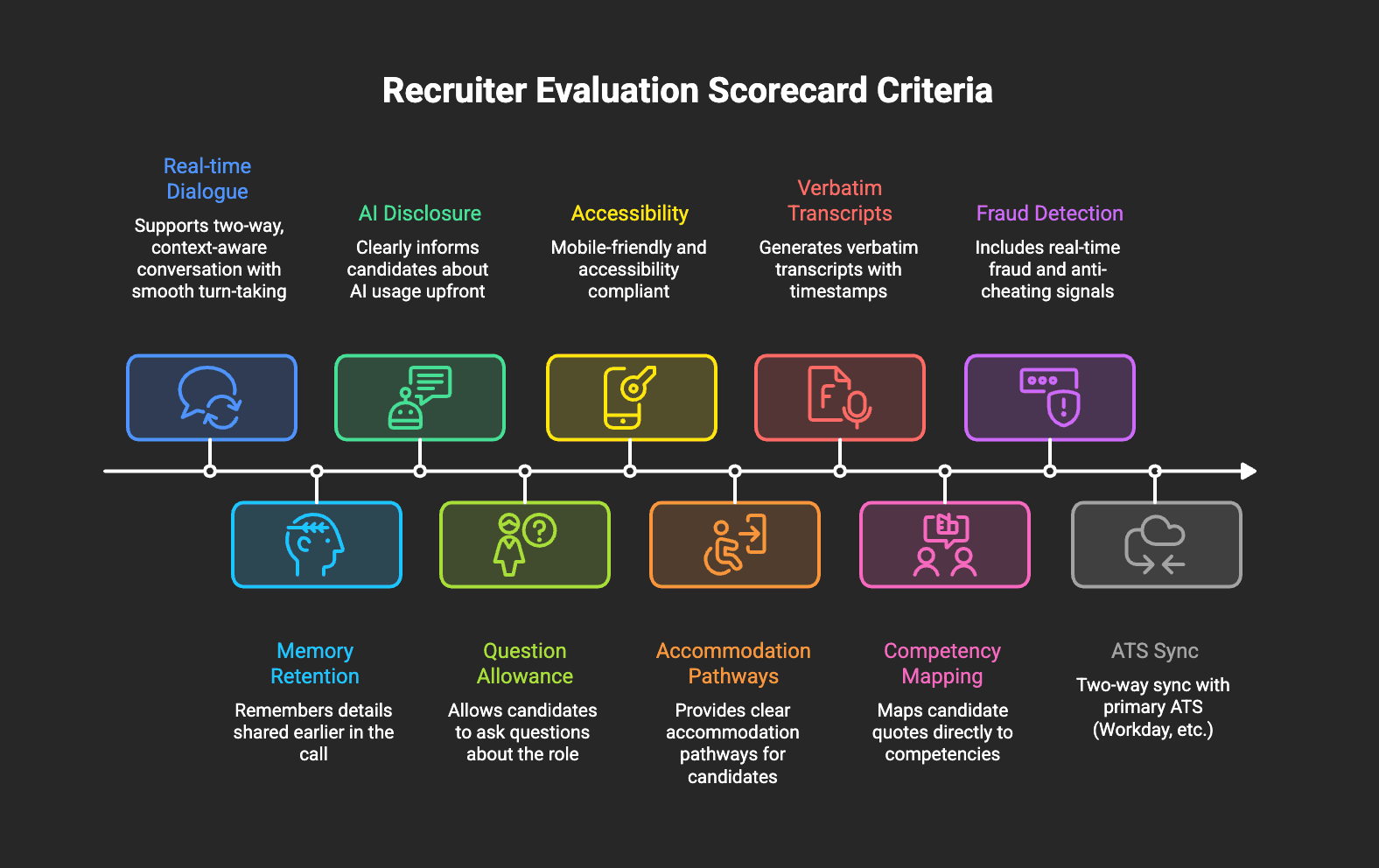
Recruiter Buyer Checklist: Evaluating AI Interview Software
Use this scorecard when evaluating an AI avatar interview platform during vendor demonstrations.
Frequently Asked Questions
Can an AI interview feel like a real conversation?
Yes. When an AI interviewer platform uses advanced natural language processing and real-time turn-taking engines, the experience feels like an interactive dialogue. The system listens to spoken answers, asks logical follow-up questions, and acknowledges candidate inputs rather than reading a static script.
How do candidates react to speaking with an AI avatar?
Data shows that when candidates are given a choice between answering one-way recorded prompts against a ticking timer or speaking with an interactive avatar, they overwhelmingly prefer the avatar. Interactive sessions achieve higher completion rates because candidates retain conversational agency.
Does an AI avatar interviewer make the final hiring decision?
No. Ethical recruiting platforms use AI to gather, structure, and summarize candidate evidence. The hiring team reviews the structured scorecards, video highlights, and candidate transcripts to make all final progression decisions.
How does conversational AI screening differ from traditional video interviews?
Traditional video interviews (often called asynchronous or one-way interviews) record candidates answering fixed prompts with no interaction. Conversational AI screening features a two-way dialogue where the system adapts its questions based on candidate responses, provides clarification, and asks for deeper detail when needed.
Conclusion: How to Choose an AI Interview Partner
Selecting the right platform is not about finding the most realistic animation; it is about choosing a partner that respects candidate time and empowers talent acquisition teams with accurate, structured evidence.
By running The Human Interview Test during procurement, recruiters can look past marketing claims and select an AI interview platform that balances conversational fluidity with rigorous, structured evaluation with appropriate bias monitoring and human oversight.
To experience how conversational AI transforms early-stage screening, test drive the JayT AI Avatar Recruiter today.