
Scale automated screening with confidence. Discover the 7 enterprise non-negotiables for AI avatar recruitment platforms to unlock real-time interview intelligence

The hiring market has moved past experimentation. AI Avatar interviews are now moving into operational infrastructure. The conversation has shifted from whether teams need AI avatar interviewers and has moved towards which platforms are actually worth deploying and which ones create more operational complexity than value.
While most AI avatars in the market are still in nascent stages, often limited to one-way recorded interviews, a few stand out because they not only offer the operational convenience of asynchronous interviews but also deliver full-fledged hiring intelligence that can think in real time and modify the conversation midway through.
If your team is evaluating which AI Avatar Recruitment Platform will suit your hiring need, here is the baseline every enterprise-ready platform should clear.
Why Traditional Screening Is Breaking Down
Recruiter inboxes flood with hundreds of applications the moment a role opens. And this is rarely for a single position. Most recruiters are managing multiple open roles simultaneously.
Hiring managers expect faster and more transparent hiring processes, all with the same team size they had three years ago.
AI Avatar interviews emerged as a structural response to this challenge: asynchronous interviews at scale, standardized evaluations, and structured hiring signals captured before a human recruiter even gets involved.
The problem is platform maturity varies significantly. The differentiator is not whether a platform uses an AI avatar. It is whether the platform improves hiring outcomes responsibly — and holds together operationally when volume, edge cases, and compliance requirements enter the picture.
The 7 Non-Negotiables for Teams to Decide
1. Transparency About the Process
Most candidates abandon AI-led interviews within the first few minutes, not because the technology fails, but because they do not understand the process they are stepping into.
A production-ready AI Avatar Recruitment platform solves this before the interview even begins. Candidates should clearly understand:
Whether the interview is being recorded
How the AI evaluates responses
Which competencies are being assessed
Who reviews the interview output
Platforms with strong transparency protocols consistently see higher interview completion rates and lower candidate drop-offs. More importantly, transparency is no longer just a candidate experiencing best practice. It is increasingly becoming a compliance expectation.
2. Structured Evaluation With Human Oversight at the Algorithm Level
"AI-led" does NOT mean "AI-unsupervised." The platforms TA leaders trust are the ones where humans configure the logic before it runs — and can audit it after.

Question banks, competency frameworks, scoring rubrics, and branching logic should be set and approved by the TA team. Not auto-generated and auto-deployed. When the algorithm scores a candidate or triggers a stage movement, the reasoning should be visible and reversible. Human override capability should be built into the workflow, not bolted on as an exception.
Global Regulations Are Moving in This Direction
Illinois Artificial Intelligence Video Interview Act
Requires employers to:
Inform candidates AI is being used
Explain how AI evaluates applicants
Obtain consent before interviews
Delete interview data upon request
New York City Local Law 144
Requires:
Advance notice of automated hiring tools
Disclosure of evaluation criteria
Bias audits for AI hiring systems
European Union AI Act
AI recruitment systems are increasingly being classified as high-risk systems, with requirements around:
Transparency
Human oversight
Bias monitoring
Record-keeping
Explainability
3. Avatar Experience — Expressions, Conduct, and Global Readiness
Candidates evaluate employer brands through every touchpoint in the hiring process. An avatar that reads as robotic, culturally misaligned, or inconsistently professional does not just reduce completion rates — it damages your brand among the candidates you most want to attract.
What this requires in practice: calibrated facial expression and emotional range, conversational professionalism that mirrors your best human interviewers, and active listening behavior — An Avatar restating what a candidate said, adapting follow-ups accordingly, not just marching through a script.
For global hiring teams, native avatar options and multilingual delivery are non-negotiable. A single-accent, single-appearance avatar conducting interviews in markets where it comes across as foreign creates measurable drop-off and resistance.
JayT, JobTwine's AI Avatar interviewer, supports multilingual interview delivery with an avatar library suited to global hiring contexts — because a locally resonant interview produces better candidate engagement and more accurate competency signals.
4. Two-Way Communication — Interruptions, Silence, Conflict
The failure mode most vendors do not showcase in a product demo is the most common one: what happens when the conversation goes off script.
A candidate interrupts mid-question. Goes silent for twenty seconds. Challenges the process. Gives an answer completely unrelated to what was asked.
A production-ready platform handles each of these in real time -
Interruptions are acknowledged gracefully without losing the interview's structure.
Silence is read accurately — thinking versus disengagement — and responded to accordingly.
Candidate frustration is de-escalated without abandoning the competency framework.
Follow-up questions are contextual, not just the next item on the list.
Platforms that cannot do this do not replace the recruiter in these moments. They create a new category of breakdowns the recruiter has to manage afterward.
5. Proctoring and Fraud Detection
Candidates taking AI’s help in the interviews are not a future risk. It is happening now. Using LLMs to generate real-time answers, referencing scripted responses on a second device, or having a third party conduct the interview on their behalf are all observed behaviors in 2025 and 2026 deployments.
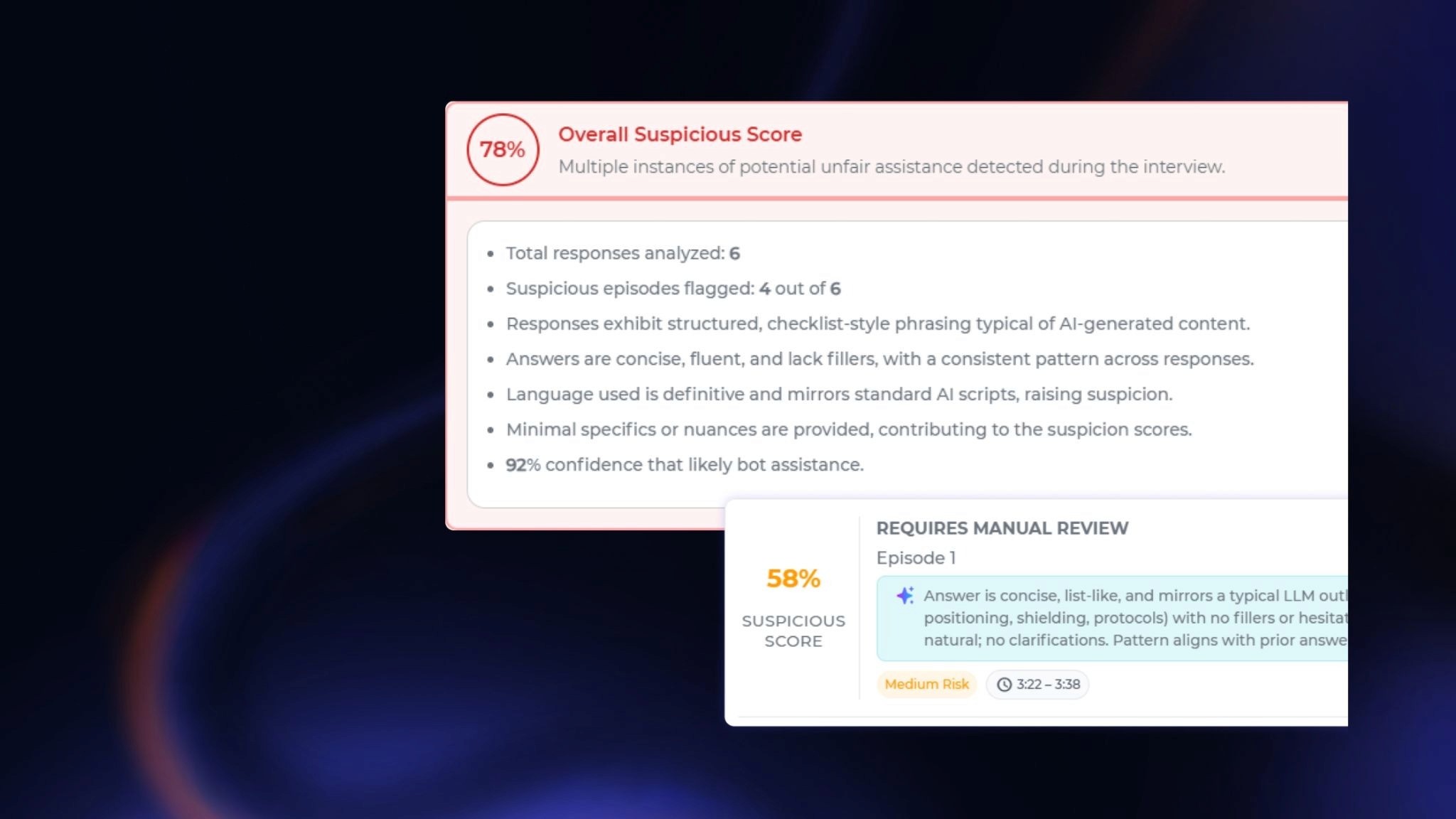
A shortlist from a platform without real-time fraud detection is not a shortlist of your best candidates. It is a shortlist of your best-coached ones.
Production-ready platforms flag tab switching, unusual latency patterns, LLM-style response characteristics, and face-match inconsistencies in real time.
They attach behavioral integrity scores to every session. And critically — they escalate flagged sessions to human review rather than making automated disqualification decisions. The platform surfaces the signal. A human makes the call.
6. Latency, Performance, and Accessibility
An AI Avatar interview that buffers or delivers responses with a half-second lag does not just frustrate candidates. It compromises the data you collect. Candidates adapt to latency — they speak faster, shorten answers, lose the conversational rhythm that produces authentic competency signals. The interview you receive is not the one the candidate would have given in a lower-latency environment.
Sub-2-second response latency is the technical floor for assessment validity. JayT is built to this threshold. Platforms operating above it are producing degraded data, regardless of how polished the interface looks.
For global hiring teams, performance consistency across geographies matters as much as peak performance. Accessibility compliance — WCAG 2.1 AA at minimum — is a legal baseline under the ADA and equivalent legislation, not an optional upgrade.
7. Security and Compliance
In 2026, compliance is a procurement requirement. Two regulatory frameworks now directly govern AI-led interview platforms in major markets.
NYC Local Law 144 requires annual independent bias audits, public posting of audit summaries, and candidate notification at least ten business days before an AI decision tool is used to evaluate them. Penalties run from $500 to $1,500 per violation per day.
The EU AI Act classifies AI recruitment tools as high-risk under Annex III. From August 2, 2026, mandatory risk assessments, bias testing, transparency disclosures, and human oversight mechanisms are required. Fines reach 35 million euros or 7% of global annual turnover.
The baseline your vendor must clear: SOC 2 Type II certification, GDPR-compliant data retention and deletion controls, role-based access architecture, data residency options for EU candidates, and the ability to produce bias audit data on demand. If your vendor cannot produce a SOC 2 Type II report or define what a bias audit of their platform looks like, that is a disqualifying answer.
Platform Comparison: How the Category Stacks Up
Platform | AI Avatar | Dynamic Follow-Ups | Structured Evaluation | Compliance | Human Oversight | Candidate Experience | Fraud Detection |
HireVue | Strong | Moderate | Strong | Strong | Strong | Moderate | Moderate |
Paradox | Moderate | Strong | Moderate | Strong | Moderate | Strong | Limited |
myInterview | Moderate | Limited | Moderate | Moderate | Moderate | Strong | Limited |
Talview | Strong | Moderate | Strong | Strong | Strong | Moderate | Moderate |
JobTwine | Strong | Strong | Strong | Strong | Strong | Strong | Strong |
What to Ask Before You Sign
Before committing to any AI Avatar platform, run this checklist.
Does the platform provide candidate-facing transparency before and after the interview?
Can you configure and audit the scoring logic?
Does the avatar hold up in non-English interviews and for candidates outside Western markets?
Can it handle interruptions, silence, and off-script moments without breaking?
Does it flag fraud signals and escalate them to humans — not auto-disqualify?
Does it perform consistently at sub-2-second latency across geographies?
Can it produce SOC 2 Type II, bias audit data, and GDPR deletion controls on request?
If the answer to any of these is unclear after the demo, the platform is not enterprise-ready.
The Next Generation of AI Avatar Hiring
The platforms that will define this category in the next two years will not be the ones with the most realistic avatars. They will be the ones that produce the most defensible hiring decisions — at speed, at scale, and under scrutiny.
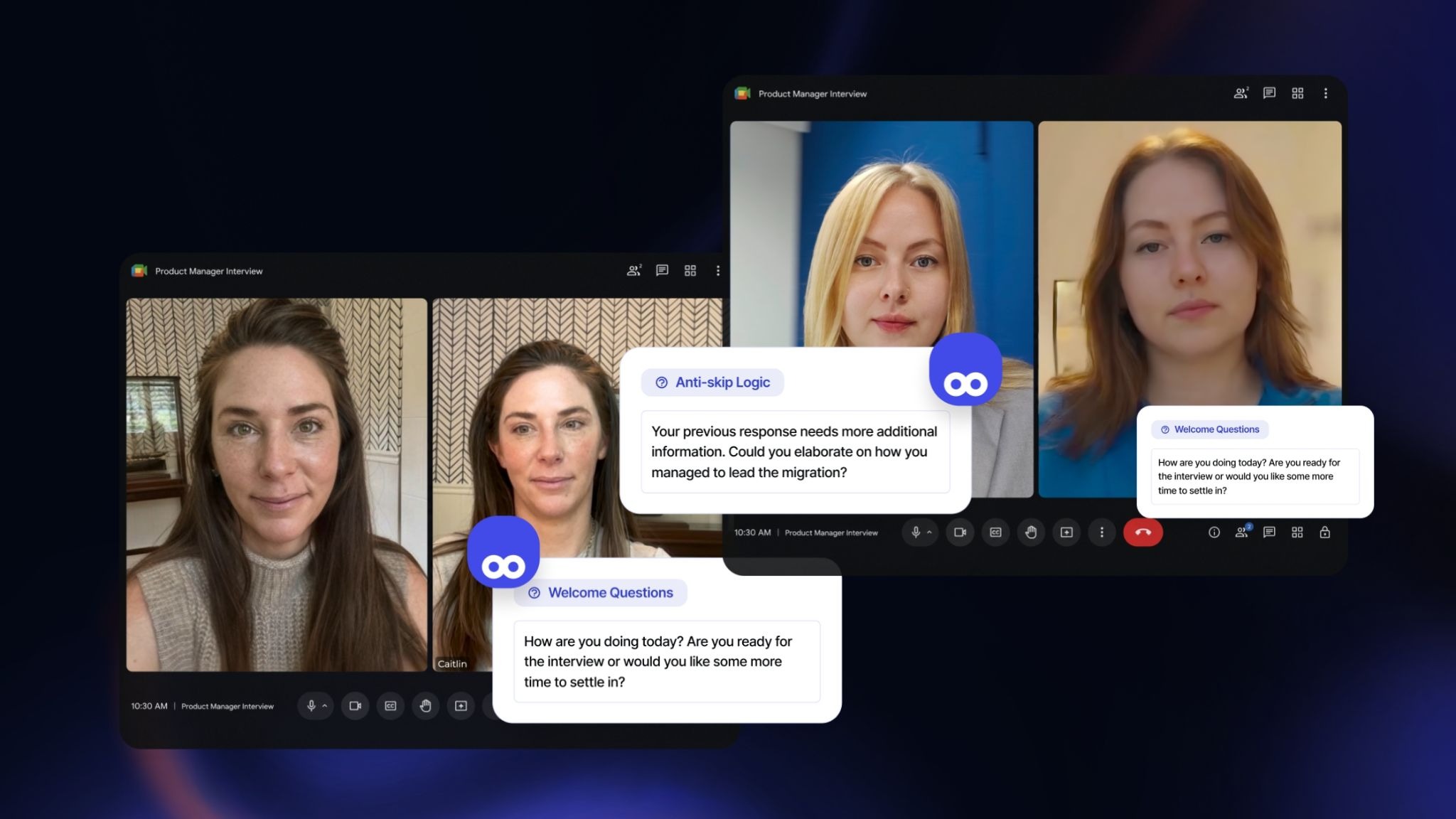
That means structured evaluation frameworks. Human oversight at the algorithm level. Candidate experiences that hold up globally. And compliance infrastructure that does not require your legal team to clean up after every deployment.
JobTwine built JayT for exactly this standard. From job post to qualified shortlist in 48 hours — with assessment data you can defend to a hiring manager, a legal team, or a regulator.
See JayT in a live session. Book a demo.