
How AI interview fraud detection spots proxy candidates, lip-sync deception, and teleprompters using gaze tracking, audio biometrics, and telemetry.

AI interview fraud detection uses computer vision, audio biometrics, and system telemetry to identify proxy test-takers, teleprompter usage, and generative audio-visual deepfakes during remote evaluations. Rather than relying on simple keyword flags, modern anti-fraud systems correlate micro-saccadic eye movements, phoneme-to-viseme lip-sync alignment, and browser focus events to verify candidate identity while preserving human oversight.
What Is the Current Threat Landscape in Remote AI Interviews?
Modern remote candidate fraud has evolved beyond simple search queries into sophisticated multi-vector deception. The most prevalent vectors in 2026 include proxy candidates, real-time LLM teleprompters, off-screen audio feeding, and synthetic visual deepfakes. Detecting these threats requires multi-layered technical surveillance rather than relying on an interviewer’s intuition.
As asynchronous screening and automated ai interviews have scaled across global recruiting workflows, candidate deception has scaled alongside them. Talent acquisition leaders face a technical threat landscape where dishonest candidates exploit remote boundaries to bypass standard evaluations. Unchecked hiring fraud introduces severe operational risks: replacing a bad engineering hire who bypassed technical screens routinely costs organizations between 1.5x to 3x that employee's annual salary.
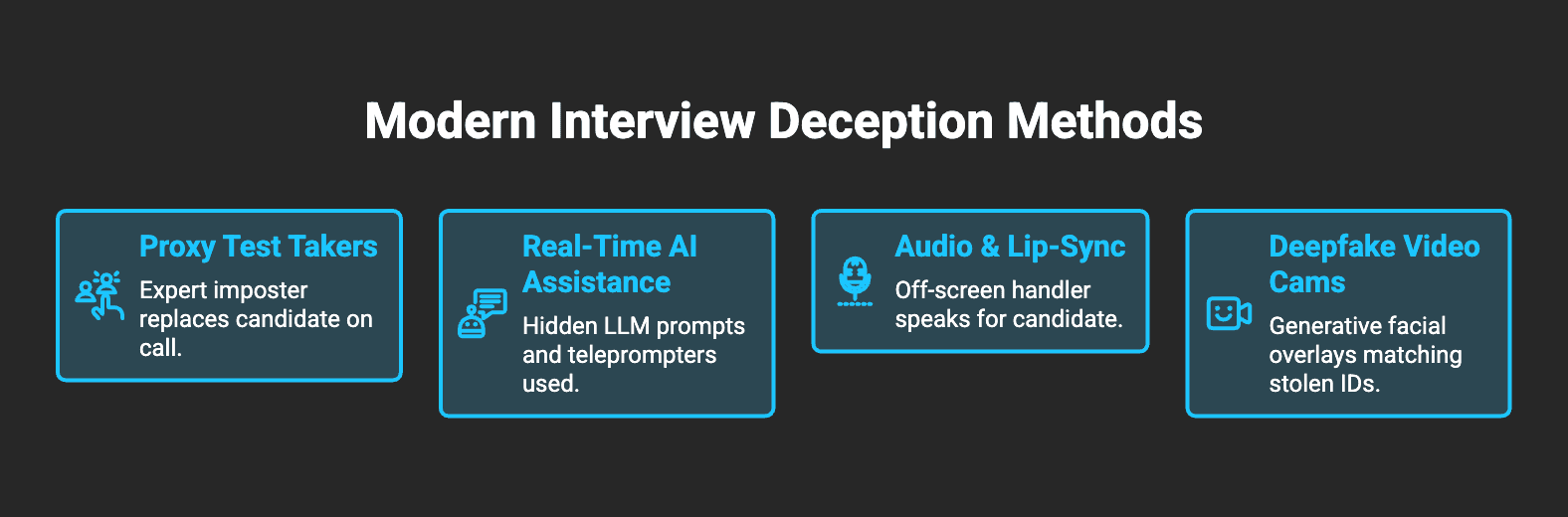
The Four Primary Fraud Vectors
Proxy Candidates: A highly skilled third-party expert impersonates the candidate during critical technical screens or live coding rounds.
Hidden Teleprompters & Dual Monitors: Candidates project live-generated LLM code or answer notes on secondary monitors positioned directly behind the camera lens.
Off-Screen Audio Feeding & Lip-Syncing: An off-screen handler speaks through a hidden earpiece while the candidate attempts to match lip movements in real time.
Generative Deepfakes & Masking: Fraudsters utilize real-time neural rendering filters to alter live webcam video feeds to match stolen government identification.
The 4-Layer Interview Integrity Architecture
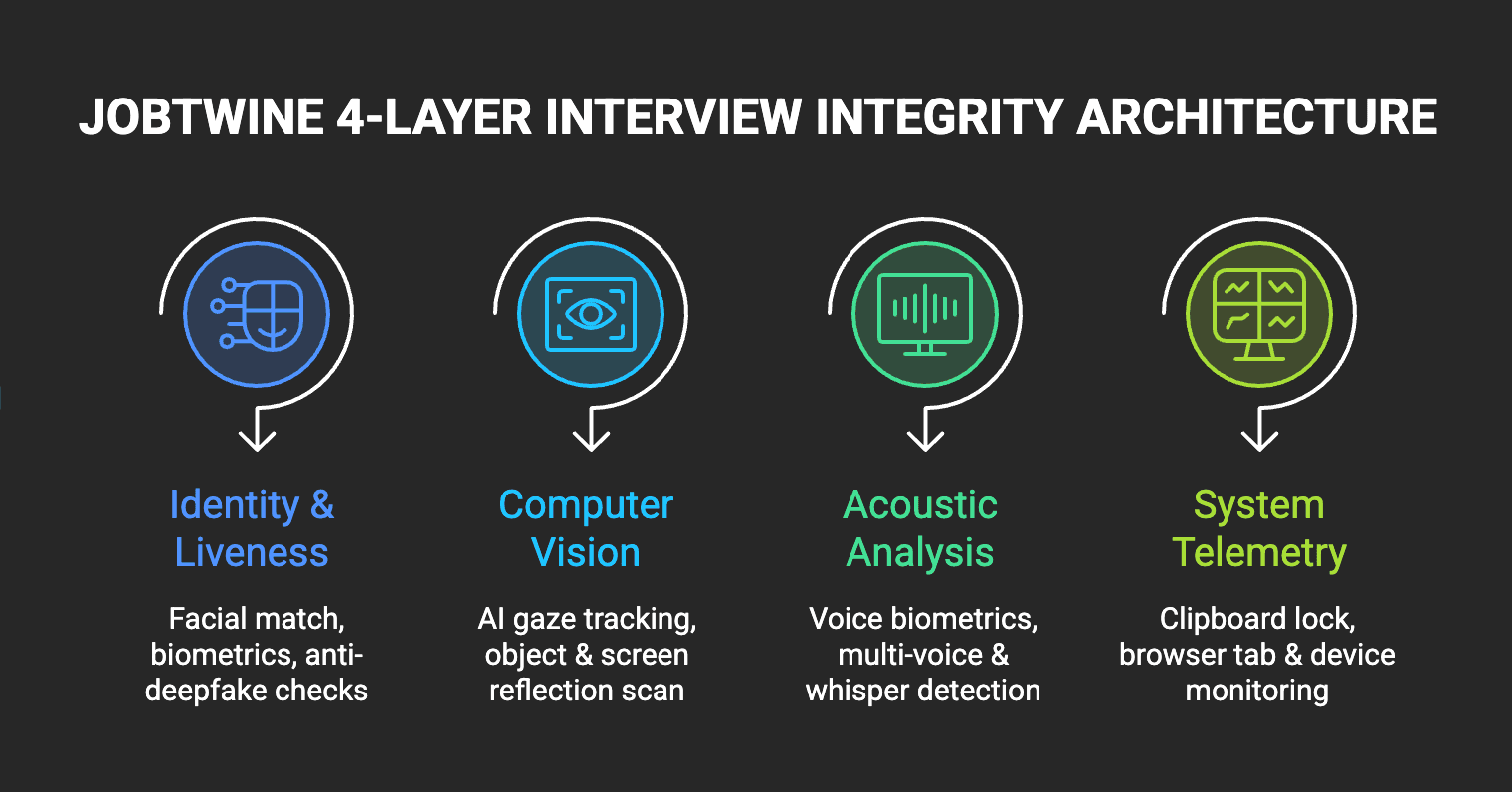
The JobTwine Interview Integrity Framework establishes a 4-layer security baseline: Identity Verification, Computer Vision Analysis, Acoustic Biometrics, and System Telemetry. Securing an interview process requires verifying all four signals simultaneously rather than trusting a single webcam feed.
Layer 1: Identity Verification and Liveness Detection
Before an evaluation starts, the platform matches government-issued photo identification against the live candidate camera feed. Microscopic challenge-response checks—such as tracking sub-conscious light-reflection shifts across skin texture and natural blink frequencies—ensure the camera feed is an authentic, live human presence rather than a pre-recorded loop or neural image generation.
Layer 2: Computer Vision and Environmental Scanning
During the video assessment, computer vision models continuously monitor the physical frame:
Multiple Face Detection: Flags secondary individuals stepping into the camera boundary to offer real-time coaching.
Absence Logging: Records instances where the candidate steps away from the frame during live technical problems.
Hardware Detection: Scans for secondary webcams, smart glasses, or secondary mobile screens.
Layer 3: Acoustic Analysis and Speech Biometrics
Audio signals are isolated to confirm speaker identity across rounds, catching off-screen voice switching, synthetic text-to-speech engines, and low-decibel whisper coaching.
Layer 4: System Environment Telemetry
The client environment is monitored via web APIs to flag unauthorized browser window switches, clipboard paste events, and virtual camera drivers.
How Does AI Gaze Tracking Detect Off-Screen Script Reading?
AI gaze tracking interview modules map 3D iris vectors against webcam lens coordinates. By calculating the ratio between saccadic eye movements and head pose stability, the system distinguishes natural cognitive thought reflection from the linear scanning movements produced when reading hidden scripts or teleprompters.
Distinguishing Cognitive Drift From Script Reading
Human candidates naturally shift their eyes away when processing complex technical problems—a phenomenon known as cognitive gaze aversion. Anti-fraud algorithms evaluate three specific spatial metrics to ensure natural thought processes are never flagged:
Saccadic Eye Movement: Reading text off a hidden screen creates rapid, micro-saccadic eye jumps from left to right (or right to left). In contrast, natural thought drift results in smooth, unpatterned focal shifts.
Head-Pose Vector Correlation: When a candidate's eyes scan back and forth across a secondary display while their head pose remains completely locked, the algorithm identifies a teleprompter reading pattern.
Fixation Anchor Duration: Reading requires prolonged fixation at static spatial coordinates outside the interview window. The system tracks whether glance vectors consistently return to a specific off-screen coordinate anchor.
How Do Audio Biometrics and Lip-Sync Analysis Spot Off-Screen Coached Candidates?
Audio-visual detection algorithms analyze phoneme-to-viseme alignment in real time. By matching spoken acoustic units (phonemes) with the visual geometry of lip formations (visemes), ai interview fraud detection software instantly spots candidates mouthing words to an off-screen handler's voice feed.
Phoneme-to-Viseme Matching
Phonemes: The acoustic building blocks of human speech (e.g., the /p/, /b/, or /t/ sounds).
Visemes: The physical, visual lip and jaw shapes that correspond to those specific acoustic sounds.
When a proxy candidate speaks off-screen while the applicant mouths along on camera, latency discrepancies emerge. Computer vision models measure lip geometry variations against incoming microphone streams at millisecond resolutions. If acoustic phonemes register before or after visual viseme formation, or if speech audio plays while candidate lip movement remains static, the session triggers a high-confidence anomaly alert.
Voice Biometric Fingerprinting
During the initial intake portion of an assessment, platforms build a voice biometric profile capturing formant frequencies, pitch variance, and vocal tract resonance. If an off-screen coach takes over during technical questioning, the system flags the acoustic mismatch against the established candidate voice print.
Comparison Matrix: Traditional Screening vs. Advanced AI Integrity Control
Traditional video interviewing relies on manual human observation, which misses browser tab switching, subtle lip-sync delays, and AI teleprompters. Automated multi-vector integrity suites continuously evaluate visual, acoustic, and system signals simultaneously.
Security Dimension | Traditional Video Interviews | Basic Automated Proctoring | JobTwine AI Integrity Suite |
Identity Verification | Manual ID glance by recruiter | Static photo comparison | Real-time liveness & biometric match |
Gaze Tracking | Unmonitored | Simple camera departure flags | 3D Iris vector & saccadic movement analysis |
Audio Security | Unmonitored | Volume threshold alerts | Voice biometrics & lip-sync viseme analysis |
Code Integrity | Manual review post-assessment | Basic copy-paste disabled | Keystroke cadence & clipboard telemetry |
Evaluation Method | Subjective interviewer impressions | Binary pass/fail algorithm | AI Copilot + Human-in-the-Loop review |
How Can Teams Protect Candidate Experience and Maintain Ethical Guardrails?
Ethical anti-fraud systems require Human-in-the-Loop (HITL) governance, candidate disclosure, and personal calibration phases. Automated flags must serve as review anchors for human recruiters rather than autonomous rejection mechanisms.
1. Human-in-the-Loop (HITL) Governance
Algorithms flag behavioral anomalies with timestamped video markers; they do not issue automated rejections. Human hiring managers review flagged segments in context before taking action on a candidate's application.
2. Neurodivergent & Baseline Accommodations
Candidate eye-movement patterns and fidgeting behaviors vary naturally. Modern platforms incorporate an initial calibration phase that establishes a personalized baseline, preventing candidates with neurodivergent traits or visual accommodations from triggering false gaze flags.
3. Data Privacy and Regulatory Compliance
Biometric data must be protected using enterprise-grade security controls (AES-256 encryption at rest and in transit). In accordance with GDPR Article 22, EEOC Title VII guidance, and India's DPDP Act, candidates retain full rights to explicit consent disclosures, data deletion requests, and human review of automated decisions.
Conclusion
Securing the remote recruitment pipeline against modern proxy candidates, hidden teleprompters, and audio feeding requires moving beyond passive video recording. By combining AI gaze tracking interview modules, voice biometric fingerprinting, phoneme-to-viseme lip-sync analysis, and system telemetry into a multi-layered detection architecture, enterprise talent acquisition teams protect talent quality without burdening honest applicants.
When evaluating ai interviews platforms, select solution providers that combine automated integrity controls with structured interview playbooks, live recruiter copilots, and explicit human-in-the-loop review capabilities.
Frequently Asked Questions (FAQ)
What triggers a false positive in AI gaze tracking during an interview?
False positives in gaze tracking typically occur when candidates naturally look away to formulate complex thoughts, consult scratch paper, or experience eye fatigue. Modern anti-fraud systems prevent false flags by establishing a baseline during setup, analyzing saccadic eye movement patterns, and requiring human recruiter validation before taking any action.
How do modern AI interview platforms catch proxy interview candidates?
Platforms detect proxy candidates through continuous biometric monitoring. They cross-reference initial photo ID verification against the live video feed, create a unique voice biometric print, and continuously analyze facial geometry throughout the session. If the candidate's facial or acoustic signature shifts mid-interview, the platform flags a proxy alert for recruiter review.
Can AI interview fraud detection spot candidates using ChatGPT or browser extensions?
Yes. Systems detect real-time generative AI usage through system telemetry—such as tracking window focus events, clipboard paste actions, and keystroke cadence anomalies—alongside gaze tracking that identifies candidates reading generated output off hidden browser windows or overlays.
How does lip-sync detection work in video interview proctoring software?
Lip-sync detection correlates acoustic units of speech (phonemes) with physical lip and jaw movements (visemes). If a candidate mouths answers while an off-screen coach speaks, or if latency exists between facial movement and audio transmission, the algorithm flags the temporal mismatch for human review.
How do platforms store candidate biometric data securely?
Biometric data is encrypted using AES-256 standards both in transit and at rest. Leading enterprise platforms adhere to global privacy frameworks such as GDPR, CCPA, and DPDP, providing transparent consent prompts before evaluations and executing automatic data deletion once hiring decisions are completed.
Protect Your Hiring Pipeline
Ready to eliminate proxy candidates and AI-assisted fraud while delivering a seamless, fair experience for every applicant?
Book a Live JobTwine Demo Today to see our secure AI Screening Avatars, Live Interviewer Copilot, and full-suite Candidate Integrity Controls in action.