
See how AI recruiters transform candidate evaluation, automate screening, and handle high-volume hiring while ATS platforms manage workflows and compliance.

An AI Recruiter is an active execution engine that conducts candidate screening, guides live interview panels, and generates evidence-backed scorecards. An applicant tracking system (ATS) is a passive database that manages requisitions, compliance audit trails, and offer workflows. Modern talent acquisition teams combine both to move from tracking static resumes to evaluating verified candidate competence.
Executive Summary and Key Takeaways
Explains why treating an ATS as an evaluation tool breaks down under high-volume synthetic resume noise.
Defines the exact functional boundary between your system of record (ATS) and your active execution layer (ai recruiter).
Demonstrates how 24/7 conversational screening eliminates candidate drop-off and top-of-funnel recruiter bottlenecks.
Covers multi-vector anti-cheat detection and human-in-the-loop oversight frameworks compliant with GDPR and NYC Local Law 144.
Every week, talent acquisition teams watch their hiring pipelines stall under an unmanageable wave of AI-generated applications. Candidates now use generative AI tools to output hundreds of hyper-customized, keyword-stuffed resumes in seconds.
The fear keeping TA leaders awake at night isn't just pipeline bloat—it's candidate selection failure. When your ATS relies on keyword filtering to handle high-volume hiring, it makes arbitrary cuts: rejecting genuinely skilled candidates while pushing forward applicants who simply know how to game resume algorithms.
Trying to solve top-of-funnel evaluation using only an ATS is like using a filing cabinet to conduct an interview. To scale screening without sacrificing evaluation rigor, enterprise hiring teams must decouple candidate record-keeping from candidate evaluation.
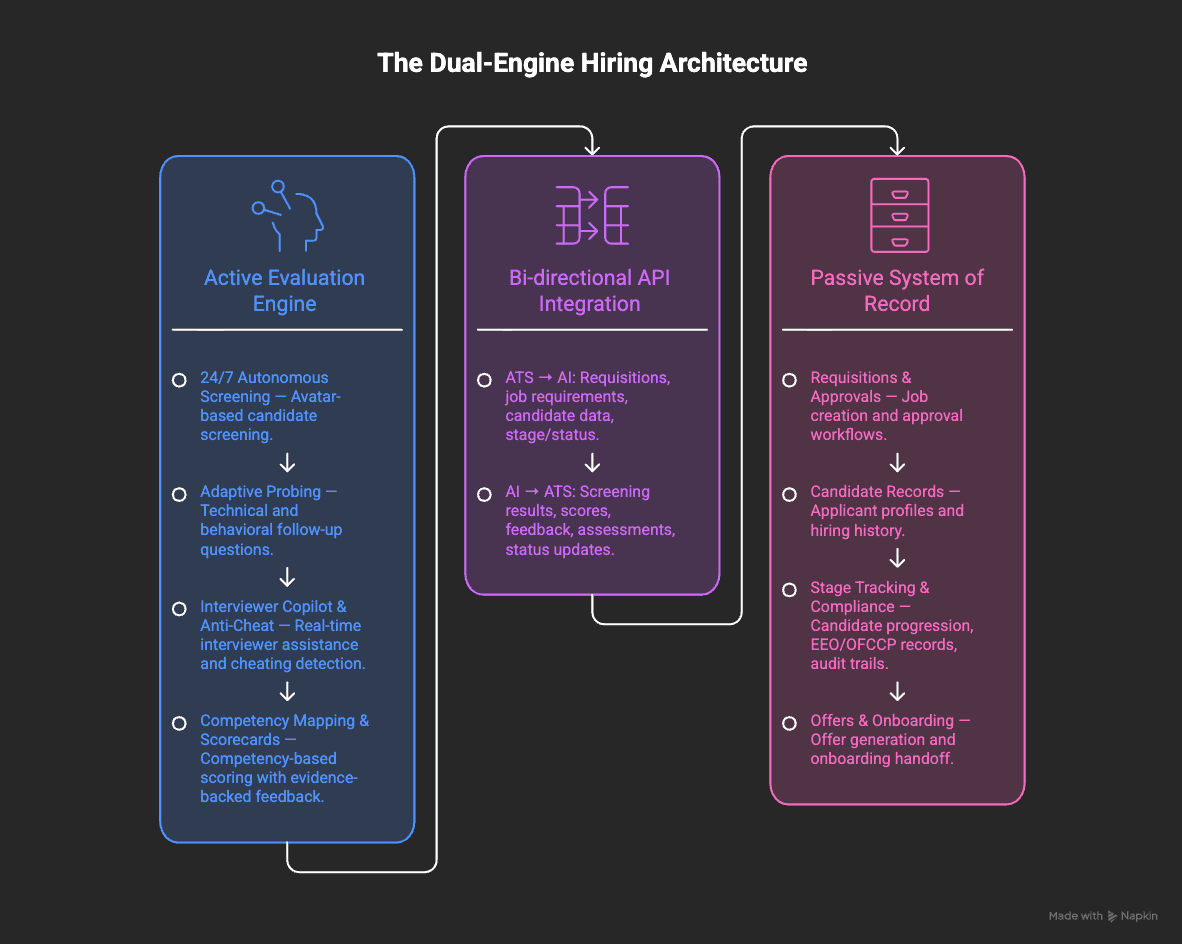
What Should Your ATS Own?
An Applicant Tracking System is engineered for compliance, governance, and requisition administration. Its core operational purpose is maintaining an auditable, legal log of applicants and job requisitions.
Core ATS Responsibilities
1. Requisition Governance: The ATS manages job openings, approval workflows, and headcount budgets, ensuring every position follows the organization’s hiring process.
2. Compliance & Legal Auditing: The ATS maintains EEO/OFCCP compliance records, candidate histories, and audit trails to support regulatory and legal requirements.
3. Offer & Onboarding Workflows: The ATS triggers offer letters, coordinates background checks, and manages handoffs to HRIS and onboarding systems.
An ATS is fundamentally passive. When forced to serve as an evaluation filter, it relies on static string-matching against PDF resumes—a mechanism rendered obsolete by candidate-side generative AI.
What Should an AI Recruiter Own?
An AI Recruiter functions as an active candidate interaction and evaluation layer deployed directly on top of your existing ATS. Rather than replacing your system of record, it automates candidate screening, enforces live panel rigor, and verifies response integrity.
AI RECRUITMENT TOOL TYPES | ||
Screening Bot | ||
Uses text-based Q&A to assess basic candidate eligibility, answer initial questions, and automate tasks such as interview scheduling. | Conducts interactive, two-way video interviews to evaluate candidate skills and depth at scale, including 24/7 screening. | Provides real-time guidance and assistance during human-led interviews, helping interviewers capture relevant evidence and make more consistent evaluations. |
1. Autonomous First-Round Screening
Instead of recruiters spending 15–20 hours a week on phone screens, an AI avatar recruiter conducts interactive, two-way screening calls 24/7. The avatar tests candidate claims using role playbooks, probing deeper when answers lack technical specifics.
2. Multi-Vector Integrity and Anti-Cheat Defense
During remote evaluations, an AI recruiter tool monitors background operational signals—such as speech latency, audio anomalies, eye gaze vectors, and tab-switching—flagging potential proxy test-taking or real-time LLM usage before candidates reach live panels.
3. Live Interviewer Copilot Guidance
During round-two and round-three human-led interviews, an interviewer copilot runs alongside hiring managers on Zoom, Teams, or Google Meet, surfacing remaining competency gaps and auto-capturing timestamped evidence.
4. Automated ATS Evidence Scoring
The system transcribes conversations, maps direct candidate quotes to role rubrics, and pushes structured scorecards straight into candidate profile cards within your ATS.
Functional Ownership: AI Recruiter vs ATS
Operational Function | Applicant Tracking System (ATS) | AI Recruiter Execution Engine |
Primary Classification | Passive database & record repository | Active evaluation & execution engine |
Candidate Evaluation | Static PDF keyword parsing | |
High-Volume Capability | Creates recruiter bottlenecks | Evaluates hundreds of candidates simultaneously |
Zero visibility during initial screens | Real-time monitoring of gaze, speech, & secondary displays | |
Panel Interview Support | Static evaluation forms | Live copilot guidance during Zoom/Teams calls |
Data Output | Manual recruiter notes & status tags | Quote-backed scorecards synced to candidate profiles |
Connecting the AI Recruiter Workflow to Your ATS
Integrating an evaluation layer into your recruiting stack requires zero disruption to existing ATS workflows.
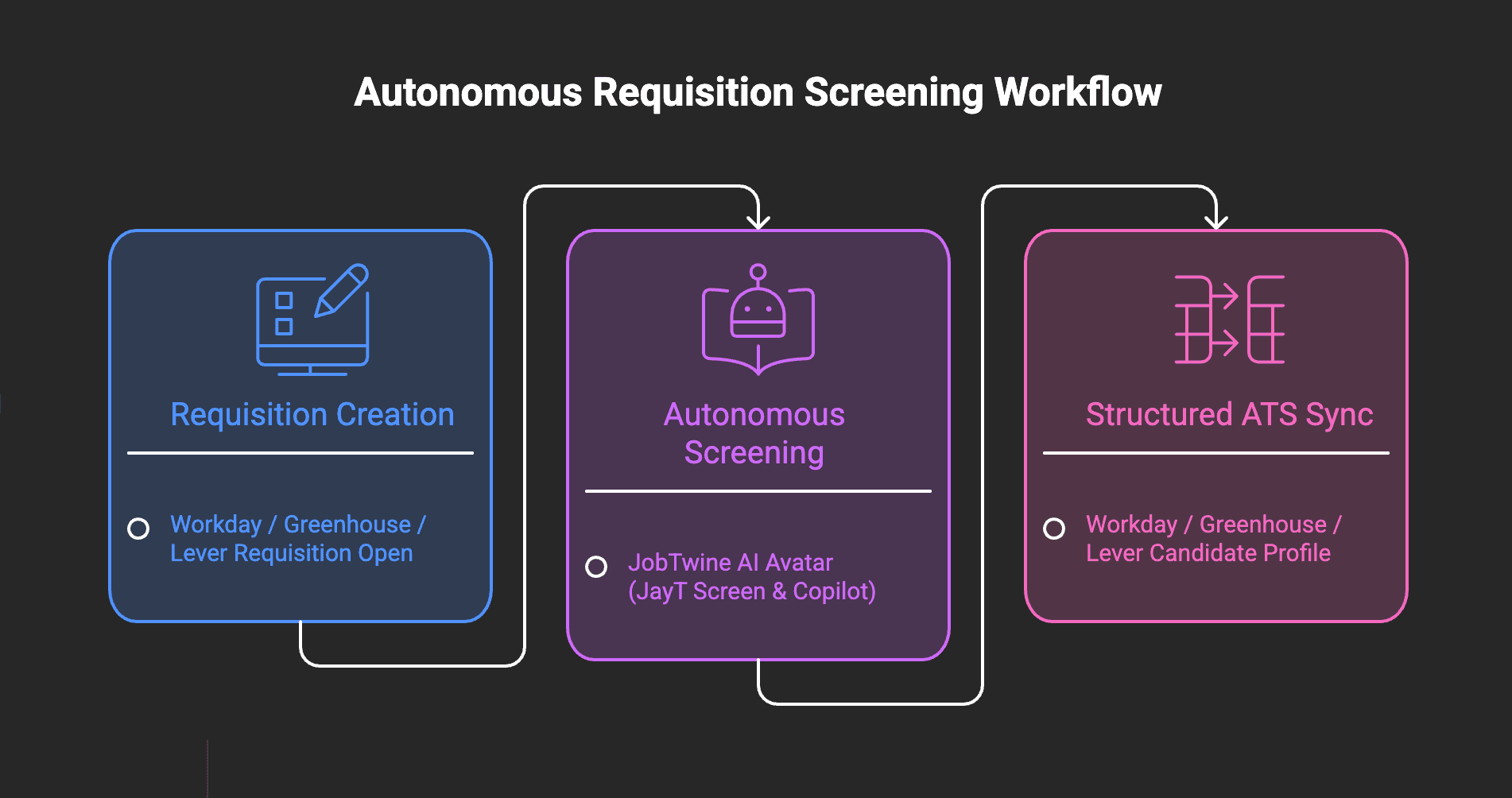
Requisition Extraction: Opening a requisition in Greenhouse, Workday, or Lever automatically triggers the AI platform to generate role-specific competency playbooks.
Autonomous Candidate Screening: Inbound applicants receive a link to complete an interactive screen with an AI avatar at their convenience.
Live Copilot Execution: Shortlisted candidates move to live human panel interviews guided by an in-call copilot.
Bi-Directional Scorecard Sync: Transcripts, video clips, integrity ratings, and quote-mapped scorecards automatically push back into the candidate's ATS profile.
Automated screening does not necessarily identify the most qualified candidate; it identifies the candidate who best presents the evidence the screening system is designed to recognize.
Why ATS Keyword Filtering Is Broken
"For two decades, talent acquisition relied on ATS databases to filter candidates by counting keyword occurrences on PDF resumes. But when candidates use generative AI to output hundreds of hyper-customized resumes in seconds, static keyword parsing collapses under synthetic noise.
An ATS was built to store candidate records, not evaluate candidate capability. The future of talent operations is layering an active execution engine on top of ATS to gather verified candidate evidence." — Vikrant Mahajan, Founder and CEO, JobTwine
Frequently Asked Questions
Does an AI recruiter replace an ATS?
No. An AI Recruiter operates as an active evaluation layer on top of an ATS. The ATS remains the legal system of record for requisitions, candidate archives, and offer generation, while the AI platform handles interactive screening, live interview support, and scorecard synthesis.
How does an AI recruiter handle high-volume hiring compared to an ATS?
While an ATS relies on manual resume reviews or static keyword filters that can create massive recruiter backlogs, an AI recruiter conducts interactive, two-way video screens 24/7. It evaluates hundreds of applicants simultaneously against objective competency rubrics without scheduling delays. JobTwine is ideal for high-volume hiring because its AI recruiter automates first-round screening at scale, helping recruiting teams evaluate more candidates faster while maintaining consistent, evidence-based evaluation.
What is the main difference between ATS screening and AI recruiter screening?
An ATS screens candidate resumes passively using string-matching keywords. An AI Recruiter evaluates candidate depth actively through conversational interviews, asking adaptive follow-up questions and generating quote-backed evidence scorecards.
How do ATS platforms and AI recruiters integrate?
Enterprise platforms connect via bi-directional APIs. When a job opens in your ATS, the AI recruiter extracts job requirements to build role playbooks. Once candidate screens finish, interview transcripts, anti-cheat flags, and rubric scores automatically sync into candidate ATS profiles.
Experience how JobTwine’s JayT AI avatar screeners and interviewer copilots turn your ATS into an evidence-driven hiring engine by scheduling a platform demo today.