
See how AI recruiting tools automate candidate screening, interviews, fraud detection, scorecards, and ATS workflows—and where they fit into your hiring stack.

An AI Recruiter is an autonomous software engine that uses artificial intelligence, natural language processing (NLP), and machine learning to handle core candidate-facing recruitment tasks. Operating as an active execution system rather than a passive database, an AI Recruiter tool executes first-round candidate screens, provides real-time interviewer copilot guidance during human-led panels, detects generative AI cheating, and synthesizes structured competency evidence directly into your ATS.
Key Takeaways
The operational evolution of recruitment tech—transitioning from legacy keyword-parsing databases to active, conversational AI Recruiter systems.
Autonomous 24/7 avatar screening, live human-interviewer copilots, real-time multi-vector fraud detection, and automated competency playbook generation.
How to layer an AI execution engine over existing systems of record (e.g., Greenhouse, Workday, Lever) using bi-directional API syncing.
Meeting global standards (GDPR, CCPA, NYC Local Law 144) through human-in-the-loop oversight and objective rubric scoring.
When talent acquisition leaders ask, "what is an ai recruiter?", they are often met with vendor confusion. Some software vendors label basic resume-parsing algorithms as AI, while others use the term to describe simple email scheduling bots.
In modern talent acquisition, an ai recruiter is an intelligent execution layer that automates, structures, and scales candidate evaluation.
When candidates use generative AI to submit hundreds of hyper-customized applications in seconds, legacy software that relies on keyword-matching fails. It simply accelerates the rate at which unverified resumes flood your pipeline. Deploying a true ai recruiter tool shifts your hiring process from reading unverified self-reported claims on paper to evaluating actual candidate competence through dynamic, interactive screening.
What Is an AI Recruiter? (Platform vs. Chatbot vs. Copilot)
To choose the right technology for your team, it is essential to distinguish between the three primary operational configurations of AI recruitment software:
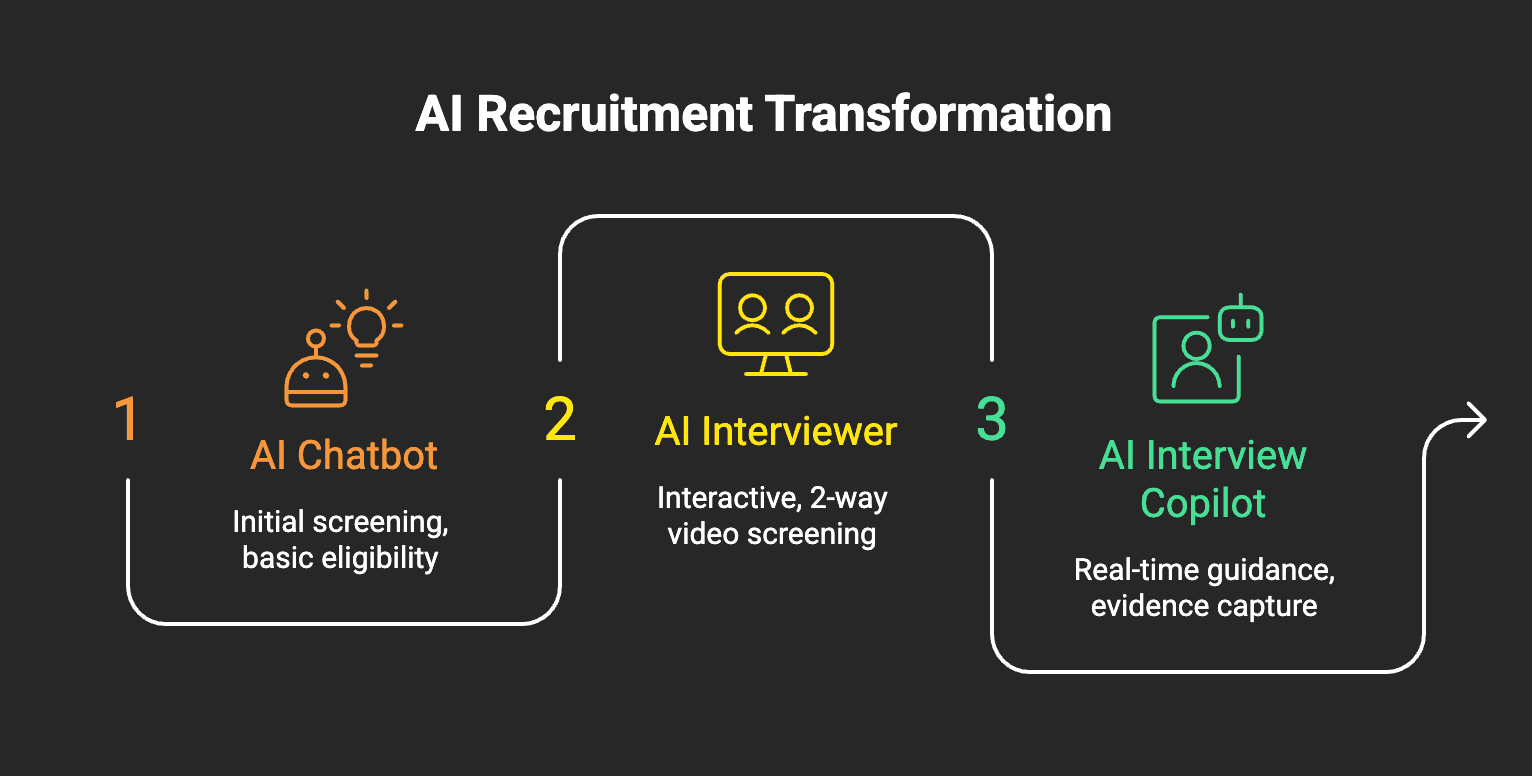
AI Recruiter Chatbots: Text-based conversational bots operating via web chat or SMS. They handle basic screening questions (e.g., work authorization, salary expectations) and schedule calendar appointments.
Autonomous AI Interviewer Avatars: Photorealistic video recruiters (such as JobTwine's JayT) that conduct dynamic, two-way first-round interviews. They probe vague answers, evaluate technical competencies against calibrated playbooks, and adapt follow-up questions in real time.
Live Interviewer Copilots: Intelligent assistants that run silently alongside human interviewers during live Zoom, Microsoft Teams, or Google Meet calls. An interviewer copilot surfaces unverified competency gaps, suggests follow-up prompts, captures timestamped evidence, and generates structured scorecards.
Structural Comparison: Manual Recruiting vs. AI Recruiter Tools
Understanding how an ai recruiter tool updates traditional recruitment workflows requires examining operational metrics across the hiring loop.
Hiring Lifecycle Stage | Traditional Manual Recruitment | AI Recruiter Execution Platform |
Top-of-Funnel Review | Manual keyword scanning of candidate resumes | |
First-Round Screens | Recruiter phone screens capped by business hours | 24/7 interactive video screens conducted by AI avatars |
Anti-Cheat Defense | Zero protection against proxy test-takers or LLMs | Real-time monitoring of gaze, speech latency, & tabs |
Panel Interview Support | Static PDF scorecards that panelists often skip | |
Post-Interview Admin | Manual data entry and delayed scorecard submissions |
How Does an AI Recruiter Fit Into Your Hiring Stack?
A common misconception among talent operations leaders is that implementing an ai recruiter requires replacing your existing Applicant Tracking System (ATS).
An ai recruiter tool does not replace your system of record; it layers directly on top of it.
Requisition Sync: An open requisition in systems like Workday, Greenhouse, or Lever triggers the AI platform to extract job requirements and build structured competency playbooks.
Autonomous Candidate Screening: Inbound applicants receive a link to complete an interactive interview with an AI avatar. The platform evaluates candidate answers, flags potential integrity issues (like off-screen LLM usage), and scores responses against defined rubrics.
Live Panel Guidance: Candidates who pass initial screening move to live human panels, where an interviewer copilot guides hiring managers to test remaining competency gaps.
Bi-Directional ATS Sync: Video recordings, transcripts, quote-backed scorecards, and candidate rankings sync back to your primary ATS without requiring manual recruiter data entry.
Key Benefits of Deploying an AI Recruiter
1. Eliminating Screening Bottlenecks
Recruiters spend up to 15 hours every week conducting introductory 15-minute phone screens. Offloading first-round evaluations to autonomous avatars reduces time-to-offer by up to 80%, allowing talent teams to focus on candidate engagement, relationship-building, and offer closing.
2. Standardization & Bias Reduction
Human interviewers are susceptible to fatigue, affinity bias, and inconsistent questioning styles. An ai recruiter evaluates every applicant against identical competency rubrics, ensuring candidate shortlists are based on objective evidence rather than subjective impressions.
3. Defending Remote Hiring from Generative AI Fraud
With candidate cheating on the rise, enterprise systems evaluate background operational signals during remote interviews—including audio latency, eye gaze metrics, and tab switching. This ensures candidates demonstrate genuine skill rather than reading off hidden LLM feeds.
“Automated screening does not necessarily identify the most qualified candidate; it identifies the candidate who best presents the evidence the screening system is designed to recognize.” — Vikrant Mahajan, Founder & CEO, JobTwine
Frequently Asked Questions
What is an AI recruiter and how does it work?
An ai recruiter is an automated software engine that uses natural language processing and machine learning to conduct candidate screening, guide live interviews, detect cheating, and write scorecards. It works by mapping candidate responses directly against job playbooks and syncing structured scorecards into your ATS.
Can an AI recruiter tool replace human recruiters?
No. An ai recruiter tool automates repetitive administrative tasks—such as top-of-funnel shortlisting, initial video screening, and post-interview documentation. This frees human recruiters to focus on strategic sourcing, hiring manager alignment, and candidate negotiation.
Is using an AI recruiter compliant with global hiring laws?
Yes, provided the tool includes human oversight and adheres to regional privacy rules. Modern enterprise platforms meet regulations such as GDPR, CCPA, and NYC Local Law 144 by functioning as decision-support systems that preserve human accountability for final hiring decisions.
How does an AI recruiter integrate with existing HR tech stacks?
Enterprise platforms connect directly to major Applicant Tracking Systems via bi-directional APIs. They pull job requisitions automatically to generate competency frameworks and push candidate rankings, transcripts, and scorecards back into the candidate's profile.
Experience how JobTwine’s JayT AI avatar screeners and live interviewer copilots transform your recruitment pipeline from a passive ATS database into an active hiring execution engine by scheduling a platform demo.