
Is an AI interviewer fair? Learn how recruiters can evaluate AI interview fairness, explainability, fraud detection, human oversight, and responsible deployment.

An AI interviewer can be fair when it uses job-relevant criteria, applies them consistently, provides evidence for its assessments, and remains subject to human oversight. Recruiters should not rely on AI-generated scores they cannot explain, audit, or challenge.
The real question is not simply "is an AI interviewer fair?" The more important question for recruiters is whether they can defend the AI-assisted decision if a candidate challenges it.
Key Takeaways
An AI interviewer is not automatically fair simply because it applies the same process to every candidate.
Recruiters need to understand what the AI evaluates and what evidence supports its scores.
AI-generated assessments should be reviewable, explainable, and auditable before they influence hiring decisions.
An AI interviewer with fraud detection can reduce the risk of candidates manipulating or outsourcing the interview process.
Fraud detection and fairness are connected because a manipulated interview can produce an unreliable candidate score.
Human oversight means recruiters remain accountable for reviewing AI outputs and making or approving hiring decisions.
Before deployment, recruiters should ask vendors how the system scores candidates, detects fraud, handles errors, and records evidence.
What Does It Mean for an AI Interviewer to Be Fair?
An AI interviewer is fair when it evaluates candidates against consistent, job-relevant criteria, produces reliable results, and allows recruiters to understand and review the evidence behind its recommendations. Fairness requires more than giving every candidate the same questions.
An AI interviewer can create a more structured interview process. Every candidate can receive the same core questions, follow the same interview structure, and be assessed against the same scoring framework. That consistency can reduce some of the variation that comes with human-led interviews, where different interviewers may ask different questions or place different weight on the same answer.
But consistency is not the same as fairness.
If an AI interviewer consistently measures the wrong things, it can consistently produce the wrong outcomes. A system may give a candidate a lower score because it misunderstands an answer, places too much weight on a weak signal, or evaluates a factor that has little connection to actual job performance. The question of fairness becomes especially important when AI avatars are used to evaluate candidates at scale.
The recruiter then faces a difficult question: Why did this candidate receive this score?
If the only answer is, "The AI scored them that way," the organisation has a serious accountability gap.
A useful way to evaluate an AI interviewer is to ask five basic questions:
Fairness Question | What Recruiters Should Look For |
What does it evaluate? | Clear, job-relevant criteria |
How does it score? | Defined scoring logic or framework |
What evidence supports the score? | Interview responses and traceable evidence |
Can humans review the output? | Recruiter access and override capability |
Can the process be audited? | Records, logs, and documented decisions |
The goal is not to expect every recruiter to understand the underlying machine-learning architecture. The goal is to ensure that recruiters can understand the hiring decision the system helped produce and have enough information to question it when necessary.
Why Is an AI Interviewer a Fairness Question and a Liability Question?
An AI interviewer becomes a liability risk when recruiters are expected to defend candidate decisions without having access to the evidence, scoring logic, or audit trail behind the AI's recommendation.
This is the central issue many organisations overlook.
When an AI interviewer rejects or downgrades a candidate, the candidate does not usually complain to the AI. They complain to the employer. The recruiter or talent leader is then expected to explain how the decision was reached and whether the process was fair.
That creates a simple accountability chain: the AI generates an assessment, the recruiter relies on that assessment, the candidate challenges the outcome, and the recruiter has to explain the decision.
The problem appears when the recruiter cannot answer basic questions. Why did the candidate receive this score? Which answers affected the result? What criteria were applied? Was the candidate evaluated consistently? Did the system make an error? Was the interview completed by the actual candidate? Can the organisation reproduce the decision?
An AI interviewer that cannot answer these questions creates a decision that is difficult to defend.
Consider the difference between two systems.
System A:
The candidate scored 62/100.
The recruiter has no clear way to understand what produced the score.
System B:
The candidate scored 62/100 because their responses demonstrated three of five required competencies. The system identified strong evidence in competencies A and B, but insufficient evidence for C, D, and E. The recruiter can review the underlying responses and override the recommendation.
The second approach gives the recruiter something they can actually review and challenge. The important distinction is not whether AI makes the final decision. It is whether the human decision-maker can understand and defend the process.
Can an AI Interviewer Be Fair Without Human Oversight?
An AI interviewer should not operate as an unquestioned decision-maker in high-impact hiring workflows because human oversight provides a necessary review layer for errors, exceptions, and candidate challenges. Human oversight does not mean a recruiter needs to manually rewatch every interview. It means the recruiter should be able to review the AI's assessment, access relevant candidate evidence, understand the basis for the score, identify potential errors, and challenge or override the recommendation when appropriate.
The level of oversight should depend on what the AI is actually doing.
AI Use Case | Suggested Oversight |
Interview scheduling | Low |
Candidate communication | Moderate |
Interview transcription | Moderate |
Interview summarisation | Moderate |
Candidate scoring | High |
Candidate rejection recommendations | High |
Automated hiring decisions | Very high |
The closer AI moves towards influencing a hiring decision, the more important human review becomes.
AI can accelerate evaluation, but it should not remove accountability.
What Should Recruiters Know About How an AI Interviewer Scores Candidates?
Recruiters should know which job-relevant criteria an AI interviewer evaluates, what evidence supports each score, how the scoring framework was validated, and whether humans can review or challenge the output.
Before rolling out an AI interviewer, recruiters should ask vendors to explain the assessment process in practical terms. What competencies are evaluated? Are those competencies linked to the actual requirements of the role? Are all candidates assessed against the same rubric? What evidence is used to generate the score? Does the system evaluate the substance of a candidate's response, or does it also consider communication style and other signals? Can recruiters see the supporting evidence? Can they override a score? Are those overrides recorded?
The recruiter does not necessarily need access to proprietary source code. They do, however, need enough information to understand the system's purpose, inputs, outputs, limitations, and controls.
Instead of asking a vendor, "Is your AI unbiased?", recruiters should ask a more useful question:
"Show me how a recruiter can understand, challenge, and audit a candidate score."
That question shifts the conversation away from broad claims about objectivity and towards the practical evidence a recruiter needs to make a defensible hiring decision.
What Is the Difference Between an Explainable AI Interviewer and a Black Box?
An explainable AI interviewer gives recruiters access to the criteria, evidence, and reasoning behind an assessment, while a black-box system provides an output without enough information to understand or challenge how it was produced.
Consider the difference between a system that simply reports "Score: 74" and one that shows the recruiter how that score was reached. In the second system, the recruiter might see that the candidate demonstrated strong evidence for two competencies, moderate evidence for another, and limited evidence for two others, with the assessment linked back to the candidate's interview responses.
The second approach gives the recruiter something they can actually review.
For practical purposes, recruiters should look for structured scorecards, competency-level assessments, evidence-linked evaluations, access to interview transcripts or recordings where appropriate, clearly defined evaluation criteria, audit trails, and human override controls.
The goal is not to expose every technical detail of an AI model. The goal is to make the hiring workflow explainable.
How Does Fraud Detection Affect AI Interview Fairness?
Fraud detection affects AI interviewer fairness because a candidate who manipulates the interview can receive a score based on performance that does not represent their actual skills. This can give that candidate an unfair advantage over people who complete the process independently. This is where an AI interviewer with fraud detection becomes an important consideration.
Imagine two candidates. Candidate A completes the interview independently. Candidate B uses outside assistance, receives real-time answer generation, has another person participate on their behalf, relies on pre-recorded responses, or uses other unauthorised tools.
If both candidates receive AI-generated scores, those scores may appear comparable. But the conditions under which the interviews took place are not comparable.
The result is both a fraud and fairness problem. The recruiter may believe that every candidate went through the same structured process. In reality, one candidate may have had access to assistance that another did not.
An AI interviewer without fraud detection does not just risk a bad hire. It risks a bad hire who gamed the process, which means the recruiter may approve a score built on answers that nobody actually verified.
What Should an AI Interviewer With Fraud Detection Check?
An AI interviewer with fraud detection should identify suspicious behaviour that may indicate a candidate did not complete the assessment independently, while avoiding unnecessary surveillance or treating every unusual behaviour as proof of cheating.
Depending on the technology and interview format, relevant signals may include identity and proxy risks, suspicious response patterns, unusual answer timing, tab switching or other system activity, potential use of external assistance, pre-recorded video injection, and indicators of synthetic or manipulated media.
The exact controls will vary depending on the interview format and the technology being used. A live conversational interview, for example, may require different integrity checks from a recorded video assessment.
The important distinction is between detection and accusation.
A fraud signal should trigger a review. It should not automatically equal rejection.
A fairer workflow looks like this:
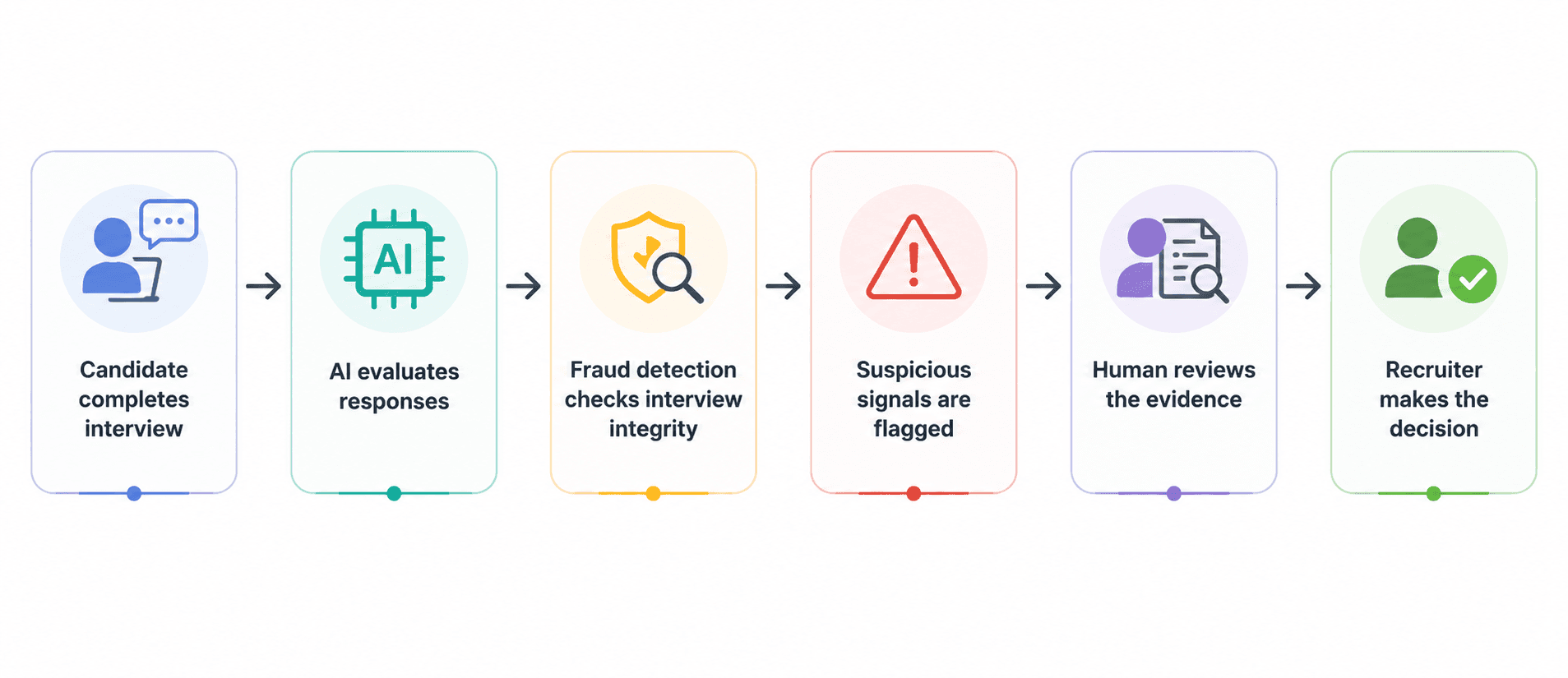
This keeps fraud detection in its proper role: a risk signal, not an automatic verdict.
Why Is Fraud Detection Part of Fair Hiring?
Fraud detection is part of fair hiring because candidates should be evaluated under reasonably comparable conditions. If one candidate completes an interview independently while another receives outside assistance, a standardised scoring process can still produce an unfair outcome.
This is an important point for recruiters evaluating AI interviewers. Standardisation only works when the underlying assessment conditions remain reasonably consistent.
Fraud detection helps protect the integrity of the assessment by identifying situations where the candidate's performance may not represent their own ability.
However, fraud detection must be implemented carefully. A system should not treat a single unusual signal as conclusive evidence of cheating. Suspicious behaviour should be investigated in context, and candidates should not be penalised solely because an algorithm has raised a flag without appropriate review.
That is why the strongest model combines AI detection with human judgement.
How Should Recruiters Evaluate an AI Interviewer Before Deployment?
Recruiters should evaluate an AI interviewer across five areas: assessment logic, evidence, fairness, fraud detection, and governance. A successful pilot should test not only whether the system saves time but whether its outputs remain accurate, explainable, and defensible.
1. Assessment
Ask what the AI measures, why those factors matter, whether they are linked to job requirements, and whether recruiters can customise the evaluation criteria.
2. Evidence
Ask whether recruiters can see why a candidate received a particular score, access the underlying interview response, and understand how the assessment connects to specific competencies.
3. Fairness
Ask how the system has been tested, what fairness checks are performed, how often those checks are repeated, and what happens when a disparity is identified.
4. Fraud Detection
Ask whether the system can detect suspicious activity, identify potential proxy interviewing, detect pre-recorded or synthetic responses, and distinguish between a fraud signal and a confirmed case.
5. Governance
Ask who owns the final decision, whether recruiters can override AI recommendations, whether decisions are logged, and whether the organisation can audit previous assessments.
The best vendor question may be the simplest: "Show me a candidate assessment that a recruiter could defend six months later."
If a vendor cannot demonstrate this, the system may not be ready for high-stakes hiring.
What Are the Biggest Red Flags When Rolling Out an AI Interviewer?
The biggest red flags are unexplained candidate scores, unclear evaluation criteria, no meaningful human override, weak fraud controls, poor audit trails, and vendor claims that rely on the idea that "AI is objective" rather than measurable evidence.
One common warning sign is a vendor that treats AI objectivity as a given. No AI system is automatically objective, so recruiters should ask for evidence of how the system is tested and monitored.
Another is a lack of evidence behind scores. A number without supporting evidence is difficult for a recruiter to interpret and even harder to defend.
Recruiters should also be cautious when vendors cannot explain how errors are identified or when the system cannot be audited. Every AI system has limitations. A credible vendor should be able to explain those limitations, how the system handles errors, and what happens when the AI gets something wrong.
Finally, fraud detection should not be treated as an optional feature if the interview is being used to assess candidates remotely at scale. If candidates can easily manipulate the process, the resulting assessment may not accurately represent their ability.
How Can Recruiters Roll Out AI Interviewers Responsibly?
Recruiters should start with a controlled pilot, define the AI's role, establish human review points, test candidate outcomes, monitor fairness and fraud signals, and document the process before expanding deployment.
The first step is to define exactly what the AI will do. Will it conduct interviews, summarise responses, score competencies, or recommend candidates? The organisation should not leave this unclear.
Next, define when human review is mandatory. If an AI score influences whether a candidate progresses, recruiters should know when and how they are expected to review that output.
The evaluation framework should also be tied to a structured rubric based on the job requirements, competencies, and skills that actually matter for the role.
A controlled pilot can then compare AI assessments with human assessments and examine candidate outcomes. Recruiters should also test the system's fraud controls using realistic scenarios involving external assistance, proxy interviews, pre-recorded content, and suspicious activity.
Once the system is live, organisations should monitor candidate progression, pass-through rates, complaints, recruiter overrides, fraud flags, and AI errors. They should also document the assessment criteria, AI outputs, human reviews, overrides, and exceptions.
The objective is not to create a perfect AI system. The objective is to create a defensible hiring process around the AI system.
What Should Recruiters Measure After Launching an AI Interviewer?
Recruiters should measure AI interviewer performance across hiring speed, candidate outcomes, fairness, accuracy, fraud detection, candidate experience, and human override rates rather than relying only on time saved.
A practical AI interviewer scorecard could include:
Category | Metrics |
Efficiency | Time-to-screen, time-to-interview |
Quality | Quality of hire, interview-to-offer rate |
Fairness | Pass-through rates, adverse impact |
Candidate Experience | Completion, drop-off, complaints |
Accuracy | AI-human agreement, error rate |
Fraud | Fraud flags, confirmed cases |
Governance | Overrides, audits, exceptions |
The most important question is not simply "How many hours did we save?"
It is:
"Did we save time without reducing the quality, fairness, or defensibility of hiring?"
That means organisations should evaluate AI interviewers against the same outcomes they care about in the wider hiring process. Faster interviews are useful, but not if they produce poorer hiring decisions, increase candidate drop-off, or create new compliance and trust risks.
What Does a Defensible AI Interview Process Look Like?
A defensible AI interview process uses structured criteria, explainable assessments, fraud controls, human oversight, documented decisions, and ongoing monitoring so recruiters can explain how and why candidates progressed or were rejected.
A strong workflow starts with structured job requirements and a standardised interview. The AI then assesses the candidate against defined criteria, with the resulting score linked to supporting evidence. Fraud detection checks the integrity of the interview, while human reviewers investigate relevant signals and review AI recommendations before a final decision is made.
The process should also create an audit trail that allows the organisation to reconstruct what happened. The distinction is important:
AI processes information.
Humans remain accountable for decisions.
The AI can handle scale and complexity. The recruiter retains responsibility for judgement. The system creates evidence, and the organisation maintains the ability to explain the process. That is a much stronger model than simply asking whether an AI interviewer is "fair."
Can an organisation prove its AI interviewer is being used fairly, transparently, and responsibly.
That requires explainable scoring, job-relevant criteria, human oversight, fraud detection, and enough evidence to reconstruct how a candidate was evaluated.
AI interviewing can make hiring more structured. It can reduce repetitive work and help recruiters handle high candidate volumes. But it can also introduce a new accountability problem if organisations deploy it without understanding how it evaluates candidates or how its decisions can be reviewed.
When an AI interviewer makes a call that a candidate challenges, the recruiter is the one who has to explain and defend it.
That means the recruiter needs more than an AI-generated score. They need visibility into the evidence behind it. They need the ability to challenge the output. They need appropriate controls around fraud and interview integrity. And they need an audit trail that shows what happened.
The future of AI interviewing should not be about removing human accountability. It should be about giving recruiters better tools to make faster, more consistent, and more defensible decisions.
An AI interviewer that cannot show a recruiter exactly why it scored a candidate the way it did hands the recruiter a decision they cannot explain. And in a dispute, the recruiter is the one who has to explain it.
Key Takeaways for Recruiters
Applying the same flawed process to everyone does not make it fair.
Recruiters need to understand the evidence behind AI-generated assessments.
AI can support hiring decisions, but accountability should remain with people.
Fraud detection is part of fairness. Candidates should be assessed under reasonably comparable conditions.
Fraud signals require human review. A suspicious signal should not automatically become a rejection.
Organisations need records that show how assessments were generated and reviewed.
Track quality, fairness, candidate experience, fraud, and recruiter confidence.
Ask vendors difficult questions before deployment. The best AI interviewer the one whose output recruiters can understand, challenge, and defend.
Frequently Asked Questions
Is an AI interviewer fairer than a human interviewer?
An AI interviewer can provide more consistency by using standardised questions and evaluation criteria, but consistency does not guarantee fairness. Recruiters should assess whether the system uses job-relevant criteria, produces explainable outputs, and is monitored for errors and disparate outcomes.
What should recruiters ask an AI interviewer vendor before buying?
Recruiters should ask how candidates are scored, what evidence supports each score, how fairness is tested, how human overrides work, what audit records are retained, and whether the system includes fraud detection for proxy interviews, external assistance, and other suspicious activity.
Can an AI interviewer detect cheating or fraud?
Some AI interviewers can detect signals associated with potential fraud, including suspicious activity, proxy participation, pre-recorded content, or unauthorised external assistance. These signals should be treated as indicators for human review rather than automatic proof that a candidate cheated.