
Tired of fragmented interview intelligence tools? See how BrightHire's live guidance falls short compared to JobTwine’s full-stack automated hiring pipeline.
JayT
The Digital Twin
The first generation of interview intelligence platforms solved a massive, fundamental headache: humans are notoriously bad at remembering what happened in a conversation. Platforms like BrightHire addressed this by introducing in-call real-time interview guidance software. They gave hiring teams a digital notary—a tool that hooks into live video calls to transcribe dialogue, track interviewer talking time, and surface template questions in the moment.
The Evolution of Live Guidance: Why Pipeline Memory Matters
Live prompt widgets offer excellent support during a live interview. They keep conversations on track and ensure interviewers stick to their planned structure. However, as enterprise talent operations scale, teams often encounter a new challenge the moment the video window closes.
While tools that offer in-the-moment guidance help an individual interviewer stay aligned with their script, managing data across multiple rounds requires a completely different approach. When evaluation data is stored within isolated call records, Talent Acquisition (TA) teams face unexpected fragmentation and interview data silos.
Without a shared memory between stages, hiring loops can become repetitive. Three different interviewers might unknowingly ask a candidate the exact same questions, while recruiters spend extra time manually connecting disjointed scorecards from independent calls. This makes it difficult to build a definitive record of which skills were verified versus which topics were simply discussed.
For modern talent teams, live guidance without pipeline memory is a half-measure. To truly scale quality hiring, we have to move past point-solution features and look at the power of a continuous, end-to-end recruitment engine—which is precisely where the architecture of JobTwine steps in.
How Clean-Slate Interviews Slow Down Data Velocity
When an interview intelligence tool operates without structural memory, the biggest casualty is your candidate experience and your data velocity.
Consider a typical multi-round hiring loop:
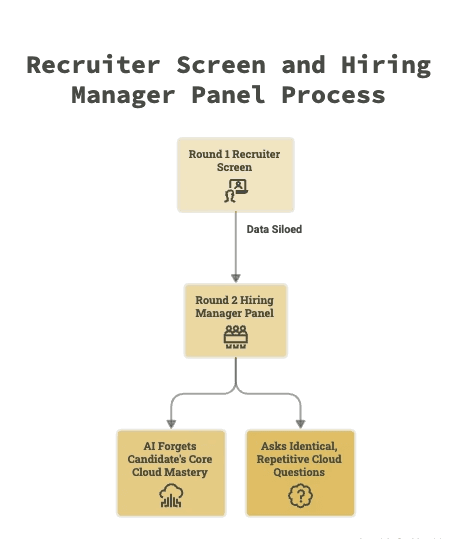
If a candidate thoroughly maps out their system architecture expertise in Round 1, a memory-backed system would intelligently push that data forward. Instead, point solutions force the Round 2 interviewer to start from a completely clean slate.
This creates a highly robotic, redundant interaction for the candidate and forces the interviewer to spend minutes asking duplicate questions instead of probing into unexplored skill sets. For businesses hiring at scale, this structural amnesia introduces a silent operational tax that compounds into a broader enterprise recruitment crisis.
What Each Tool Solves, and What It Does Not
Capability | Live Guidance (BrightHire) | Connected Pipeline (JobTwine) |
In-call help for the interviewer | Live transcription and prompts | Live transcription and prompts, plus context from earlier rounds |
Memory across rounds | None — every call starts fresh | Each round carries forward what the last one found |
Round-one screening | Not included — a person schedules and runs it | Run on its own schedule by JayT (Autonomous AI Recruiter) |
Checking panel coverage | Done by the recruiter, by hand | Done automatically by the system before the offer stage |
Candidate response validation | Not included | Automated Real-time Fraud & Integrity Proctoring |
Scorecard management | One per call, read separately | Combined into a single, unified file across every round |
BrightHire is a strong notary for a single call. However, it does not automate round-one screening, does not check candidate answers against earlier rounds, and does not confirm a panel covered everything before an offer goes out. Those gaps are exactly where a recruiter's time is still wasted. For a deeper look at how the features line up side-by-side, check out the complete JobTwine vs BrightHire Comparison matrix.
Shifting from In-Call Analytics to End-to-End Execution
The fundamental limitation of tools like BrightHire is that they act as point solutions—they only exist within the live meeting box. True transformation happens when your interviewing platform acts as a unified organizational brain across the entire recruitment lifecycle, seamlessly executing an AI-driven hiring strategy.
Instead of a passive note-taker, a full-stack engine like JobTwine continuously funnels data through a seamless, automated workflow:
Before the Call: Rather than manually pasting rigid rubrics, a Smart Playbook Builder auto-maps specific role competencies and crafts tailored question banks in minutes based purely on your job description.
The Screening Bottleneck: Instead of recruiters spending weeks stuck in phone-screen backlogs, an autonomous AI avatar like JayT can handle high-volume first-round screenings 24/7. It actively dialogues with candidates, scores their competencies against the playbook, and delivers an objective, ranked shortlist.
During the Live Interview: When human interviewers take over, JobTwine's AI Interviewer Copilot provides real-time guidance grounded in cross-interview context. It highlights what has already been proven, guides the interviewer to uncover remaining gaps, and prevents repetitive questioning.
After the Call: Instead of a recruiter manually parsing transcripts and chasing managers for notes, structured, evidence-backed scorecards are automatically generated and synced directly across 50+ major Applicant Tracking Systems (ATS).
Tracking What is Actually Verified
A comprehensive platform ensures the answers are authentic. This is why native, multi-layered fraud mitigation is vital to detecting and preventing proxy hiring fraud before it impacts your business. By actively evaluating behavioral anomalies, real-time gaze patterns, and language cadence shifts, JobTwine flags real-time cheating dynamically.
This shifts the entire paradigm of recruitment data: you are no longer just documenting what a candidate said—you are tracking an auditable trail of what skills they actually possess.
What to Check Before You Buy Either One
Do not ask whether a tool uses AI during a call. Ask what happens to the information once the call ends. A platform worth paying for should answer two questions without help from a recruiter:
What did an earlier round already cover for this candidate?
What does the panel still need to check before an offer goes out?
If the answer to both is "a person checks that by hand," the tool solved the call in front of it and left the harder problem on your desk. See how JobTwine’s end-to-end architecture helps modern enterprises reduce interview times by 60% by transforming disjointed sessions into a continuous, data-driven system.