
Learn why traditional AI interviews feel robotic and how an AI avatar interviewer uses natural follow-ups, context and human oversight to improve hiring.

Traditional AI interviews feel robotic when they rely on fixed questions, countdown timers, and one-way responses without reacting to what a candidate says. AI avatars can improve the experience by supporting natural conversation, relevant follow-up questions, and candidate questions—but only when the technology is transparent, responsive, and backed by human oversight.
What Candidates Say About Static One-Way Screening
The core flaw of traditional automated interviews comes down to a feeling of unilateral evaluation. As one mid-level candidate described after abandoning a senior project management application:
"Talking into a blank camera feed with a giant red clock counting down 60 seconds isn't an interview—it's a recorded deposition. When I needed three seconds to organize my thoughts on a complex technical project, the screen cut me off and jumped straight to salary expectations. There was no way to clarify the prompt, no feedback on what I said, and zero opportunity to ask what the team culture was like. I closed the tab because if that's how a company screens people, it tells me everything I need to know about how they treat employees."
What Is a Traditional AI Interview?
Not all automated hiring software works the same way. Understanding where candidate frustration originates requires separating distinct categories of screening tools:
One-Way Video Screening: Candidates record answers to static, pre-set prompts on camera. Response windows are hard-capped, and no real-time interaction occurs.
Text Chatbots: Conversational text widgets designed for basic intake, pre-screening questions, scheduling, and standard FAQ resolution.
Voice Bots: Audio-only automated systems that dial out or take inbound calls to collect structured audio responses via interactive voice recognition.
Interactive AI Avatars: Two-way, real-time conversational systems featuring an animated or rendered digital persona capable of listening, processing responses contextually, and replying dynamically.
Why Do AI Interviews Feel Robotic?
Candidates rarely dislike automation because it involves technology; they dislike it when the technology mimics a rigid assembly line. The "robotic" feeling stems from specific design flaws:
Fixed Scripts & Zero Context: Static software reads standard prompts without acknowledging what the candidate just said. If a candidate delivers an exceptionally detailed technical answer, a rigid tool simply moves to the next scripted item.
Rigid Countdown Timers: Strict 60- or 90-second response windows punish thoughtful, measured speakers and reward fast talking, inflating candidate anxiety.
Awkward Latency & Pauses: Unoptimized voice processing creates unnatural multi-second gaps between a candidate’s final word and the system's next action.
No Opportunity for Candidate Questions: Traditional video setups make screening a one-way extraction of data. Candidates cannot ask about team structure, expectations, or next steps.
Unclear Evaluation Criteria: Candidates are left in the dark about who sees their footage, whether facial expressions are being analyzed, or how answers translate into hiring scores.
Does Adding an Avatar Solve the Problem?
Simply placing a photorealistic visual face on top of a static text-to-speech script does not solve candidate dissatisfaction. In fact, doing so carelessly can make the experience worse.
When a digital avatar features hyper-detailed visual rendering but lacks dynamic conversational intelligence, candidates experience the "uncanny valley." The avatar looks human, but its inability to parse tone, adapt to interruptions, or provide logical follow-ups creates a jarring disconnect.
An avatar face acts merely as a visual delivery mechanism. The overall quality of the interaction depends entirely on the intelligence, memory, and responsiveness of the underlying conversational AI engine.
What Actually Improves the Experience?
To convert a transactional screening tool into an engaging, respectful dialogue, an interactive interview platform must prioritize dynamic conversational capabilities:
Natural Turn-Taking: The system listens without cutting candidates off mid-thought, accommodating natural pauses without instantly advancing the prompt.
Contextual Follow-Ups: Rather than sticking blindly to a pre-set list, the system asks relevant clarifying questions based on candidate answers (e.g., "You mentioned migrating to microservices—what was your specific role in managing that team's downtime?").
Candidate Question-Answering: Candidates can ask the system about benefits, office schedules, or job details, turning screening into a two-way evaluation.
Clear Upfront Disclosure: Candidates know before answering the first prompt that they are speaking with an AI agent, how their data will be reviewed, and who will make final hiring decisions.
Built-in Accessibility & Support: Universal accommodations—including instant live captions, variable speech rates, and straightforward human escalation paths—are accessible at all times.
One-Way Video vs. Poorly Designed Avatar vs. Well-Designed Interactive Avatar
Feature / Dimension | Traditional One-Way Video | Poorly Designed Avatar | Well-Designed Interactive Avatar |
Interaction Model | One-way voice/video recording | Scripted one-way with visual face | Dynamic two-way conversation |
Follow-up Capability | None | Pre-programmed/static branching | Contextual, real-time generation |
Candidate Questions | Not supported | Fixed menu options | Free-form Q&A from job knowledge base |
Pacing & Timing | Hard countdown timer per prompt | Timed script playback | Adaptive turn-taking with pause tolerance |
Candidate Impression | Depersonalized, transactional | Gimmicky, uncomfortable ("uncanny valley") | Professional, responsive, informative |
What Candidates Should Be Told (Transparency & Compliance)
Candidate trust depends on clear communication regarding data usage and procedural fairness. Research shows that perceived procedural fairness directly impacts an applicant's impression of an organization's overall attractiveness as an employer.
To maintain compliance and build trust, hiring organizations must explicitly inform candidates of four critical elements:
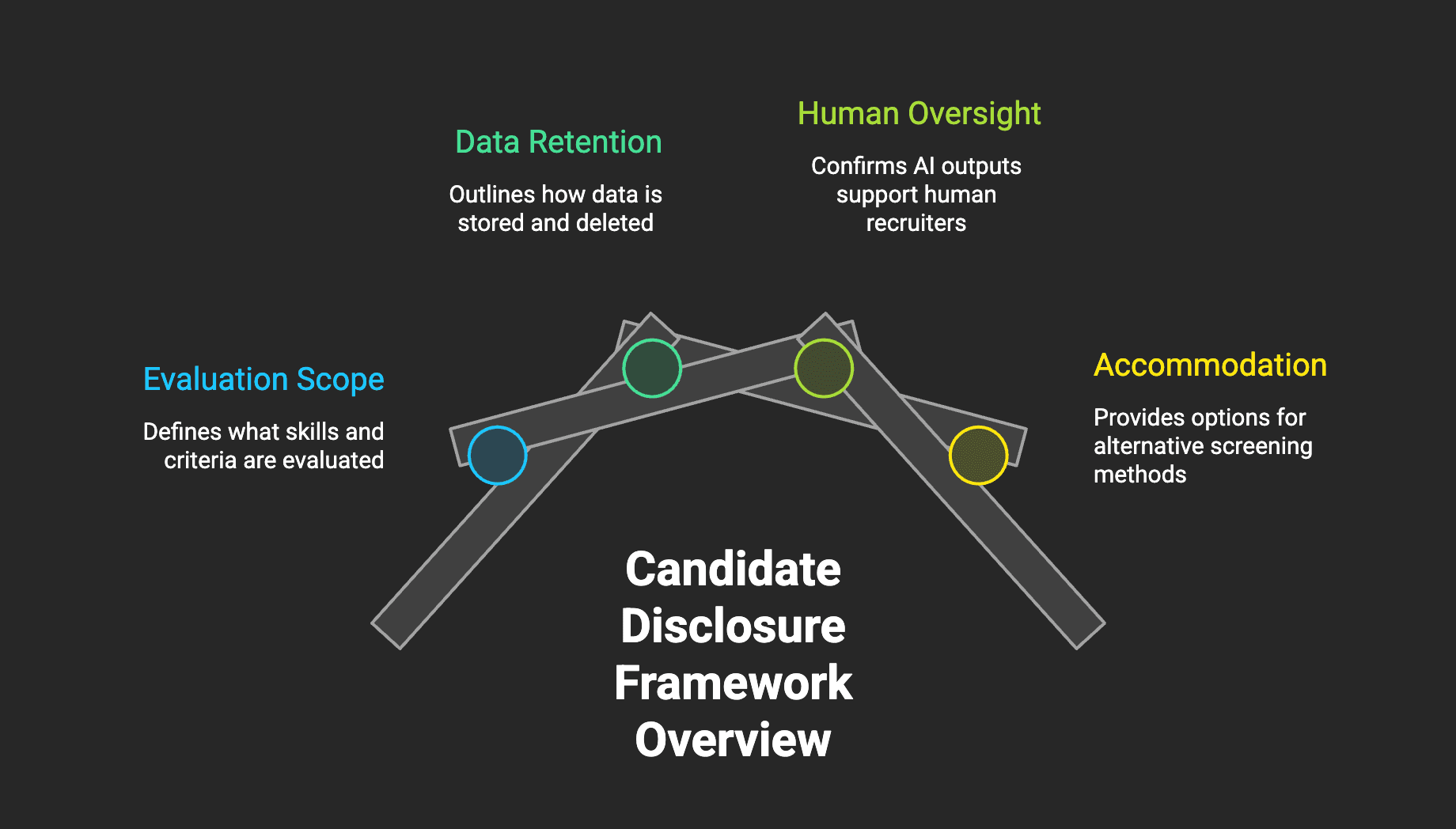
When operating in specific legal jurisdictions, platforms must comply with regional regulatory frameworks:
U.S. EEOC Guidance: Requires employers to provide reasonable accommodations under the ADA, ensuring algorithmic screens do not disadvantage candidates with disabilities.
NYC Local Law 144 (DCWP): Mandates independent annual bias audits for Automated Employment Decision Tools (AEDTs) and public disclosure of impact ratios alongside a 10-day prior notice to candidates.
Illinois Artificial Intelligence Video Interview Act: Requires advance notice, candidate consent prior to recording, strict limitations on video sharing, and mandatory deletion upon candidate request.
How Employers Should Measure Quality
Recruiters should evaluate an AI interview platform by looking beyond completion statistics to focus on response quality, fairness, and candidate experience:
Completion vs. Abandonment Rates: Track dropout rates specifically at the introductory step versus midway through the conversation to identify UX friction points.
Depth of Response Evidence: Measure whether follow-up prompts extract concrete, actionable work examples rather than superficial buzzwords.
Candidate Question Frequency: Monitor how often applicants use the interaction to ask questions about the company or role.
Candidate Satisfaction (CSAT): Collect quick, post-interview ratings assessing fairness, clarity, and ease of use.
Recruiter Override Rates: Track how often human talent teams agree with or adjust structured interview summaries generated by the AI platform.
When a Human Interviewer Is Still Better
AI interview systems excel at early-stage screening, skill verification, and high-volume preliminary assessments. However, automation should explicitly step aside in specific hiring contexts:
Executive and Senior Leadership Roles: High-stakes strategic positions require nuanced peer-to-peer discussion, vision alignment, and relationship-building.
Sensitive or High-Empathy Discussions: Conversations addressing non-standard employment gaps, compensation negotiations, or tailored accommodations require direct human care.
Final Evaluation Rounds: Late-stage interviews designed to assess mutual team chemistry and cultural contribution.
Complex Ethical Judgment Assessments: Roles requiring deep contextual judgment benefit from human-to-human scenario exploration.
Buyer Checklist: 8 Practical Platform Evaluation Questions
When assessing conversational AI interview vendors, ask these eight essential questions during product evaluations:
How does the system handle mid-sentence pauses or candidate interruptions during responses?
Does the platform generate contextual follow-up questions dynamically, or does it select from a rigid branching tree?
Can candidates ask unscripted questions about the role and receive accurate answers sourced directly from our knowledge base?
How are candidates informed about AI usage, data retention, and accommodation options prior to entering the session?
What specific evidence-based summaries does the platform generate for human recruiters, and how are candidate claims verified? (For example, platforms like JobTwine’s JayT compile indexed, evidence-backed transcripts linked directly to job-relevant scorecard rubrics).
Has the technology undergone an independent bias audit compliant with local requirements like NYC Local Law 144?
What is the process for candidates with speech, hearing, or visual impairments to request and immediately receive accommodations?
What methodology supports your candidate completion, drop-off, and satisfaction benchmarks?
Frequently Asked Questions
Why do static one-way video interviews have high drop-off rates?
Candidates often feel uncomfortable talking to an unfeeling countdown timer without feedback. The lack of dialogue, inability to clarify questions, and absence of human connection create a transactional experience that leads many qualified applicants to abandon the process.
Does an AI avatar analyze facial expressions or body language to judge candidates?
No. Reliable interview platforms focus exclusively on what candidates say—evaluating demonstrated skills, past work evidence, and problem-solving reasoning against job-related criteria rather than unproven facial or body language metrics.
How does a well-designed AI avatar handle candidate accommodations?
Accessible platforms offer upfront disclosure screens allowing candidates to request accommodations, toggle live text captioning, adjust audio playback speeds, or transfer seamlessly to a non-automated interview process without penalty.
Can candidates ask the AI interviewer questions about the job?
Yes. Modern interactive avatar systems leverage trained, role-specific knowledge bases to answer candidate questions regarding responsibilities, workplace model (remote/hybrid), benefits, and hiring timeline steps in real time.
Does using an AI avatar completely replace human recruiters?
No. An AI avatar serves as a preliminary conversational screening assistant. Its role is to replace static screening questionnaires and conduct structured, two-way initial chats. Final hiring decisions and deeper relational interviews remain strictly driven by human hiring teams.
What data laws govern AI video and avatar interviews?
AI interview software must align with regional privacy and employment legislation, such as the U.S. EEOC disability guidelines, the Illinois Artificial Intelligence Video Interview Act, NYC Local Law 144, and global regulations like the EU AI Act and GDPR. These laws enforce transparency, candidate consent, bias audits, data deletion rights, and access to reasonable accommodations.
Internal Quality & Data Methodology Standard All performance metrics cited across JobTwine documentation are verified against controlled cohort samples. Candidate completion rates (e.g., 94% platform completion versus standard 50–60% one-way video completion benchmarks) are measured from candidate session launch to final response submission across standardized enterprise screening workflows. Recruiter override metrics track the variance between automated scorecard recommendations and final hiring manager stage-advancement decisions. |